
What Background Checks Should You Run on a Home Care Nurse?


A minimum screening package for a home care nurse includes a criminal history search, a check of the National Sex Offender Public Website, a state abuse and neglect registry search, and license verification with the relevant state board. If you’re hiring through an agency that bills Medicare or Medicaid, it must also run OIG and SAM.gov exclusion checks, ideally rechecked monthly. If you’re hiring privately and pulling a report through a consumer reporting agency, the Fair Credit Reporting Act requires a standalone disclosure and signed authorization first.
TL;DR:
Conduct targeted criminal, abuse, and license checks in all states and jurisdictions the nurse has lived in, with rechecks every few months.
Require proof of federal exclusion searches and license verification documentation before hiring or finalizing any home care arrangement.
Understand that federal and state checks do not catch everything, so ongoing re screening and documentation are essential for safety.
Use online public registries and state licensing boards directly, and remain cautious of incomplete or restricted registry data.
Avoid disqualifying a candidate solely based on record reports unless strict criteria like abuse, fraud, or license revocation are clearly met.
Table of Contents
How Can Families Run a Background Check on a Home Nurse?
Hiring privately means you carry the legal weight an agency’s HR and compliance staff usually shoulder. That is manageable, but only if you follow the steps in order.
Collect identifying details first. Get the candidate’s full legal name, date of birth, current and prior addresses, and any state license numbers. Weak identifiers are the number one reason background checks return false negatives or miss records entirely.
Decide on scope. A national multi-jurisdiction criminal search through a consumer reporting agency casts a wide net, but a targeted county and state court search in every place the candidate has lived often catches more than a shallow “instant” national database search.
Follow FCRA procedure if you use a consumer reporting agency. You must give the candidate a standalone disclosure separate from the job application, get written authorization, and if the report leads you to pass on the candidate, follow the pre-adverse and adverse action steps the FTC outlines.
Run the free public checks yourself. The National Sex Offender Public Website, your state’s nursing board license lookup, and your county clerk’s court records portal cost nothing and take under an hour combined.
Some registries won’t cooperate with you no matter how thorough you are. State abuse and neglect registries are frequently restricted to licensed providers, not open to the public, which is one real reason families lean on agencies for anything beyond a straightforward private hire.
Pro Tip: Call the state nursing board directly instead of relying only on the online lookup. Disciplinary actions sometimes post to the website weeks after the board actually acted.
What Do Federal and State Screening Layers Actually Cover?
Agencies run a stack of checks, not one check, because no single database catches everything. Understanding the layers helps you evaluate whether an agency is doing this seriously or just checking a box.
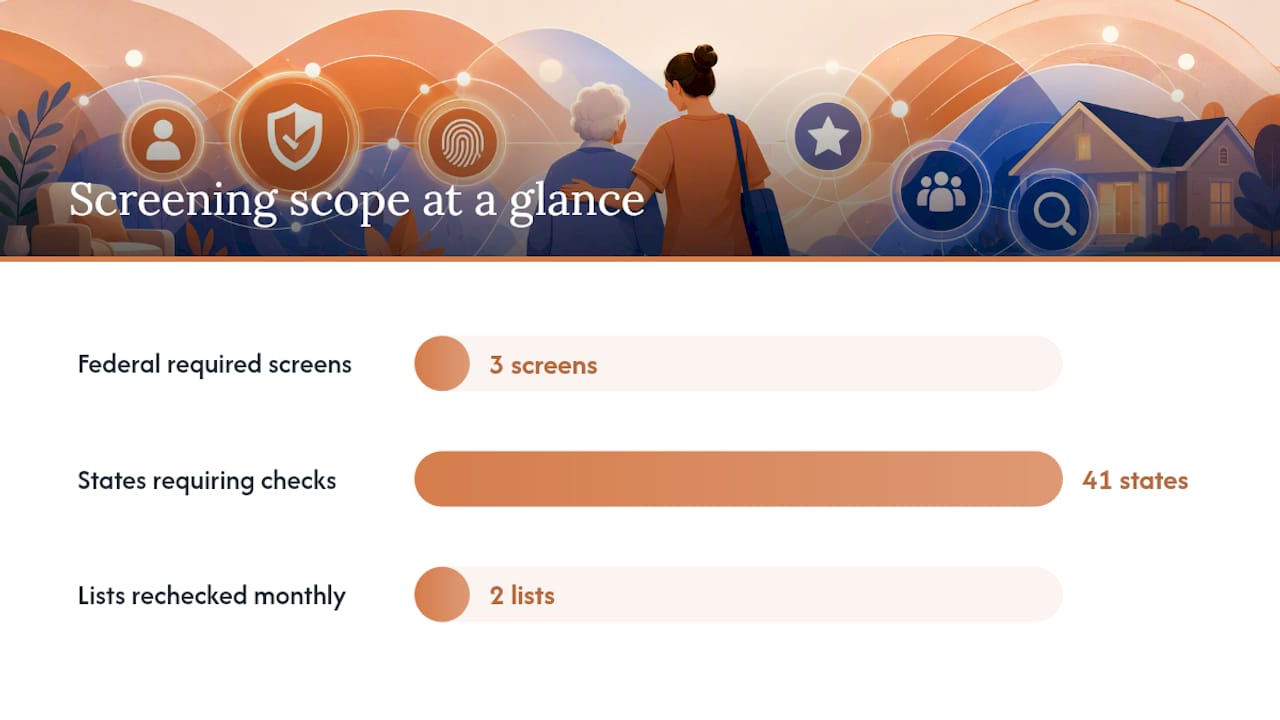
The federal floor consists of three screens every legitimate home health agency should run before a nurse ever enters a patient’s home:
OIG List of Excluded Individuals/Entities (LEIE), which flags anyone barred from federally funded health programs for fraud, patient abuse, or license revocation.
SAM.gov exclusions, a broader federal debarment list covering government contracting fraud and related offenses.
State Nurse Aide Registry, which confirms certification status and flags substantiated findings of abuse, neglect, or misappropriation of property.
On top of that federal floor sits a patchwork of state requirements. An OIG survey found that 41 states require home health agencies to run background checks, but they don’t agree on the details. Some states mandate FBI fingerprint checks through a centralized clearinghouse; others accept a name-based state search. Role-based verification adds another layer: RNs and LPNs need active board license checks, and serious cases should also run through the National Practitioner Data Bank, which tracks adverse actions against health care practitioners nationally.
Timing matters as much as scope. Agencies following best practice recheck OIG and SAM exclusions monthly, since both lists update on a rolling basis and a clean check from six months ago tells you nothing about today.
What Should You Ask a Home Care Agency Before Hiring?
An agency’s screening is only as good as its documentation. Ask to see it, not just hear about it.
Request these items before signing anything:
Proof of OIG and SAM.gov exclusion checks, including the date they were run.
License verification screenshots or printouts from the state board, not a verbal confirmation.
FBI fingerprint or live-scan receipts, if your state requires them.
The agency’s written rescreening policy and cadence.
Whether the agency bills Medicare or Medicaid, since that status legally obligates the federal exclusion screens.
A well-run agency answers these questions without hesitation and can produce documentation on request, because tracking the date, vendor receipt, and adjudication notes for every hire is standard practice for agencies that take compliance seriously. Vague answers, reluctance to share paperwork, or “we trust our nurses” as a substitute for a real answer are red flags worth walking away from.
Pro Tip: Ask specifically how the agency handles a nurse who moves from another state. A clean record in one state doesn’t automatically transfer, since screening requirements reset when nurses cross state lines.
Agencies also typically carry liability insurance and documented hiring procedures that protect you legally in ways a private hire simply can’t match.
Which Records Actually Disqualify a Candidate?
Not every record on a background check should end a candidacy, and federal law backs that up. Substantiated abuse or neglect registry findings, OIG or SAM exclusions, violent felony convictions, and license revocations are near-universal disqualifiers, though exact rules vary by state.
The Equal Employment Opportunity Commission’s Title VII guidance requires an individualized assessment rather than a blanket policy: consider how directly the offense relates to caregiving duties and how much time has passed. Rejecting every candidate with any criminal history, regardless of relevance, can create unlawful disparate impact.
Verify the original court or registry record rather than relying on a report summary alone.
Give the candidate a chance to provide context before making a final decision.
Document the reasoning behind any adverse decision, since that paper trail is what protects you if the choice is ever challenged.
Consult an attorney or your agency’s compliance staff for anything ambiguous.
How Often Should Nurses Be Rescreened?
A clean background check on day one doesn’t guarantee anything six months later. Continuous monitoring closes that gap, and it’s worth writing into any care agreement you sign.
The strongest setups combine a few tools: FBI Rap Back, available in states that support it, which pings the agency automatically if a caregiver is arrested anywhere in the country; monthly vendor checks against OIG and SAM exclusion lists; and a full periodic rescreen, typically annual, covering criminal and registry databases again. Agencies that run continuous monitoring catch post-hire arrests or new exclusions before they turn into a safety incident, rather than months later during a routine renewal.
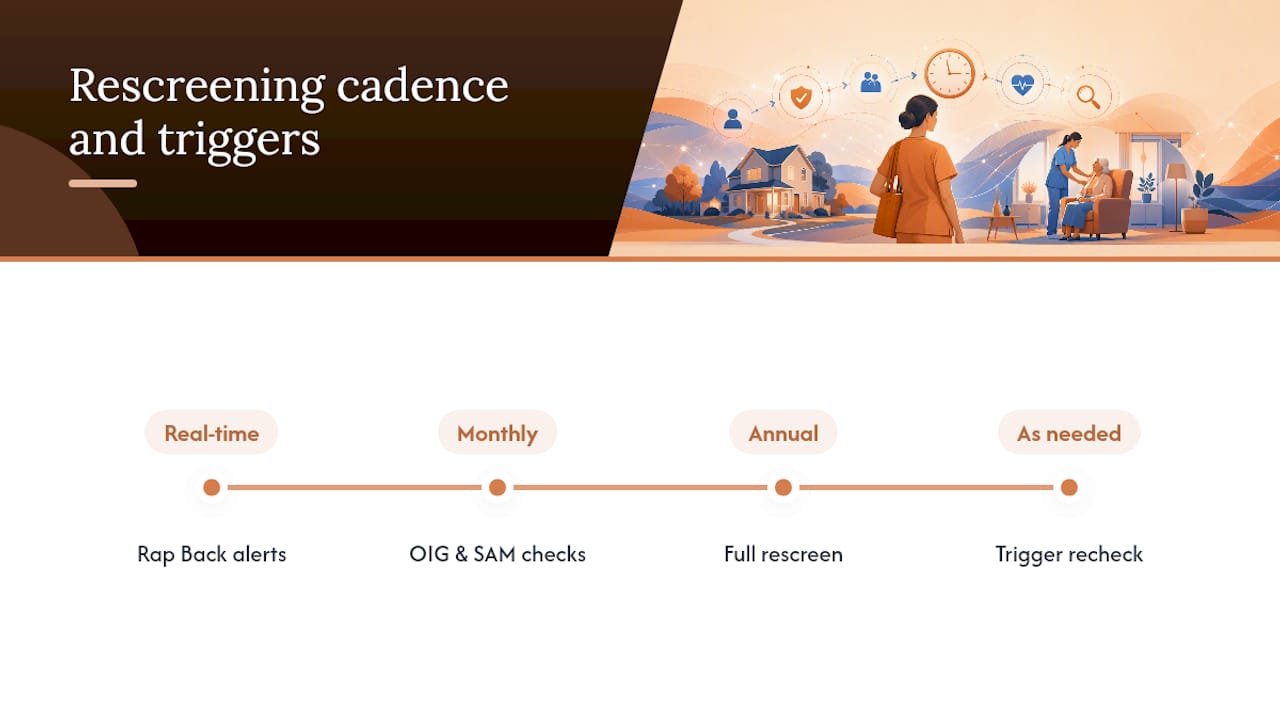
Any role change, incident report, or return from extended leave should trigger an immediate recheck rather than waiting for the next scheduled cycle.
Pro Tip: Put the rescreening cadence in writing in your care agreement, and ask for proof on request rather than a promise. “We rescreen annually” means little without a document showing the last date it happened.
Checklist: Your First 60 Days
Move fast on the basics, then layer in verification over the following weeks.
Days 1 to 7: Collect the candidate’s full legal name, date of birth, and license numbers. Run the free NSOPW check and a state license lookup. If using a consumer reporting agency, get signed authorization before ordering the report.
Days 7 to 60: Verify county court records in every state the candidate has lived. Request the agency’s documentation of federal and state checks. Put a rescreening cadence in writing before finalizing the hire and starting home nursing care.
What Opulent Private Care Does Differently on Screening
Background checks tell you what a nurse hasn’t done wrong. They don’t tell you whether a nurse is the right fit for your child’s trach care, feeding schedule, or seizure protocol. Opulent Private Care’s “3 Thumbs Up Rule” adds that second layer, requiring sign off from the family, the nurse, and Opulent before care ever starts, on top of the standard screening stack.
Opulent also publishes its shift fill rates and nurse retention numbers, because continuity is itself a safety measure. A rotating cast of caregivers means more handoffs and more room for error in high-acuity cases involving ventilators or G-tubes. Role-specific vetting for those conditions goes beyond a standard background check.
— Opulent
Verify Your Nurse Match With Opulent Private Care
Opulent Private Care is the alternative to piecing together background checks on your own for Georgia families managing tracheostomy, ventilator, feeding tube, or neurological care at home. Every nurse clears the federal and state screening stack described above before ever meeting your family, and you can request documentation of those checks directly rather than taking anyone’s word for it.
Opulent also handles the Medicaid GAPP paperwork that trips up many families hiring privately, and matches nurses based on clinical needs and family fit rather than simply filling a shift. If your child needs a nurse who has already cleared federal exclusion checks, state license verification, and a clinical competency review for high-acuity care, start a nurse match request with Opulent Private Care and ask directly for proof of screening before your first visit.
Where to Verify Records Yourself
Check candidates directly against the OIG List of Excluded Individuals/Entities, SAM.gov, and the NSOPW registry. For FCRA rules on consumer reports, see the FTC’s plain-language guidance, and for practical reference and county-record tips, consult the Family Caregiver Alliance.
This article is general information, not a substitute for advice from a qualified lawyer. Consult a qualified legal professional about your own circumstances before acting on anything here.
Sources
Recommended
Comments