
HIPAA with Home Care: What Georgia Parents Need to Know

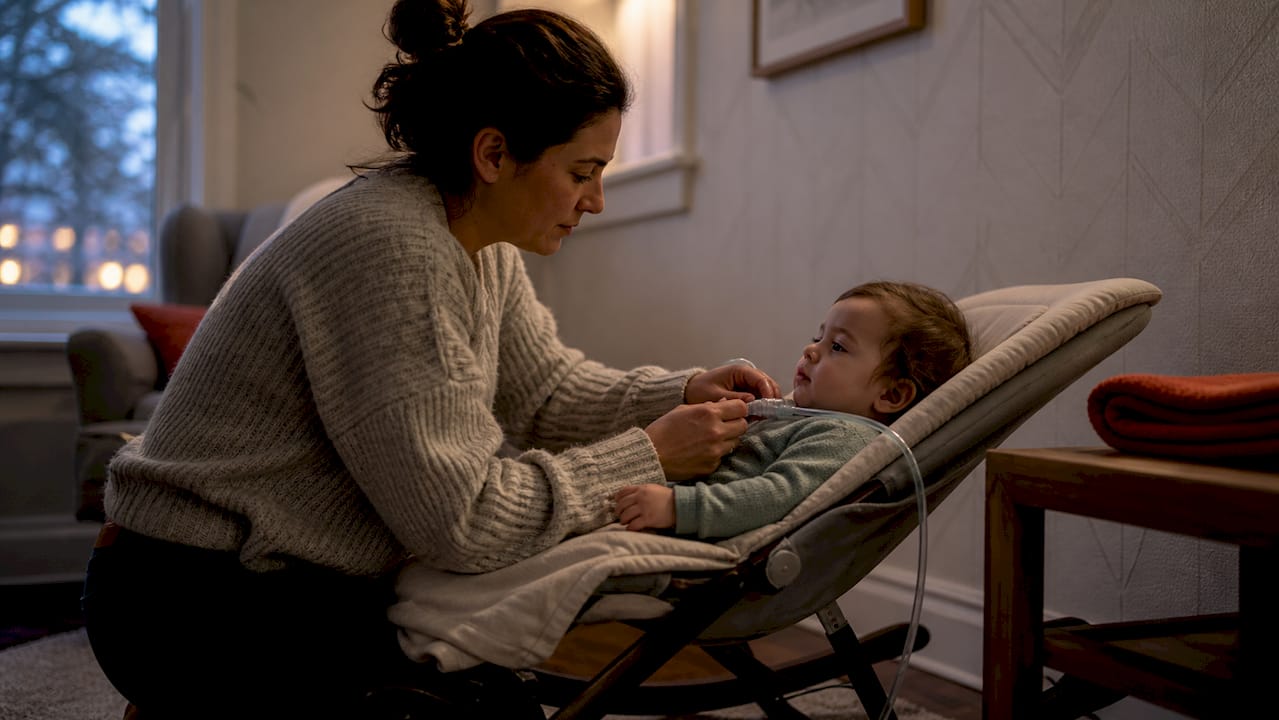
As a parent or legal guardian of a medically fragile child receiving in-home pediatric nursing in Georgia, you are generally your child’s personal representative under HIPAA. That means you can access your child’s protected health information (PHI), request corrections, and authorize who else receives it. Three narrow exceptions exist, and Georgia state law adds a layer worth knowing, but the default answer is yes: you have the right.
The most common exceptions at a glance:
A minor consented to care under Georgia law without requiring parental consent (certain mental health or reproductive health services)
A court order directs care decisions or restricts parental access
You previously agreed to a confidential relationship between your child and a specific provider
Pro Tip: Before your child’s first shift, ask the agency for the name of their HIPAA privacy officer and a blank records-request form. Getting these two items on day one prevents delays later.
Two authoritative sources anchor everything in this article: the U.S. Department of Health & Human Services (HHS) / Office for Civil Rights (OCR), which enforces HIPAA nationally, and Georgia’s Department of Behavioral Health and Developmental Disabilities (DBHDD), which governs state-specific confidentiality rules for behavioral health records.
Key takeaways
As a parent in Georgia, you are generally your child’s personal representative under HIPAA, which means you can access, share, and authorize disclosures of your child’s PHI unless a narrow legal exception applies.
Point | Details |
Parental access is the default | You are generally your child’s personal representative and can access all PHI unless a specific exception applies. |
Three exceptions exist | Independent minor consent, court-directed care, and agreed confidentiality are the only HIPAA bases for restricting parental access. |
Georgia adds a layer | DBHDD rules affect behavioral health records; always ask whether Georgia-specific confidentiality applies to any service your child receives. |
Document everything | Send records requests in writing, keep receipts, and retain copies of all signed authorizations. |
Opulentprivatecare | Offers a named HIPAA contact, continuity-focused staffing, and Medicaid/GAPP paperwork help from day one of intake. |
Table of Contents
What does being a ‘personal representative’ mean for you under HIPAA?
How to request records, set authorizations, and handle timelines
What to do when an agency refuses access or raises privacy concerns
Questions to ask a home-care agency about privacy before you hire
How Opulentprivatecare approaches PHI and privacy in pediatric home nursing
What does being a ‘personal representative’ mean for you under HIPAA?
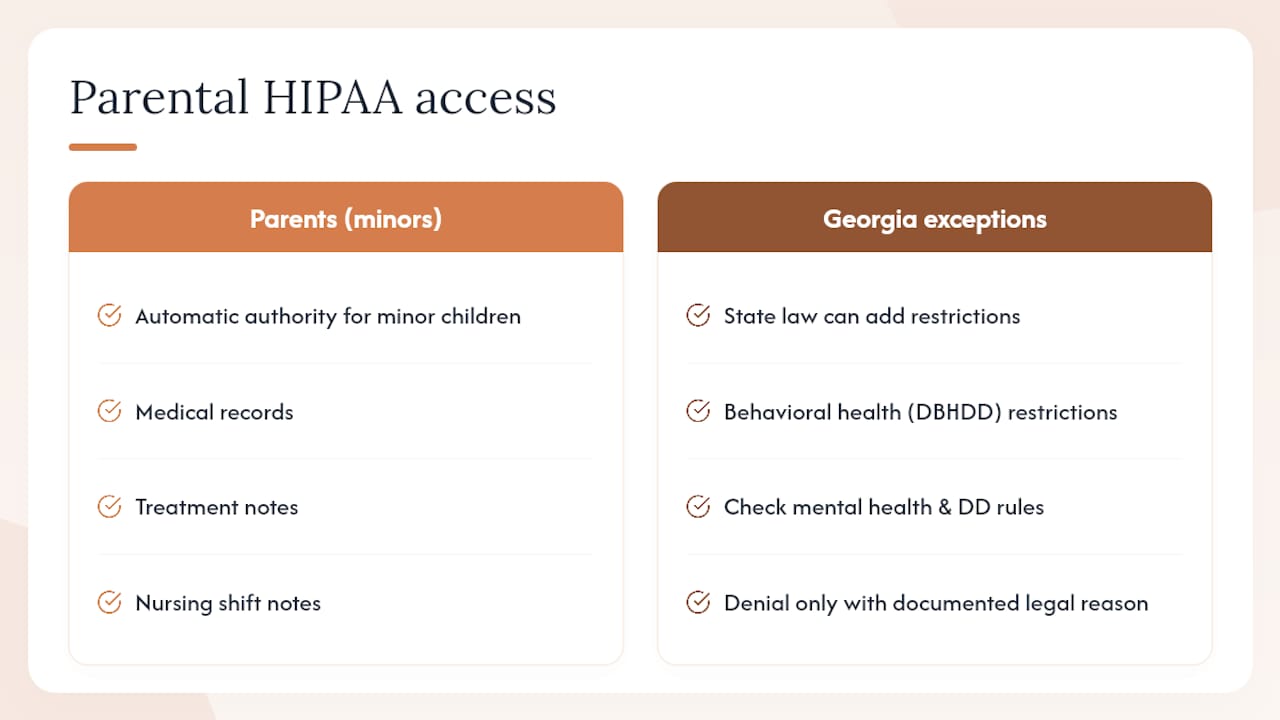
Under the HIPAA Privacy Rule, a personal representative is someone who has the legal authority to make health care decisions for another person. For most parents of minor children, that authority is automatic. OCR has confirmed that covered entities should configure their systems to allow parental access and cannot impose extra requirements, like demanding the child’s own signature, when no exception applies.
What that access actually covers is broad: medical records, treatment notes, nursing shift documentation, billing statements, and electronic portal access. If your child’s home-care agency uses an EHR or patient portal, you should have login credentials or a designated access path. Denying that access without a documented legal reason can be a HIPAA violation.
HIPAA is a federal floor, not a ceiling. Georgia law can add restrictions, particularly for behavioral health records governed by DBHDD policy. If your child receives any mental health or developmental disability services alongside skilled nursing, check whether Georgia’s confidentiality rules affect which records you can access and when.
Example: A parent whose child uses a ventilator at home requests nursing shift notes through the agency’s portal. Because she is the legal guardian and no exception applies, the agency must provide access. If the portal is not configured for parental access, OCR guidance says that is a system problem the agency must fix, not a reason to deny the request.
How does PHI actually flow in a home-care setting?
HIPAA permits sharing PHI for treatment, payment, and health-care operations without a separate authorization. In a home-care context, that covers a lot of ground. Care coordination guidance from NCBI notes that HIPAA is designed to facilitate, not obstruct, communication among people involved in a patient’s care. Providers who over-restrict sharing often do so out of excessive caution, not legal obligation.
Typical information recipients in pediatric home care:
Parents and legal guardians (primary recipients)
Other family caregivers you have named or who are present during care
School nurses or therapists involved in the child’s treatment plan
Medicaid/GAPP billing staff and case managers
The agency’s clinical director when a clinical event occurs
The “minimum necessary” standard applies to disclosures outside treatment. A billing department needs diagnosis codes and service dates, not full nursing notes. A school nurse coordinating seizure protocols needs the relevant clinical summary, not the child’s entire record.
Three quick scenarios:
Ventilator alarm event: The night nurse documents the event, notifies the parent immediately, and reports to the agency clinical director. All three disclosures are permitted under treatment and operations.
Medicaid billing: The agency submits claims to GAPP with diagnosis and service data. No separate authorization is needed because payment is a permitted purpose.
Telehealth check-in: A physician reviews nursing notes via a secure platform. The platform must have a Business Associate Agreement (BAA) with the agency. If it does not, that is a compliance gap worth flagging.
How to request records, set authorizations, and handle timelines
Start with these steps:
Contact the agency’s privacy officer or intake coordinator and ask for their records-request form and HIPAA authorization template.
Provide a government-issued ID confirming your identity as parent or legal guardian.
Specify the records you want (date range, record type) in writing.
Keep a copy of every request with the date and delivery method.
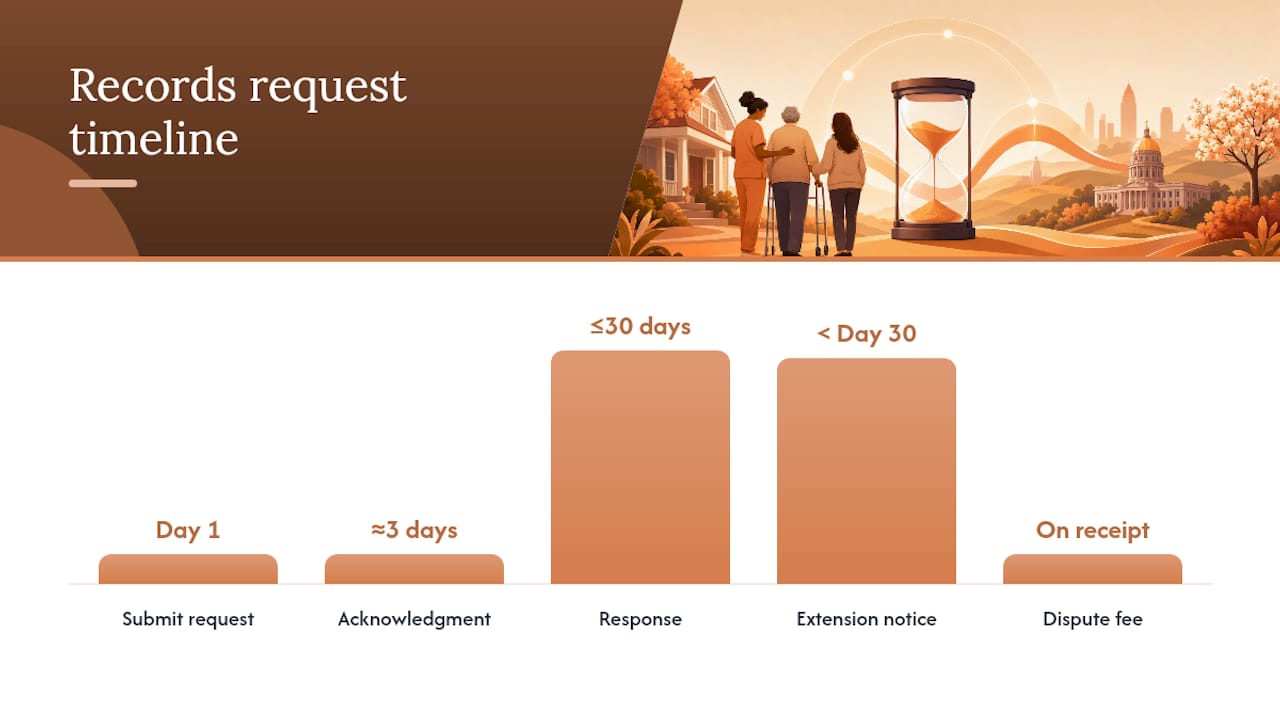
Under HIPAA, covered entities generally have 30 days to respond to a records request, with one possible 30-day extension if they notify you in writing. Fees for copies must be reasonable, typically limited to labor and supply costs for paper copies or a flat fee for electronic records.
Step | Action | Typical Timeframe |
Submit request | Written request to privacy officer | Day 1 |
Acknowledgment | Agency confirms receipt | Within a few business days |
Response | Records provided or denial issued | Within 30 days |
Extension notice | Agency notifies you if more time needed | Before Day 30 |
Dispute fee | Submit written objection to agency | Upon receipt of invoice |
Sample language you can use:
If the 30-day window passes with no response, send a follow-up in writing and note the original request date. That paper trail matters if you later need to escalate.
What to do when an agency refuses access or raises privacy concerns
Ask for the refusal in writing, including the specific legal basis cited.
Pull your signed intake agreements and any authorizations you provided. Georgia case law confirms that documented authorizations and patient agreements carry significant weight in privacy disputes.
Escalate to the agency’s named HIPAA privacy officer. If Opulentprivatecare is your provider, use the internal escalation contact provided at intake.
If internal escalation fails, file a complaint with HHS OCR at hhs.gov/ocr. OCR accepts complaints within 180 days of the alleged violation.
What to bring to an OCR complaint:
Copies of all written requests and any responses
Dates and methods of delivery (email receipts, certified mail confirmations)
The agency’s written refusal or documentation of non-response
Pro Tip: Send every records request via email or certified mail so you have a time-stamped delivery receipt. A verbal request that gets “lost” is much harder to escalate than a documented one.
Questions to ask a home-care agency about privacy before you hire
Who is your designated HIPAA privacy officer, and how do I reach them?
How do nurses document care during home visits, and what platform do you use?
Do you have Business Associate Agreements with all third-party vendors (telehealth, billing, EHR)?
How do you handle mobile devices used by nurses in the home?
What HIPAA training do nurses receive, and how often is it updated?
Can I see a sample authorization form and revocation form before signing anything?
How do you handle records requests, and what is your typical response time?
What is your process if I want to limit who receives my child’s information?
How do you manage PHI when a nurse is replaced or a shift changes?
Do you have a written privacy policy I can review?
Expect specific, confident answers. A named privacy officer, documented training schedules, and willingness to share sample forms are all good signs. Vague answers like “we follow all HIPAA rules” without specifics warrant follow-up.
How Opulentprivatecare approaches PHI and privacy in pediatric home nursing
Opulentprivatecare builds privacy practices into its care model from the start. The 3 Thumbs Up Rule requires sign-off from the family, the nurse, and Opulentprivatecare before care begins. That three-way agreement means everyone’s expectations, including how information is shared and with whom, are aligned before the first shift.
Concrete practices parents can expect:
A named HIPAA contact available from intake onward
Signed BAAs with applicable third-party vendors
Secure mobile documentation protocols for nurses in the field
Staff HIPAA training as part of onboarding and ongoing compliance
Assistance with Medicaid/GAPP paperwork, including authorization forms and billing disclosures
Continuity-focused staffing with published nurse-retention metrics, so fewer handoffs mean fewer PHI exposure points
Opulentprivatecare publishes shift-fill rates and nurse-retention data because families deserve to know how reliable their care team actually is. Fewer rotating nurses means fewer people handling your child’s records.
Pro Tip: At intake, include a completed HIPAA authorization listing every person authorized to receive your child’s PHI: the other parent, a grandparent who provides backup care, the school nurse. Updating this list proactively prevents delays when you need information shared quickly.
A note from Opulent on privacy and partnership
Families of medically fragile children carry enough. Worrying about whether your nursing agency respects your authority over your child’s information should not be one more burden. At Opulentprivatecare, we treat your role as your child’s legal guardian as the foundation of every care relationship, not a box to check on an intake form. We publish our retention numbers, name our privacy contacts, and build our intake process around your right to know, authorize, and limit. If you have questions about how we handle your child’s PHI or want to review our privacy documentation before signing anything, reach out directly. That conversation is always available.
Opulentprivatecare supports HIPAA-aware intake from day one
Families navigating Medicaid, GAPP paperwork, and in-home nursing for a medically fragile child need a partner who handles the administrative complexity without cutting corners on privacy. Opulentprivatecare provides exactly that: named HIPAA contacts, nurse matching based on clinical and family fit, and hands-on GAPP program assistance so authorizations and billing disclosures are handled correctly from the start.
The 3 Thumbs Up Rule means your family approves the nurse before care begins, and our continuity model means the same nurse stays with your child, reducing the number of people who ever touch your child’s records. Privacy documentation is available on request at any point in the intake process. Ready to get started? Contact Opulentprivatecare to begin the intake process and request your privacy documentation today.
Useful sources for Georgia parents
This article provides general information about HIPAA and privacy rights, not legal advice. Confirm current rules with HHS OCR, a Georgia-licensed attorney, or a qualified health care compliance professional for your specific situation.
Recommended
Comments