
Pediatric Home Health Nursing Resume: Examples and Templates


A hire-ready pediatric home health nursing resume leads with your active RN license, top pediatric credentials, and at least one quantified outcome — front and center, before the recruiter scrolls. Here is the core checklist to confirm before you send anything:
Must-have resume checklist:
Active state RN license with license number and expiration date
PALS (Pediatric Advanced Life Support) and BLS certifications with expiration dates
CPN (Certified Pediatric Nurse) if held, or CPNP-PC for nurse practitioners
Top 5 pediatric clinical skills (tracheostomy care, ventilator management, enteral feeding, seizure management, medication administration)
Named EMR/EHR systems (Epic, Cerner, Axxess, MatrixCare, WellSky)
Caseload numbers (e.g., “managed 10 pediatric patients per week”)
OASIS assessment experience with a completion metric if possible
Family/caregiver teaching documented with a measurable outcome
One quantified result (readmission reduction, OASIS completion rate, or training outcome)
Copy-paste professional summary lines (adapt to your level):
Entry-level: “Compassionate BSN-prepared RN with PALS certification and pediatric clinical rotation experience in tracheostomy and feeding-tube care. Committed to family-centered, continuity-focused home health nursing for medically fragile children.”
Mid-career: “Pediatric home health RN with 4 years managing independent caseloads of 8–12 medically complex children per week. Experienced in OASIS documentation, Axxess EMR, tracheostomy and ventilator care, and caregiver education with measurable family competency outcomes.”
Experienced: “Seasoned pediatric home health RN with 12 years in high-acuity private duty nursing, including tracheostomy, ventilator, and G-tube management for medically fragile children. Reduced hospital readmission rates by 28% through individualized care plans; completed 95% of OASIS assessments within 48 hours of admission.”
ATS quick note: Place your RN license number and primary certifications (PALS, CPN, BLS) in both the header and a dedicated “Licenses & Certifications” section. ATS systems parse headers inconsistently, so the dedicated section is your safety net.
Table of Contents
What does a pediatric home health nursing resume look like at each career stage?
How do you use a copy-paste template for pediatric home health nursing?
How do you write a professional summary for pediatric home health nursing?
How do you showcase pediatric home health experience with strong bullets?
What skills and certifications should you list on a pediatric home health nursing resume?
Which resume format works best for pediatric home health nursing applications?
How should you list education, licensure, and continuing education?
What do pediatric home health agencies actually look for on your resume?
What are the most common resume mistakes for pediatric home health nurses?
What Opulentprivatecare looks for when matching nurses to families
What does a pediatric home health nursing resume look like at each career stage?
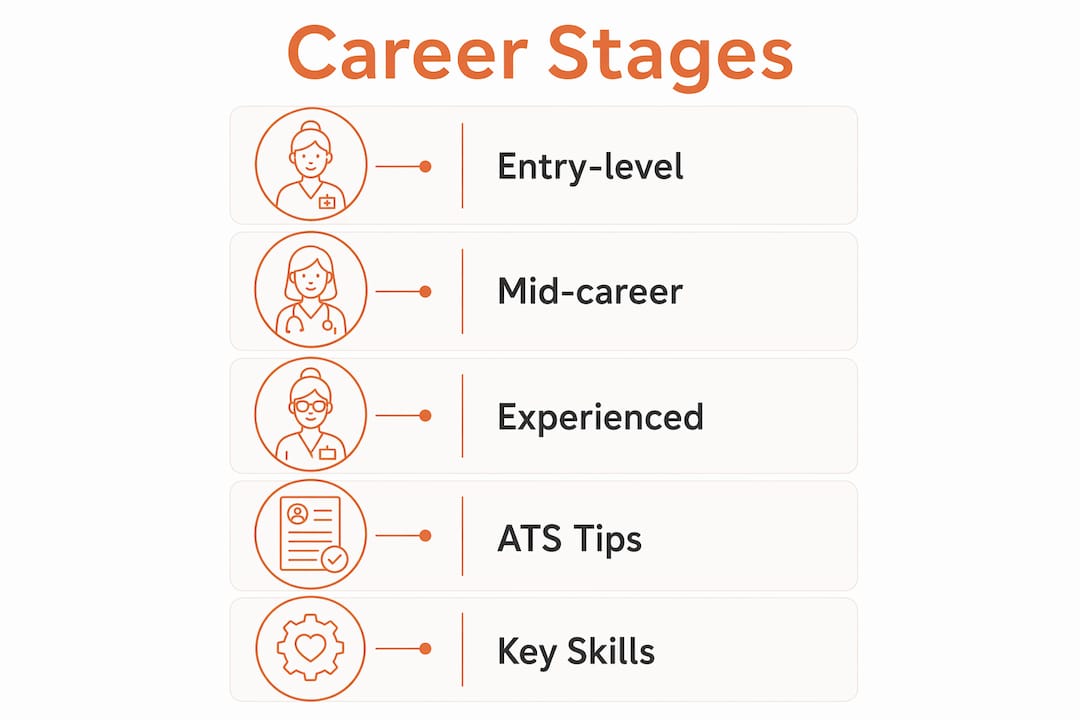
Three annotated samples follow — entry, mid-career, and experienced. Each shows structure, phrasing, and the measurable bullets that move resumes past automated screening.
Entry-level sample
MAYA CHEN, BSN, RN Atlanta, GA | (404) 555-0192 | maya.chen@email.com | RN License #GA-123456 (exp. 06/2027) | PALS | BLS
Professional Summary Compassionate new graduate RN with pediatric clinical rotation experience in tracheostomy care and enteral feeding. PALS-certified and eager to deliver family-centered, continuity-focused home health nursing for medically fragile children in Georgia.
Core Competencies Tracheostomy care · Enteral feeding · Seizure precautions · Medication administration · Family caregiver education · Epic EMR · OASIS orientation · BLS/PALS
Clinical ExperiencePediatric Clinical Rotation — Children’s Healthcare of Atlanta, Atlanta, GA (Jan 2025–May 2025)
Assisted with tracheostomy suctioning and tube care for 4 pediatric patients under RN supervision
Educated 6 family caregivers on enteral feeding procedures; all demonstrated return competency before discharge
Documented patient assessments in Epic EMR with zero charting errors across 200+ clinical hours
Education Bachelor of Science in Nursing (BSN) — Georgia State University, May 2025
Certifications
PALS Provider — American Heart Association (exp. 06/2027)
BLS Provider — American Heart Association (exp. 06/2027)
Callout: The license number appears in the header AND a dedicated section. The caregiver education bullet quantifies the outcome (“all demonstrated return competency”), not just the task.
Mid-career sample
JAMES OKAFOR, BSN, RN, CPN Savannah, GA | (912) 555-0347 | james.okafor@email.com | RN License #GA-456789 (exp. 09/2026) | PALS | CPN | BLS

Professional Summary Pediatric home health RN with 5 years managing independent caseloads of 8–12 medically complex children per week. Skilled in OASIS documentation, Axxess and MatrixCare EMR, tracheostomy and ventilator care, and caregiver education with documented family competency outcomes.
Core Competencies Tracheostomy & ventilator management · Enteral/G-tube care · Seizure management · OASIS documentation · Axxess · MatrixCare · Caregiver training · Medication reconciliation · Independent caseload management
Professional ExperiencePediatric Home Health RN — Sunrise Home Health, Savannah, GA (June 2020–Present)
Managed an independent caseload of 10 medically fragile pediatric patients per week across a 3-county territory
Trained 15 family caregivers in tracheostomy emergency response; zero unplanned ER visits among trained families in 12 months
Completed 93% of OASIS assessments within 48 hours of admission, exceeding agency benchmark of 85%
Documented all visits in Axxess EMR; maintained 100% chart completion rate for 18 consecutive months
Pediatric Staff RN — Memorial Health University Medical Center, Savannah, GA (Aug 2018–May 2020)
Provided bedside care for pediatric patients with complex respiratory and neurological conditions
Participated in discharge planning and caregiver education for home transition
Education BSN — Armstrong State University, 2018
Certifications
CPN — Pediatric Nursing Certification Board (exp. 03/2027)
PALS Provider — AHA (exp. 11/2026)
BLS Provider — AHA (exp. 11/2026)
Continuing Education
Tracheostomy & Ventilator Competency Training — Georgia Home Health Association, 2024
Pediatric Seizure Management CEU — PNCB, 2023
Callout: PAR bullets dominate. “Trained 15 family caregivers… zero unplanned ER visits” is a Problem-Action-Result structure that connects action to outcome. The OASIS completion rate beats the agency benchmark — that contrast is what gets attention.
Experienced sample
PATRICIA WELLS, MSN, RN, CPN Marietta, GA | (770) 555-0581 | p.wells@email.com | RN License #GA-789012 (exp. 01/2028) | PALS | CPN | BLS
Professional Summary Seasoned pediatric home health RN with 12 years in high-acuity private duty nursing. Specializes in tracheostomy, ventilator, and G-tube management for medically fragile children. Reduced hospital readmission rates by 28% through individualized care plans; completed 95% of OASIS assessments within 48 hours of admission.
Core Competencies High-acuity pediatric home care · Tracheostomy & ventilator management · G-tube/enteral feeding · Seizure & cardiac monitoring · OASIS documentation · Epic · Axxess · WellSky · Caregiver training & mentorship · Quality metrics reporting
Professional ExperienceLead Pediatric Home Health RN — Georgia Pediatric Home Care, Marietta, GA (2016–Present)
Managed a caseload of 12 high-acuity pediatric patients per week, including 6 ventilator-dependent children
Reduced hospital readmission rates by 28% through individualized care plans and proactive family communication
Completed 95% of OASIS assessments within 48 hours of admission, consistently above agency threshold
Mentored 4 new pediatric home health nurses; all passed 90-day competency evaluations on first attempt
Trained 20+ family caregivers in tracheostomy suctioning, emergency response, and feeding-tube troubleshooting
Pediatric Home Health RN — Northside Home Health, Atlanta, GA (2013–2016)
Delivered skilled nursing care to 8–10 pediatric patients weekly across neurological, respiratory, and cardiac diagnoses
Documented all visits in WellSky; zero documentation deficiencies across 3-year tenure
Education MSN — Kennesaw State University, 2015 | BSN — University of Georgia, 2012
Certifications
CPN — Pediatric Nursing Certification Board (exp. 07/2027)
PALS Provider — AHA (exp. 05/2027)
BLS Provider — AHA (exp. 05/2027)
Continuing Education
Advanced Ventilator Management for Home Health — AAHC, 2025
Pediatric Palliative Care Essentials — NHPCO, 2024
Callout: The summary leads with the single strongest outcome metric. The mentorship bullet signals leadership without requiring a management title.
Bullet bank: 15 ready-to-adapt bullets by acuity level
Basic acuity:
Administered oral and IV medications to 6 pediatric patients per shift; zero medication errors over 12 months
Documented all patient assessments in Epic EMR; maintained 100% chart completion rate
Educated 10 family caregivers on home medication schedules; all demonstrated return competency
Moderate acuity:
Managed enteral feeding via G-tube for 4 pediatric patients; identified and resolved 3 tube-displacement incidents without ER transfer
Conducted OASIS assessments within 48 hours of admission for 90% of assigned patients
Trained 8 family members in seizure recognition and first-response protocols; zero missed emergency calls
High acuity:
Provided tracheostomy care and suctioning for 6 ventilator-dependent pediatric patients per week
Managed ventilator settings and alarm response for children with chronic respiratory failure; zero unplanned ventilator-related hospitalizations in 18 months
Coordinated with pulmonology and neurology teams to adjust home care plans for 3 medically complex children
Reduced unplanned ER visits by implementing proactive family communication protocols across a 10-patient caseload
Trained 5 family caregivers in emergency tracheostomy tube replacement; all achieved competency within 2 training sessions
How do you use a copy-paste template for pediatric home health nursing?
This one-page template is ATS-ready. Fill in the bracketed fields, keep the section order, and export as a PDF unless the employer requests DOCX.
[FULL NAME], [CREDENTIALS] [City, State] | [Phone] | [Email] | RN License #[State-XXXXXX] (exp. [MM/YYYY]) | [PALS] | [CPN] | [BLS]
Professional Summary [2–3 sentences: experience level + pediatric specialty + one quantified outcome + family-centered care philosophy]
Core Competencies [List 10–14 ATS keywords: clinical skills, EMR names, certifications, documentation skills]
Professional Experience[Job Title] — [Employer], [City, State] ([Start Date]–[End Date])
[PAR bullet: action verb + pediatric task + measurable result]
[PAR bullet: caregiver education + outcome]
[PAR bullet: OASIS or documentation metric]
[PAR bullet: caseload size or territory]
Education [Degree] — [Institution], [Year]
Licenses & Certifications
[Certification name] — [Issuing body] (exp. [MM/YYYY])
[State RN License] — [State Board of Nursing], License #[XXXXXX] (exp. [MM/YYYY])
Continuing Education
[Course name] — [Provider], [Year]
Technical Proficiencies [Epic] | [Cerner] | [Axxess] | [MatrixCare] | [WellSky] | [OASIS-E]
Formatting guidelines for ATS compatibility:
Use a clean, single-column layout with no tables, text boxes, or images inside the resume body.
Choose an ATS-safe font: Lato, Rubik, or Raleway at 10–12pt for body text, 14–16pt for your name.
Set margins to 0.75–1 inch on all sides; use 1.0–1.15 line spacing.
Save as PDF for most submissions; switch to DOCX only when the job posting explicitly requests it.
Name your file: LastName_FirstName_PediatricHomeHealthRN_Resume.pdf — never “Resume_Final_v3.pdf.”
Run a keyword comparison: paste the job description into a plain text document, highlight every clinical skill and EMR name, then confirm each appears in your resume.
Pro Tip: Use find-and-replace to tailor your resume to each job posting in under 10 minutes. Swap the EMR name in your Core Competencies section, adjust the acuity language in your summary, and update the top bullet to match the employer’s stated priority.
How do you write a professional summary for pediatric home health nursing?
The professional summary is the first thing a recruiter reads and the last thing most nurses write well. Keep it to 2–3 sentences. Every sentence must earn its place.
The framework: Experience level + pediatric specialty + one quantified proof point + family-centered care signal.
That structure gives recruiters and ATS scanners exactly what they need: clinical fit, acuity match, and a reason to call you.
When to use a summary vs. an objective: Use a summary if you have any relevant experience, including clinical rotations. Reserve an objective statement for career changers with no nursing experience at all — and even then, reframe it as a goal tied to a transferable skill.
Three micro-examples:
Entry-level: “PALS-certified BSN-prepared RN with pediatric clinical rotation experience in tracheostomy and enteral feeding care. Passionate about family-centered home health nursing for medically fragile children; committed to continuity and caregiver empowerment.”
Mid-career: “Pediatric home health RN with 5 years managing independent caseloads of 8–12 medically complex children per week. Proficient in OASIS documentation, Axxess EMR, and high-acuity tracheostomy and ventilator care; recognized for caregiver education outcomes and reliable shift attendance.”
Experienced: “Seasoned pediatric home health RN with 12 years in high-acuity private duty nursing including tracheostomy, ventilator, and G-tube management. Reduced hospital readmission rates by 28% through individualized care plans and proactive family communication; PALS- and CPN-certified.”
Keyword placement: Work PALS, CPN, OASIS, and at least one EMR name (Axxess, Epic, or WellSky) into the summary itself, not just the Core Competencies section. ATS systems weight keywords higher when they appear in multiple sections. Condition-specific terms like “tracheostomy,” “ventilator,” and “enteral feeding” belong here too, especially when applying to agencies that serve medically fragile children.
Tone: Compassion and clinical competence belong together in this summary. A line like “committed to continuity and family-centered care” signals the soft-skill dimension that pediatric home health agencies screen for just as hard as certifications.
How do you showcase pediatric home health experience with strong bullets?
Listing tasks is the single most common resume mistake in nursing. “Provided tracheostomy care” tells a recruiter nothing they couldn’t assume. What they want to know is: how many patients, how often, and what happened because of your care.
The PAR framework (Problem-Action-Result) fixes this in one sentence. Here is how it maps to common pediatric home health scenarios:
PAR bullet templates by scenario:
Tracheostomy/ventilator care:
Managed tracheostomy suctioning and tube care for 6 ventilator-dependent pediatric patients per week; zero unplanned respiratory hospitalizations over 18 months
Responded to ventilator alarms and adjusted settings per physician protocol for 4 children with chronic respiratory failure; maintained 100% incident documentation in WellSky
Feeding tube/enteral nutrition:
Administered enteral nutrition via G-tube for 5 pediatric patients; identified and resolved 4 tube-displacement incidents without ER transfer
Educated 8 family caregivers on G-tube feeding protocols and troubleshooting; all achieved return competency within 2 sessions
Seizure management:
Implemented individualized seizure action plans for 3 pediatric patients with refractory epilepsy; trained family members in rescue medication administration and emergency response
Documented seizure frequency and duration in Axxess EMR; data contributed to neurology team’s medication adjustment for 2 patients
OASIS and documentation:
Completed OASIS assessments within 48 hours of admission for 93% of assigned patients, exceeding agency benchmark of 85%
Maintained 100% chart completion rate in MatrixCare across a 12-month period with zero documentation deficiencies
How to show independent practice:
Caseload size, visit frequency, and territory coverage are the three numbers that prove you can work autonomously. Write them explicitly: “managed 10 pediatric patients per week across a 4-county territory” is far stronger than “provided home health nursing services.” OASIS ownership is another signal of independence — if you completed assessments without supervision, say so.
Quick checklist for converting tasks to results:
Replace “provided” with a specific action verb (administered, trained, managed, reduced, documented)
Add a number: patients, visits per week, completion rate, or training outcome
Add a result: no ER transfers, exceeded benchmark, zero deficiencies, family competency achieved
Keep each bullet to one sentence
What skills and certifications should you list on a pediatric home health nursing resume?
Certifications carry more weight in pediatric home health than in most nursing specialties because agencies screen for clinical fit before they read anything else. Lead with the credentials that clear initial screening, then build out the skills list.
Priority certifications (list these prominently):
Certification / Credential | Issuing Body | Hiring Signal |
State RN License (active) | State Board of Nursing | Legal authority to practice; required for any offer |
PALS (Pediatric Advanced Life Support) | American Heart Association | Pediatric emergency capability; often required |
CPN (Certified Pediatric Nurse) | Pediatric Nursing Certification Board | Specialty validation; differentiates mid/senior candidates |
BLS (Basic Life Support) | American Heart Association | Baseline safety requirement for all home health roles |
CPNP-PC (Certified Pediatric Nurse Practitioner) | PNCB | Advanced practice; relevant for NP applicants |
ACLS (Advanced Cardiac Life Support) | American Heart Association | Cardiac and high-acuity case capability |
WCC (Wound Care Certified) | NAWC | Relevant for wound/ostomy pediatric cases |
OASIS competency is screened by most pediatric home health recruiters because it ties directly to home health reimbursement and required documentation workflows. List it explicitly in both your Core Competencies section and your experience bullets.
Clinical competencies by acuity level:
Basic: Medication administration, vital signs monitoring, wound care, infection control, family education
Moderate: Enteral/G-tube feeding, seizure management, cardiac monitoring, urinary catheter care, developmental assessment
High: Tracheostomy care and suctioning, ventilator management, complex medication protocols, neurological monitoring, emergency airway management
EMR/EHR systems to name explicitly: Epic, Cerner, Axxess, MatrixCare, WellSky. Naming specific systems matters because agencies use these exact strings as ATS keywords. “Proficient in EMR documentation” matches nothing; “Axxess, MatrixCare, WellSky” matches three separate filters.
Soft skills worth listing (with specificity):
Family-centered communication (not just “communication skills”)
Independent caseload management
Caregiver training and competency verification
Reliable attendance and continuity (especially valued in private duty settings)
Which resume format works best for pediatric home health nursing applications?
Format choice depends on your career stage and how cleanly your experience maps to the target role. Here is a direct comparison:
Format | Best For | ATS Friendliness | Pros | Cons |
Chronological | Mid-career and experienced nurses with consistent home health history | High | Easy to scan; shows career progression; ATS parses dates cleanly | Exposes gaps; weak for career changers |
Hybrid (Combination) | Nurses transitioning from hospital to home health, or those with mixed experience | High | Leads with skills, then shows history; balances both | Slightly longer; requires careful ordering |
Functional | Career changers or nurses with significant gaps | Low | Hides gaps; groups skills prominently | ATS often fails to parse; recruiters distrust it |
The honest take: Functional resumes are a last resort. Most ATS systems struggle to parse them, and recruiters in home health are experienced enough to notice when dates are missing. If you have a gap, address it directly (more on that below) rather than hiding it with a functional format.
ATS optimization checklist:
Use standard section headings: “Professional Experience,” “Education,” “Certifications” (not creative alternatives like “My Journey” or “Where I’ve Been”)
Place your RN license number and expiration date in the header and the Certifications section
List EMR names (Axxess, Epic, WellSky) in both Core Competencies and experience bullets
Include “OASIS” as a standalone keyword, not buried in a sentence
Avoid tables, text boxes, columns, headers/footers with critical info, and images
Use ATS-safe fonts like Lato, Rubik, or Raleway
Submit as PDF unless the posting says otherwise; some older ATS systems prefer DOCX
Match the language in your resume to the language in the job description. If the posting says “medically fragile children,” use that phrase. If it says “private duty nursing,” use that too.
How should you list education, licensure, and continuing education?
Education and licensure are trust signals, not filler. Format them so a recruiter can confirm your credentials in under five seconds.
State RN license formatting:
List it in the header: RN License #GA-123456 (exp. 06/2027)
Repeat it in a dedicated “Licenses & Certifications” section with the full state board name
Never omit the expiration date — an unlisted expiration raises a flag
Degree listing:
List your highest degree first: MSN, then BSN if both are relevant
Include institution name, degree type, and graduation year
Omit individual coursework unless you are a new graduate with no clinical experience; even then, list only pediatric-specific courses
Continuing education and CEUs:
List recent pediatric CEUs with the course name, provider, and year
Prioritize courses directly relevant to home health acuity: tracheostomy/ventilator competency, PALS renewal, pediatric seizure management, OASIS training
Format: Course Name — Provider Name, Year
Examples:
Tracheostomy & Ventilator Competency Training — Georgia Home Health Association, 2024
PALS Renewal — American Heart Association, 2025
Pediatric Seizure Management — PNCB, 2023
OASIS-E Documentation Training — CMS/State Agency, 2024
In-progress certifications:
List them with “(in progress, expected [Month Year])” — never imply completion
Example: CPN — Pediatric Nursing Certification Board (exam scheduled August 2026)
Renewals and expirations: Always show the expiration date. A certification listed without one looks either expired or sloppy. If a certification lapsed and you are renewing, note the renewal date rather than the original issue date.
For nurses early in their pediatric nursing career, the education section can carry more weight than experience — use it to highlight pediatric clinical hours, simulation training, and any pediatric-specific coursework.
What do pediatric home health agencies actually look for on your resume?
Agencies screening for home-based pediatric roles are not reading resumes the way a hospital HR department does. They are matching a nurse to a specific child and family. That changes what they prioritize.
The four things that move a resume to the shortlist pile:
1. Clinical fit for the child’s acuity. If the role involves a ventilator-dependent child, a resume without explicit ventilator experience gets screened out fast. Name the specific conditions you have managed: tracheostomy, ventilator, G-tube, seizure, cardiac monitoring. Generic “pediatric experience” is not enough.
2. Independent caseload management. Home health nurses work without a charge nurse down the hall. Agencies want evidence you can make clinical decisions autonomously. Caseload numbers, OASIS ownership, and documentation metrics all signal this.
3. Family-centered communication. This is where most hospital nurses undersell themselves. If you have trained caregivers, educated parents on emergency protocols, or coordinated with families on care plan changes, those bullets belong on your resume. Quantify them: “trained 8 family members in tracheostomy emergency response” is a concrete proof point.
4. Continuity and reliability. Agencies that use continuity-focused staffing models — where families see the same nurse consistently — screen hard for this. Long assignments, low turnover, and reliable attendance metrics all signal it. A resume that shows two-year tenures at each employer reads very differently from one with six-month stints. Opulentprivatecare’s nurse retention focus reflects exactly this priority: families with medically fragile children need a nurse they can count on, not a rotating roster.
What agencies actually screen for first: Your RN license status, PALS certification, and one explicit caseload metric. If those three items are not visible in the first third of your resume, you may not make it to the phone screen — regardless of how strong the rest of your experience is.
Pro Tip: Lead your resume with your single strongest pediatric outcome metric and the certification that clears initial screening. For most pediatric home health roles, that means PALS in the header and a caseload number in the first bullet of your most recent job.
Language that signals family fit without naming clients: “maintained consistent caregiver relationships across 18-month assignments,” “recognized by families for reliability and compassionate communication,” or “provided continuity of care for medically fragile children across multi-year placements.”
What are the most common resume mistakes for pediatric home health nurses?
Most of these mistakes take under 15 minutes to fix once you know what to look for.
Top mistakes:
Burying the license and certifications. If your RN license number and PALS certification are not visible in the top third of the page, fix that first.
Listing tasks instead of outcomes. “Provided tracheostomy care” versus “managed tracheostomy care for 6 ventilator-dependent children per week; zero unplanned hospitalizations over 18 months.” The second version gets callbacks.
Omitting OASIS experience. OASIS competency is a required documentation skill for home health reimbursement. Leaving it off signals you may not know the home health workflow.
Skipping EMR names. “Proficient in electronic health records” matches zero ATS filters. Name the systems: Axxess, MatrixCare, WellSky, Epic.
Using rotation or agency language carelessly. Phrases like “float pool” or “per diem rotation” without context can read as unreliable to a continuity-focused agency. Reframe: “provided consistent care to assigned pediatric patients across 6-month placements.”
Including photos, tables, or decorative formatting. These break ATS parsing and can cause your resume to appear blank on the recruiter’s screen.
One-minute pre-submission checklist:
File named correctly (LastName_FirstName_PediatricHomeHealthRN_Resume.pdf)
RN license number visible in header
PALS and BLS expiration dates listed
At least one caseload number in the first job entry
OASIS appears as a standalone keyword
EMR name(s) listed in Core Competencies
Exported as PDF (unless DOCX requested)
Pro Tip: Addressing an employment gap is simpler than most nurses expect. List the gap period with a brief, honest label: “Career pause — family caregiving, 2022–2023.” Then follow it immediately with any CEUs, certifications, or volunteer clinical work completed during that time. Agencies respect honesty far more than a resume that tries to hide six months.
Reframing hospital experience for home health: Hospital nurses often undersell the skills that transfer directly. Discharge planning becomes “coordinated home transition for complex pediatric patients.” Bedside family education becomes “trained caregivers in post-discharge medication management.” The clinical skills are the same; the framing just needs to match the home setting.
Red flags recruiters notice and how to reframe them:
Short tenures (under 6 months): group contract roles under one header or add “contract” to the title
No home health experience: lead with clinical rotation home visits or community health placements
Expired certifications: list renewal date, not original issue date, and note “renewal in progress” if applicable
Key Takeaways
A hire-ready pediatric home health nursing resume places your active RN license, PALS certification, and one quantified caseload or outcome metric in the top third of the page — before the recruiter scrolls.
Point | Details |
License and certs go first | RN license number, PALS, CPN, and BLS belong in the header and a dedicated certifications section. |
Quantify every key bullet | Replace task descriptions with PAR bullets: caseload size, OASIS completion rate, caregiver training outcomes. |
Name your EMR systems | List Axxess, MatrixCare, WellSky, Epic, or Cerner explicitly — generic “EMR experience” matches no ATS filter. |
OASIS is non-optional | Include OASIS as a standalone keyword and back it with a completion metric if you have one. |
Tailor every application | Match your summary language and Core Competencies to the exact wording in each job description before submitting. |
What Opulentprivatecare looks for when matching nurses to families
When Opulentprivatecare reviews a nurse’s profile for a pediatric home health placement in Georgia, three resume signals rise to the top every time.
First, explicit high-acuity experience. A resume that names tracheostomy, ventilator, or G-tube care — with a caseload number attached — tells us the nurse has done this work independently, not just observed it. That specificity matters enormously when matching a nurse to a medically fragile child.
Second, evidence of family-centered communication. Caregiver training bullets with measurable outcomes (“trained 6 family members in emergency tracheostomy response; all achieved competency”) show that a nurse understands the home health dynamic. In a home setting, the family is part of the care team. Nurses who document that relationship on their resume stand out immediately.
Third, continuity signals. Long placements, consistent attendance metrics, and low turnover history all tell us a nurse is likely to stay. Families with medically complex children cannot afford a rotating roster. Opulentprivatecare’s 3 Thumbs Up Rule — requiring approval from the family, the nurse, and Opulentprivatecare before a placement begins — means we are already filtering for fit. A resume that signals reliability makes that match faster and more confident.
For nurses ready to apply, the next steps are straightforward: tailor your resume to the specific role using the template above, prepare a 60–90 second spoken summary of your top pediatric credential and strongest outcome metric for the phone screen, and have your certification documents ready to share digitally. If you are applying in Georgia, Opulentprivatecare’s GAPP program support can help navigate Medicaid paperwork alongside your placement.
Authoritative references and trusted sources
Centers for Medicare & Medicaid Services (CMS) — OASIS documentation: Primary source for OASIS assessment requirements and home health reimbursement documentation standards
Pediatric Nursing Certification Board (PNCB) — CPN Certification: Official certification body for the Certified Pediatric Nurse credential
PNCB — CPNP-PC Certification: Advanced practice pediatric nurse practitioner certification details
Bureau of Labor Statistics — Registered Nurses: National employment data and occupational outlook for RNs
University of Texas Tyler — Writing a Nursing CV: Academic guidance on nursing resume vs. CV structure and formatting
Home Health Nurse Resume Examples — ResumeMentor: PAR bullet examples and home health resume formatting guidance
Home Health Nurse Resume — WriteCV: Sample outcome metrics for home health nursing resumes
Pediatric Nurse Resume Examples — Enhancv: ATS font recommendations and pediatric nursing resume structure
Opulentprivatecare — Pediatric Home Visits Guide: Agency perspective on trach/vent/feeding-tube case priorities and family matching
Opulentprivatecare — Pediatric Home Care Alternatives: Nurse retention and continuity-focused staffing context
ResumeMint — Tailoring Your Resume: Practical guidance on matching resume language to job descriptions
Recommended
Comments