
Parent Training for Home Nursing: Your Hospital-to-Home Roadmap

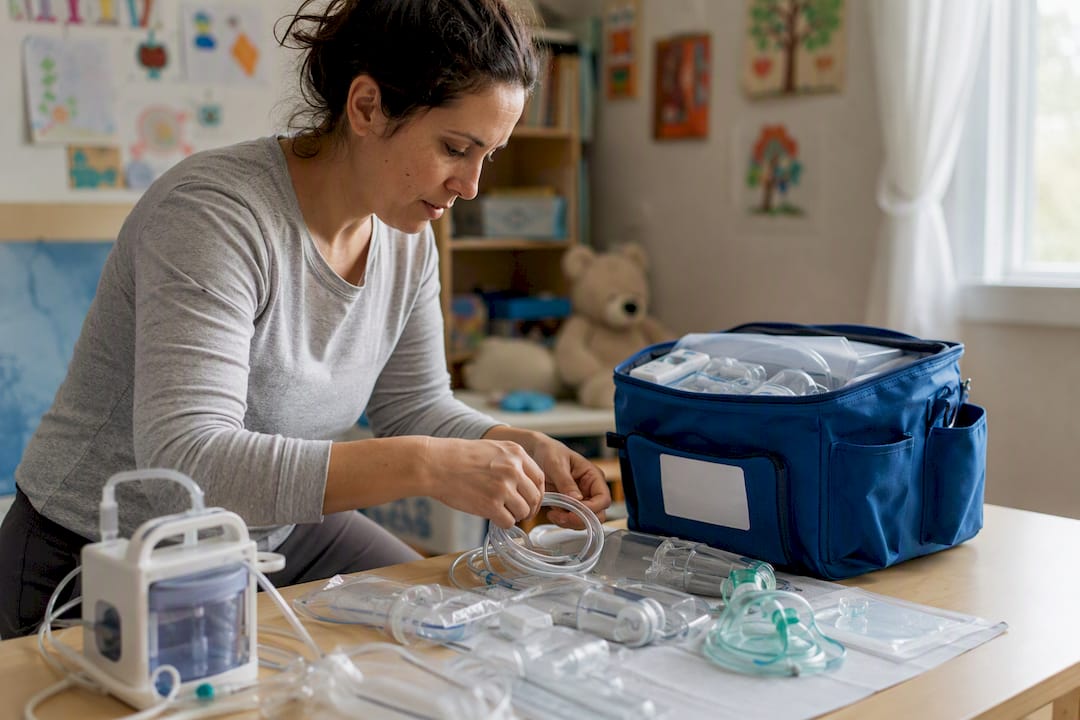
Parent training for home nursing teaches parents and legal guardians to perform clinically skilled tasks, tracheostomy care, ventilator management, feeding-tube care, and seizure or emergency response, and to document that competency before a medically fragile child leaves the hospital. Start today: ask your care team for the Caregiver Skills Checklist, request bedside training plus a rooming-in period, name two people who will train as primary caregivers, and confirm your equipment vendor and home nursing coverage are lined up.
Do these in the next 24 to 72 hours:
Request the Caregiver Skills Checklist in writing from your bedside nurse or case manager.
Identify and commit two family members to the full training track, not just one.
Ask when bedside teaching and simulation lab sessions are scheduled.
Confirm your durable medical equipment (DME) order has been submitted, not just discussed.
Ask your case manager which home nursing agency will manage your authorization.
Key Takeaways
Parent training for home nursing succeeds when documented competency, at least two trained caregivers, and reliable nursing continuity all come together before and after discharge.
Point | Details |
Get the checklist first | Request the Caregiver Skills Checklist immediately so training and documentation start on day one. |
Train two caregivers, not one | Hospitals require at least two trained family caregivers to prevent single points of failure. |
Rooming-in proves readiness | Independent cares over 24 to 72 hours is the real competency test before discharge. |
Paperwork drives timing | GAPP and Medicaid authorization delays, not clinical readiness, cause most discharge delays. |
Choose a continuity-focused partner | Opulentprivatecare’s published shift-fill and retention metrics and 3 Thumbs Up Rule support consistent nurse matching for GAPP families. |
Table of Contents
Core Clinical Skills You Need for Home Nursing
Hospitals do not hand parents a manual and wish them luck. Every skill below gets taught hands-on, then checked off by an RN or respiratory therapist before you’re cleared to go home.
Suctioning: clears secretions from the airway. Competency checkpoint: you suction your child at least twice under direct RN observation without prompting.
Tracheostomy site care: prevents skin breakdown and infection around the stoma. Checkpoint: demonstrated cleaning and dressing change with correct technique.
Trach tie changes: keeps the tube secure without cutting off circulation. Checkpoint: independent tie change while a second trained caregiver assists.
Routine and emergency trach tube changes: routine changes happen on schedule; emergency changes happen when the tube comes out unexpectedly. This is one of the highest-priority skills, since a dislodged tube can become life-threatening in minutes.
Trach CPR: modified resuscitation technique specific to a child with a tracheostomy. Non-negotiable before discharge, per programs like the Texas Children’s Hospital tracheostomy care guide.
Ventilator basics and alarm response: knowing what each alarm means and how to respond calmly matters as much as understanding the machine itself.
Feeding-tube (G-tube/PEG) care and pump use: covers site care, formula administration, and troubleshooting a clogged tube.
Medication administration, including syringe pump basics for continuous or timed dosing.
Pulse oximeter and monitor use: reading trends, not just single numbers, since a slow drift often precedes a crisis.
Humidification and circuit care: dried-out airways are a common, preventable complication.
Battery and power management: what to do during an outage, and how long backup power realistically lasts.
Emergency bag maintenance: keeping a Go-Bag stocked and current, not packed once and forgotten.
For medically fragile children on tracheostomy and ventilator support, an awake, trained caregiver must be present at all times, which is exactly why this list exists and why hospitals treat it as non-negotiable.
What Is the Typical Hospital-to-Home Training Timeline?
Discharge planning for a child on a trach or vent usually starts weeks before anyone talks seriously about a leave date. The staged pathway looks like this:
Early discharge planning: begins as soon as your child’s condition stabilizes, often while still in the ICU.
Bedside teaching with RN and RT: hands-on instruction during routine cares, repeated until it becomes second nature.
Simulation lab or classroom training: practice on a manikin or in a controlled setting before touching your own child under pressure.
Documented skill sign-offs: each skill gets checked off individually, not bundled into one final test.
Rooming-in or independent cares: you take over all care for 24 to 72 hours in a hospital room while staff observe from a distance, stepping in only if needed.
Final DME verification and home nurse scheduling: equipment delivery and nursing shifts get confirmed before a discharge date is set.
Discharge: the last step, not the first milestone.
The full process runs anywhere from a few weeks to several months. The biggest delays are rarely clinical. They come from home nursing agencies struggling to staff shifts and DME companies taking longer than expected to deliver equipment. Programs intentionally train at least two family caregivers, partly because a single trained parent creates a dangerous single point of failure and partly because independent cares reveal issues that only show up in a home-like setting, not in a supervised bedside session.
How Is Caregiver Competency Documented Before Discharge?
Rooming-in, sometimes called independent cares, is the primary way hospitals verify you’re ready. You take full responsibility for your child’s care in a hospital room for 24 to 72 hours while your team watches from nearby, stepping in only for genuine emergencies. This mirrors the model used by Children’s Hospital Colorado’s Ventilator Care Program, which treats caregiver education as a staged process rather than a single class.
Before you leave, collect these documents:
Signed Caregiver Skills Checklist with dates and staff initials.
Training completion records for each skill area.
Ventilator and DME instruction sheets specific to your equipment models.
A written emergency plan and Go-Bag checklist.
A copy of your nurse and RT competency verification.
Pro Tip: Photograph every signed checklist page the day it’s completed and keep them in a dedicated folder on your phone. When a new home nursing agency or a recertification review asks for proof of training, you’ll have it in seconds instead of chasing down hospital records weeks later.
Practical Ways to Practice and Prepare at Home
The first four to six weeks at home are where theory meets reality, and most families describe this stretch as more exhausting than the hospital stay itself. A discharge guide for pediatric tracheostomy families points to this period as the one where caregiver stress peaks, which is exactly why preparation before you leave the hospital matters so much.
Before discharge:
Build your Go-Bag: spare trach tube, suction catheters, saline, gloves, tape, and a manual resuscitation bag at minimum.
Verify DME delivery dates in writing, not just a verbal promise.
Confirm backup power sources and know how long each one lasts.
Label supplies and set up a visible medication and feeding schedule board.
After discharge, run these routines:
Schedule regular drills for suctioning and emergency scenarios, not just when something goes wrong.
Practice at night. Daytime competence doesn’t automatically transfer to a 3 a.m. alarm.
Rotate caregivers through full shifts so both trained adults handle overnight care solo.
Keep a daily log and a supply reorder schedule so you’re never caught short.
Pro Tip: Make a one-page “child baseline” card listing current medications, equipment settings, and recent vital signs. Keep a copy in the Go-Bag and one taped inside a kitchen cabinet. If paramedics show up, that card saves precious minutes.
How Do Insurance and State Programs Pay for This Training?
Most families pay for home nursing through Medicaid-authorized programs, private insurance prior authorization, or a combination of both. In Georgia, the Georgia Pediatric Program (GAPP) covers eligible medically fragile children under 21 and requires prior authorization before nursing hours begin.
Applications route through a Medicaid-approved GAPP nursing agency, which coordinates the Caregiver Skills Checklist as part of the formal approval packet.
Paperwork to gather:
Physician orders (sometimes called PPOT forms).
Nurse Care Plan (NCP).
Signed Caregiver Skills Checklist.
Any state-specific DMA forms or prior authorization paperwork.
Ask your case manager directly: who submits the authorization, what’s the expected approval timeline, and how are hours recertified later? Missing signatures and DME delivery gaps cause most delays, so confirm every signature line is complete before the packet goes out.
Which Tasks Need a Family Caregiver vs. a Licensed Nurse?
Trained family caregivers can typically handle routine suctioning, feeding-tube maintenance, medication administration, and responding to common ventilator alarms. Tasks like IV medication administration, complex ventilator setting changes, or managing a child during active respiratory instability generally require a licensed RN.
Watch for these markers that signal you need professional nursing presence rather than relying solely on family caregivers: unstable oxygenation levels, frequent unexplained alarms, recent hospitalizations, or any period where vent settings are actively being adjusted.
Many families land on a hybrid model: trained parents cover daytime routine care while scheduled private-duty nursing handles overnight shifts or complex medical windows. Full 24/7 RN coverage tends to fit children with more volatile conditions or families without a second trained caregiver available.
How to Choose a Home Nursing Partner
Not every agency approaches pediatric trach and vent care the same way. Look for a partner that treats caregiver training as part of the job, not an afterthought.
Selection criteria | What to look for |
Clinical competence | Nurses with documented pediatric trach and vent experience, not general adult care background |
Training and mentorship | Willingness to participate in your pre-discharge bedside training and rooming-in |
Paperwork support | Experience assembling Medicaid or GAPP authorization packets without repeated delays |
Continuity metrics | Published shift-fill rates and nurse retention data, not vague reassurances |
Emergency responsiveness | Clear escalation process and local staff who can respond quickly |
When you’re scoring candidates, ask each agency to show you actual numbers, not just describe their philosophy. Opulent Private Care applies this same logic internally with its 3 Thumbs Up Rule, requiring sign-off from the family, the assigned caregiver, and Opulent itself before care starts, and it publishes its own shift-fill and retention metrics rather than asking families to take reliability on faith.
Who Makes Up Your Multidisciplinary Care Team?
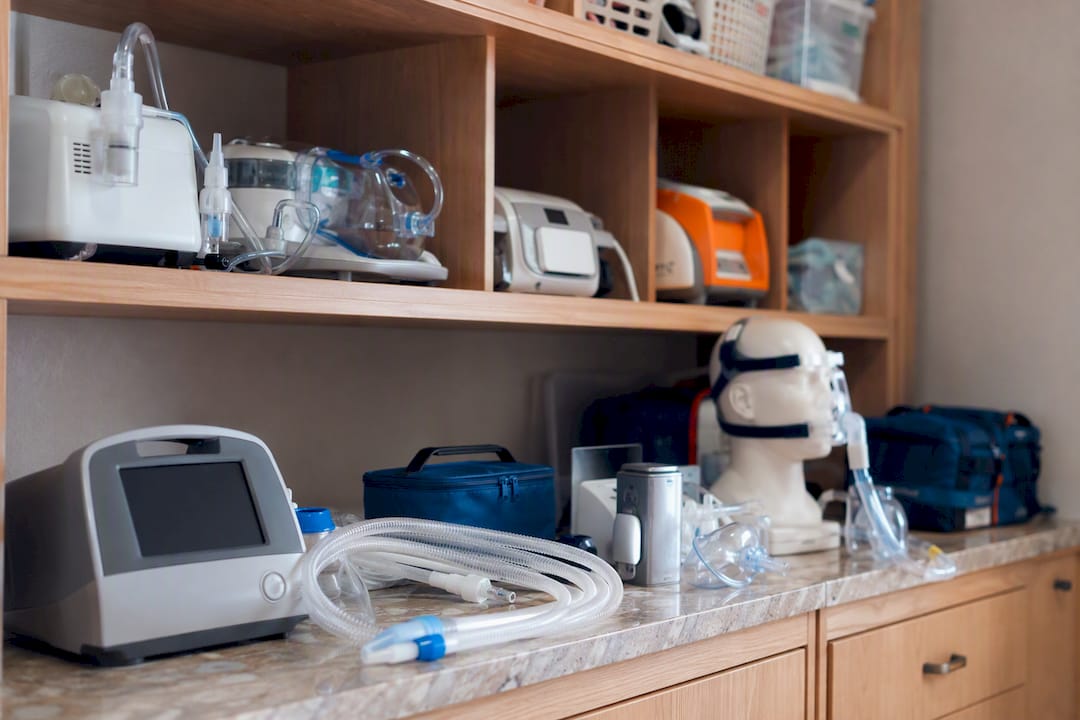
Your child’s care team extends well beyond the bedside nurse. RNs handle direct clinical teaching and skill verification. Respiratory therapists own the ventilator and airway education, since that’s their specialty. Case managers coordinate the discharge timeline, insurance authorizations, and DME orders, often juggling several moving pieces at once. Social workers address the practical and emotional load, everything from transportation barriers to connecting you with financial assistance programs.
Children’s Wisconsin frames parents as the primary care coordinator, the person who bridges the hospital team and daily life at home. Nobody on the clinical team knows your child’s normal breathing pattern or baseline color the way you will after a few weeks. Their training reinforces your instincts. It doesn’t replace them.
Your case manager is usually your single point of contact when something falls through, whether that’s a delayed DME shipment or a home nursing shift that goes unfilled. Get their direct line, not just a general department number, and ask upfront how quickly they respond to urgent messages versus routine ones. That single detail tells you more about how smoothly your transition will go than almost anything else in the discharge packet.
Caring for Your Own Mental Health During Training
Caregiver burnout during this transition is common enough that hospital discharge guides now build it into the planning conversation directly. The intensity of the first weeks at home, disrupted sleep, constant vigilance, the weight of knowing a missed alarm carries real consequences, wears on even the most prepared parents.
Ask your social worker about respite care options before you’re desperate for them, not after. Some state Medicaid programs, including GAPP-adjacent services in Georgia, include limited respite hours as part of a broader care plan. Peer support groups, often organized through the hospital or condition-specific nonprofits, connect you with other parents who’ve lived through the exact same 3 a.m. alarm fatigue.
Caregiver education doesn’t end at discharge. It’s an ongoing process, and regular clinical reassessments and refreshers happen as your child grows and needs shift, which means your training relationship with the hospital continues well past the day you drive home. Treat those follow-up appointments as recalibration, not a formality to skip once you feel confident.
If you notice persistent dread, irritability, or exhaustion that doesn’t lift with sleep, mention it to your pediatrician or case manager directly. Untreated caregiver burnout doesn’t just affect you. It affects the quality and consistency of the care your child receives.
Understanding Consent, Liability, and Your Legal Role
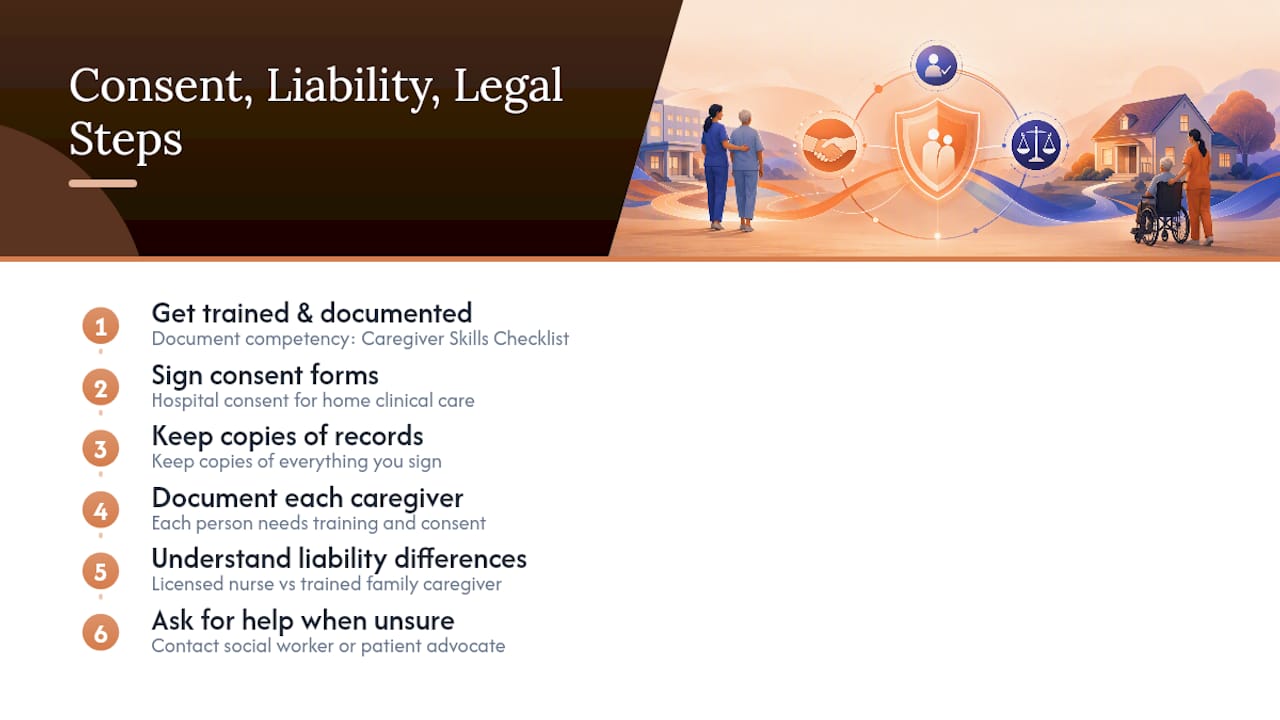
Once you’re trained and documented as competent, you’re performing tasks that would otherwise require a licensed nurse, and that carries real legal weight. Hospitals require signed consent forms acknowledging you’ve received training and understand the risks of home-based clinical care. Keep copies of everything you sign.
Your documented competency, the same Caregiver Skills Checklist covered earlier, doubles as a legal record. If a dispute ever arises with an insurer, a school, or a home nursing agency about whether you’re qualified to perform a specific task, that signed documentation is your evidence.
Liability generally shifts differently depending on who’s performing the task. A licensed home health nurse operates under their own professional liability and state nursing board oversight. A trained family caregiver operates under a different framework entirely, one where informed consent and documented training matter far more. This isn’t a gray area to guess at. If you have specific concerns about liability in a particular situation, ask your hospital’s social worker or patient advocate to connect you with the right resource rather than relying on general assumptions.
Guardianship and consent also matter if your child’s care involves anyone beyond you: grandparents, other family caregivers, or school staff administering medication. Each person handling a clinical task typically needs their own documented training and, in some cases, a separate consent form on file.
How Should You Communicate with Providers and Emergency Services?
Clear communication is a clinical skill in its own right, not an afterthought. When you call your child’s pulmonologist or case manager, lead with the specific change you’re seeing: oxygen saturation trending down over the past hour, not just “something feels off.” Specificity gets you a faster, more useful response.
For 911 calls, the one-page baseline card you built during practical prep does the heavy lifting. Paramedics who’ve never met your child before need equipment settings, current medications, and recent vitals fast, and reading that off a card beats trying to recall it under stress.
Know your escalation ladder before you need it: which issues go to your DME company, which go to your home nursing agency or on-call nurse, and which go straight to 911. A ventilator alarm you’ve been trained to troubleshoot is different from one that persists after correct intervention. The second one escalates immediately.
Keep a written list of every provider’s direct number, not just the main hospital switchboard, taped near your emergency supplies. During an actual crisis, scrolling through old text threads to find a number wastes time you don’t have.
Does Your Training Program Account for Language and Culture?
Training quality shouldn’t depend on which language you speak at home. Ask directly whether your hospital offers interpreter services during bedside teaching and simulation sessions, not just during physician consultations. Clinical vocabulary is precise, and a family caregiver who misunderstands a dosage instruction or an alarm meaning because of a language gap faces the same risks as one who was simply undertrained.
Written materials matter just as much as spoken instruction. Ask for your Caregiver Skills Checklist, emergency plan, and DME instructions translated into your primary language, and confirm someone reviews the translated version with you rather than just handing over a document.
Cultural context shapes caregiving decisions too, from who in an extended family takes on the primary caregiver role to how comfortable a family feels asking questions during training. A good multidisciplinary team adapts to that reality instead of expecting every family to fit one teaching style.
Why Continuity of Care Changes Everything
Trained family caregivers deserve nursing partners who show up, and keep showing up. That’s the part conventional advice underplays: a rotating cast of unfamiliar nurses undermines the very competency-building process this entire training pathway is built around. Measurable reliability, published shift-fill rates, actual retention numbers, isn’t a marketing detail. It’s the difference between a family that trusts its care team and one that’s perpetually re-explaining a child’s baseline to a stranger.
Get Help With Nurse Matching and GAPP Paperwork
Training gets you ready to be a competent family caregiver. It doesn’t handle the paperwork, the nurse recruiting, or the staffing gaps that stall so many families after discharge. Opulentprivatecare exists for exactly that gap: GAPP paperwork assistance so authorization delays don’t stall your care plan, nurse matching based on clinical fit rather than whoever’s available, and continuity-focused staffing built to avoid the rotating-nurse problem that wears families down.
Every placement runs through Opulentprivatecare’s 3 Thumbs Up Rule, meaning the family, the caregiver, and Opulentprivatecare all sign off before care begins, so you’re never stuck with a nurse who’s a poor fit for your child’s needs. If you’re navigating GAPP eligibility, coordinating training with a home nursing schedule, or simply need a partner who publishes real retention numbers instead of vague promises, reach out to Opulentprivatecare to start the conversation. First contact typically means a conversation about your child’s specific needs and where you are in the GAPP process, not a sales pitch.
Frequently Asked Questions
How long does parent training for home nursing usually take? Timelines vary widely, from a few weeks for straightforward cases to several months when home nursing staffing or DME delivery causes delays.
Do both parents need to complete the training? Hospitals typically require at least two trained caregivers, who don’t have to both be parents, but each must independently demonstrate every required skill.
What happens if I fail a competency checkpoint? You get more practice and another attempt. Hospitals build in repetition specifically because skills like trach CPR take multiple tries to master under pressure.
Will Medicaid or GAPP cover ongoing home nursing after training? In Georgia, GAPP can authorize in-home nursing hours for eligible medically fragile children, though prior authorization and periodic recertification are required.
Can a trained family caregiver replace a home nurse entirely? For children with unstable conditions, frequent alarms, or complex ventilator needs, professional nursing presence remains necessary alongside trained family caregivers, not instead of them.
This article is general information, not a substitute for advice from a qualified doctor. Consult a qualified healthcare professional about your own circumstances before acting on anything here.
Sources
PubMed - Tracheostomy caregiver training and safety (PMID 28943140)
Children’s Hospital Colorado — Ventilator Care Program caregiver education (PDF)
Texas Children’s Hospital — Tracheostomy care guide (TrachCare-English–2024.pdf)
Georgia Department of Community Health — Georgia Pediatric Program (GAPP) fact sheet
Recommended
Comments