
What Consistent, Responsive Caregiving Means for Your Child

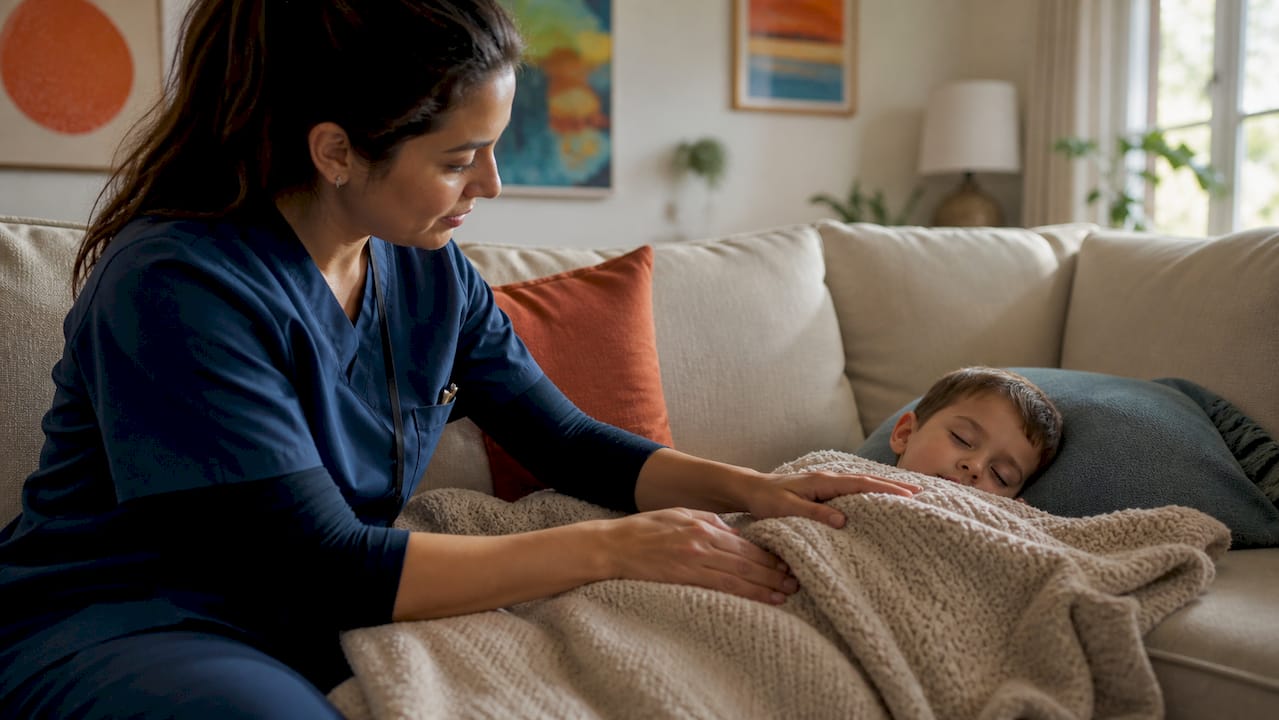
Consistent, responsive caregiving means the same trusted adult reads your child’s cues and reacts to them promptly, predictably, and warmly, day after day. That combination, the same person showing up plus responding the right way, is what builds secure attachment and teaches a child’s nervous system how to calm itself down. Kids raised this way separate more easily, explore more confidently, and recover faster from stress. A consistent caregiver isn’t a luxury; it’s the mechanism.
You don’t need a perfect routine to get these benefits. You need a predictable one.
If you’re looking for a place to start tonight, pick one moment in your day, bedtime works well for most families, and build a short, repeatable ritual around it: same three steps, same order, same tone of voice. That single change signals safety to your child’s brain before you’ve done anything else.
Definition: Responsive caregiving is answering a child’s needs promptly and appropriately; consistency means the same trusted person does it reliably over time.
Core benefit: Secure attachment and a steadier stress-response system, according to research from the American Academy of Arts and Sciences.
Tonight’s step: Choose one transition (bedtime, drop-off, mealtime) and script it the same way every time.
Key Takeaways
Consistent, responsive caregiving, the same trusted adult reliably reading and answering a child’s cues, is the strongest everyday driver of secure attachment and healthy stress regulation.
Point | Details |
Continuity has a timeline | Attachment benefits become measurable when a caregiver stays with a child for at least 12 months, ideally 2 to 3 years. |
Predictability lowers stress | Children with predictable, responsive caregivers develop more adaptable stress-response systems and calmer separations. |
Ask about caregiving models | Primary caregiving, looping, and multiage grouping all reduce how often a child has to rebuild trust with someone new. |
Small routines compound | Three predictable daily anchor points (morning, meals, bedtime) build consistency faster than a full rigid schedule. |
Continuity is a safety factor | For medically fragile children, a stable caregiver catches subtle clinical changes earlier than rotating staff can. |
Opulentprivatecare operationalizes continuity | Its 3 Thumbs Up Rule, published retention metrics, and GAPP assistance are built to keep one nurse with one family long-term. |
Table of Contents
The Research Behind Consistent Caregiving and Attachment
Children who stay with the same caregiver for a significant period, often more than a year, show measurably stronger attachment security and steadier emotional and behavioral development, according to NAEYC’s review of continuity-of-care research. That timeline matters because attachment isn’t built in a single warm interaction. It accumulates through hundreds of small, repeated exchanges where a caregiver reads a cue correctly and responds the same way each time.
The neuroscience behind this is more specific than “consistency is good.” Predictable, sensitive caregiving helps a child’s stress-response system become more adaptable rather than reactive, according to developmental science research published by the American Academy of Arts and Sciences. A child who can anticipate what happens next, another diaper change, then a bottle, then a nap, spends less physiological energy bracing for the unknown. That energy gets redirected toward exploring, learning language, and practicing social skills instead of scanning the room for threats.
The 12-month threshold isn’t arbitrary. It shows up repeatedly in the continuity-of-care literature as the point where attachment benefits become measurable rather than theoretical.
Academic research backs this up outside of childcare centers too. Studies on caregiver sensitivity and consistency in institutional settings, orphanages and residential care programs, found that consistent, sensitive caregiving is a critical context for early development, even when it doesn’t come from a biological parent, according to research published in PMC. The takeaway generalizes well: attachment security depends more on reliability of response than on any particular relationship label.
Two national organizations have staked out clear positions here, and it’s worth knowing what each one actually recommends:
NAEYC promotes continuity of care as a core program-quality standard, recommending that infant and toddler programs structure staffing so children keep the same primary caregiver across multiple years rather than rotating classrooms annually.
ZERO TO THREE focuses on the responsiveness half of the equation, defining responsive caregiving as responding appropriately, promptly, and consistently to an infant’s or toddler’s needs, and offering practical tips for building that responsiveness into everyday interactions.
Neither organization claims perfection is required. The research consistently points to reliability, not flawlessness, as the active ingredient.
What Changes When Caregiving Is Actually Consistent
Parents ask a fair question at this point: what does secure attachment actually look like in daily life? It’s not an abstract psychological state. It shows up in observable, sometimes surprising ways.
Separations get easier, not harder. Counterintuitively, children with a consistent, responsive caregiver tend to separate more calmly, not less, because they trust the caregiver will still be responsive when reunited. Kids without that trust often cling harder or shut down emotionally, because uncertainty about the response is the stressor, not the separation itself.

Self-soothing develops faster. When a caregiver responds to distress the same way each time, a child internalizes that pattern and starts applying pieces of it independently. A toddler who’s always been picked up and told “you’re okay, I’ve got you” during a meltdown will eventually murmur a version of that to themselves before an adult even arrives.
Behavioral escalations drop. Children with unpredictable responses often escalate faster, screaming instead of whining, because they’ve learned that a bigger reaction is sometimes the only thing that reliably gets a response. Consistency removes the incentive to escalate.
Learning readiness and social skills improve. A child who isn’t spending cognitive resources monitoring an unpredictable adult has more bandwidth for everything else: vocabulary, pretend play, turn-taking with peers, following multistep instructions.
Family stress drops too. This one gets underreported. When parents trust their child’s caregiver, whether that’s a daycare provider, a nanny, or a home nurse, they stop mentally rehearsing worst-case scenarios during the workday. That mental space matters more than most parents expect until they get it back.

Primary Caregiving, Looping, and Multiage Models Explained
If you’ve heard childcare programs mention “primary caregiving” or “looping” and weren’t sure what set them apart from standard classroom rotation, here’s the distinction.
Primary caregiving assigns one specific staff member as the main point of contact and principal caregiver for a smaller group of children within a larger classroom, without excluding other staff from ever interacting with that child. According to federal guidance from the Administration for Children and Families, this structure is implemented through written job descriptions and formal assignments, not left to chance. The point is that families and children always know who to go to, and that person carries deeper knowledge of the child’s specific patterns, allergies, sleep quirks, comfort routines, than a rotating staff pool ever could.
Looping keeps a caregiver with the same group of children as they age up, moving from the infant room to the young toddler room together rather than starting over with new staff each birthday. Some programs loop for a full year, others for two or three.
Multiage grouping mixes children of different ages in one classroom with a stable staff team, so a child stays with the same caregivers across a wider developmental range instead of transitioning rooms on a fixed calendar.
All three models point at the same goal: minimizing the number of times a child has to rebuild trust with someone new. Continuity gives a caregiver more chances to observe a child closely enough to respond to increasingly subtle cues, something rotating staff structurally cannot replicate.
If your current program doesn’t offer any of these, you can still ask for pieces of it:
Request that your child be assigned a specific primary contact, even informally, rather than rotating between whoever’s on shift.
Ask directly about staff turnover rates and average caregiver tenure before enrolling.
If a room transition is coming up, ask whether the receiving caregiver can spend time with your child beforehand rather than meeting on day one.
For home-based care, ask providers how they handle continuity when a caregiver is sick or leaves the role.
How to Build Predictable, Responsive Routines at Home
Research explains why consistency matters. This is how you build it into an ordinary week without overhauling your life.
Design three predictable anchor points, not a full schedule. Trying to script your entire day usually collapses within a week. Instead, pick morning wake-up, a mealtime, and bedtime, and give each one a short, repeatable sequence. Bedtime might be bath, book, same two songs, lights out. Morning might be same greeting, same breakfast question, same “five more minutes” warning before leaving. The sequence matters more than the specific content.
Use consistent scripts and advance warnings for transitions. Kids resist transitions less when they can see them coming. A countdown (“two more minutes, then we clean up”) given the same way every time becomes a cue your child’s brain starts to trust and prepare for, rather than a surprise to resist.
Practice the observe, validate, respond sequence. This is the practical core of responsiveness. When your child signals distress, frustration, excitement, whatever, pause long enough to actually notice it, name what you see out loud (“you’re frustrated the tower fell”), and then respond, whether that’s help, comfort, or simply staying present. ZERO TO THREE’s guidance on responsive parenting frames this labeling step as one parents skip most often, jumping straight to fixing the problem before the child feels heard.
Build a one-page care summary if more than one adult is involved. Any household with a nanny, grandparent, co-parent across two homes, or rotating caregiver needs one shared document: nap windows, comfort strategies that work, words the child uses for bathroom needs, food preferences, and how you handle meltdowns. This isn’t bureaucracy for its own sake. It’s what lets a second caregiver respond the same way you would, which is the entire point of consistency.
Pick one communication tool and stick with it. A shared notes app, a physical notebook that travels between home and daycare, or a simple group text, doesn’t matter which, as long as everyone involved in your child’s care actually checks it and everyone agrees to log the same categories of information.
Pro Tip: Write your care summary in your child’s voice where possible (“I say ‘uppie’ when I want to be picked up, not ‘up’”). Specific language cues get missed constantly in handoffs between caregivers, and they’re often the fastest way for a new or backup caregiver to earn a child’s trust.
None of this requires rigid perfection. A missed bedtime routine on a chaotic Tuesday doesn’t undo six months of consistency. What matters is that the pattern holds often enough that your child can predict it.
Why Continuity Is a Safety Issue for Medically Fragile Children
For a child managing a tracheostomy, a feeding tube, seizures, or a cardiac condition, caregiver consistency stops being a developmental nicety and becomes a safety mechanism. A caregiver who has cared for the same child for months knows what that child’s baseline breathing sounds like, what their normal color looks like, and what a subtle shift in behavior usually signals before it becomes an emergency. A rotating caregiver meeting that child for the first time has none of that baseline knowledge, and in a medically complex case, that gap can mean a warning sign gets missed entirely.
This is the operational problem Opulentprivatecare was built to solve, and it’s why continuity gets treated as a measurable outcome rather than a nice-to-have.
Opulentprivatecare’s 3 Thumbs Up Rule requires sign-off from the family, the caregiver, and Opulentprivatecare itself before a nurse ever starts a case, so the match is right from day one instead of adjusted after problems surface.
Rather than rotating nurses through a case as availability shifts, Opulentprivatecare structures staffing around keeping the same nurse with the same family for as long as possible.
Opulentprivatecare publishes operational metrics like shift fill rates and nurse retention rather than treating that information as private, so families can evaluate reliability with real numbers instead of marketing language.
Opulentprivatecare assists families directly with Medicaid and Georgia Pediatric Program (GAPP) paperwork, which is often the biggest administrative barrier standing between a family and consistent coverage.
A caregiver who has known your child for six months notices the small things: the cough that sounds slightly different, the color that’s a shade off, the fussiness that doesn’t match the usual pattern. That early recognition is what continuity actually buys a medically fragile child.
If you’re evaluating any home nursing or long-term caregiver service, medically fragile child or not, ask these questions directly rather than accepting general reassurances:
What is your nurse retention rate, and will you show me the number?
How do you handle a shift when the assigned caregiver is sick or unavailable?
What does your matching process look like before care starts?
Who is my point of contact if something feels off with the caregiver relationship?
Continuity of pediatric care at home isn’t just about comfort or convenience for families managing complex conditions; it’s a documented factor in catching problems early, a point worth understanding fully before you sign on with any pediatric caregiver managing complex medical needs.
Recognizing and Preventing Caregiver Burnout
Continuity only works if the caregiver providing it can sustain the role, and burnout is the single biggest threat to that sustainability. Administrative strain and staff turnover are well documented as barriers to continuity in childcare programs generally, according to NAEYC’s continuity-of-care research, and the same pressures show up in family caregiving and home nursing arrangements.
Watch for these early signs before they become a crisis:
Growing irritability or emotional flatness during caregiving tasks that used to feel routine.
Physical exhaustion that doesn’t improve with a normal night’s sleep.
Dread building around specific caregiving duties, especially medical tasks.
Withdrawing from support networks or refusing offers of help out of guilt.
Build backup capacity before you need it, not during a crisis. A small team beats a single point of failure: identify one or two backup people (a relative, a respite worker, a second trained caregiver) and actually rehearse a handoff with them before an emergency forces one.
Pro Tip: Schedule respite time on the calendar the same way you’d schedule a medical appointment. Respite that depends on “finding the energy to ask for it” rarely happens.
If you’re supporting a caregiver, family or professional, showing warning signs, recognizing pediatric caregiver burnout early is far easier than recovering from it after a sudden resignation or health crisis forces a disruption in your child’s care.
Trusted Resources and When to Get Professional Support
A few organizations are worth bookmarking as ongoing references, not just one-time reads:
NAEYC for program-quality standards and continuity-of-care research.
ZERO TO THREE for responsive-parenting guidance and developmental milestones.
The Program for Infant/Toddler Care for detailed primary-caregiving implementation guidance.
The CDC for broader child mental-health guidance and when concerns warrant escalation.
Contact your pediatrician if you notice a sudden regression in language, social withdrawal that lasts more than a few weeks, or a marked change in sleep or appetite. Contact early intervention services if developmental milestones are consistently missed. Contact a home nursing provider directly if your child’s medical needs have outgrown what a family caregiver can safely manage alone, sooner rather than later, since alternative pediatric home care models take time to set up properly.
This week, pick one thing: request a primary caregiver assignment at daycare, start your one-page care summary, or make one call to ask a provider about their retention numbers.
A Nurse’s View on What Continuity Actually Looks Like
A caregiver who has been with the same family for eight months once described the shift plainly: the first few weeks were about learning the child’s patterns, but by month three, she could tell something was wrong from the doorway, before the monitors flagged anything. That’s not intuition. It’s the product of hundreds of ordinary shifts spent watching one child closely enough to notice small deviations from normal.
The lesson generalizes past medically complex cases: consistency isn’t glamorous, and it doesn’t announce itself. It just accumulates, shift after shift, until it becomes the thing that catches problems early or helps a child settle faster than a stranger ever could. If you’re building this for your own family, don’t wait for a crisis to start asking for it.
Finding a Consistent Caregiver for a Medically Fragile Child
Families searching for occasional babysitting have different needs than families managing a tracheostomy, a feeding tube, or a seizure disorder around the clock. For the second group, the alternatives are usually a rotating pool of agency nurses or a single overstretched family member trying to cover every shift alone. Neither gives you the kind of continuity that catches a subtle clinical change before it becomes an emergency.
Opulentprivatecare was built specifically around that gap. The 3 Thumbs Up Rule means a nurse is matched and approved by your family, the caregiver, and Opulentprivatecare before care ever begins, so you’re not troubleshooting a bad fit after the fact. Staffing is structured to keep the same nurse with your child over time instead of rotating coverage as availability shifts, and Opulentprivatecare publishes shift fill rates and nurse retention numbers so you can evaluate reliability with real figures rather than promises. For families navigating Medicaid or GAPP paperwork, Opulentprivatecare also handles that process directly, which is often the slowest part of getting consistent coverage in place.
If your child needs skilled nursing support at home in Georgia, start by visiting Opulentprivatecare’s pediatric nursing page to begin the intake process and get matched with a nurse who’s a real fit for your family, not just the next available shift.
Frequently Asked Questions
What does “consistent caregiver” actually mean for a young child?
It means the same trusted adult, a parent, a daycare provider, or a home nurse, remains responsible for the child’s care over an extended period, allowing that person to learn the child’s specific cues and respond to them reliably.
How long does a caregiver need to stay for continuity to matter?
Research on continuity of care points to a minimum of about 12 months for attachment benefits to become measurable, with stronger effects when continuity extends to two or three years, according to NAEYC.
Can a child have more than one consistent caregiver?
Yes. Primary caregiving assigns one main point of contact without excluding other adults, and many children thrive with two or three consistent caregivers, a parent, a grandparent, a daycare provider, as long as each one responds predictably.
What happens when caregiving is inconsistent?
Children with unpredictable caregiving tend to show more anxious or resistant attachment behaviors, escalate distress faster to get a response, and spend more mental energy monitoring their environment instead of exploring or learning.
How can I coordinate consistency between daycare, family, and other caregivers?
Build a shared one-page care summary covering routines, comfort strategies, and specific language cues, then agree on one communication tool everyone actually uses, so every caregiver responds to your child the same way.
Is consistent caregiving more important for children with medical needs?
It’s important for every child, but for medically fragile children it also functions as a safety mechanism, since a caregiver who knows a child’s baseline can spot subtle warning signs earlier than someone meeting that child for the first time.
This article is general information, not a substitute for advice from a qualified doctor. Consult a qualified healthcare professional about your own circumstances before acting on anything here.
Sources
Recommended
Comments