
Pediatric Caregiver Burnout: Recognize It and Recover

Pediatric caregiver burnout is a state of chronic physical, emotional, and cognitive exhaustion that develops when the demands of caring for a medically complex child consistently exceed the support and recovery time available to the parent or primary caregiver. If you are reading this because something feels wrong, trust that instinct. Here is what to do in the next hour:
Step away for 10 minutes. Hand care to any available adult, even briefly. If no one is present, place your child in a safe position and sit in an adjacent room.
Call or text someone on your support list and say: “I need a break today. Can you come over or take a call?”
Complete one screening question: On a scale of 0–10, how confident are you that you can safely perform your child’s next care task? A score below 6 warrants immediate escalation.
Two red flags that require action right now, not tomorrow: If you are having thoughts of harming yourself or your child, or if you genuinely cannot perform a safety-critical task (suctioning, medication administration, ventilator check) without making errors, call 988 (Suicide and Crisis Lifeline) immediately. This is not a parenting failure. It is a medical situation, and 988 is staffed around the clock for exactly this.
Pro Tip: Save 988 in your phone contacts right now, before you need it. Searching for a number during a crisis costs precious seconds.
Key Takeaways
Pediatric caregiver burnout is a clinical condition driven by structural overload, and the most effective responses are structural: skilled nursing, validated screening, and funded respite.
Point | Details |
Burnout is measurable | Use ZBI, PHQ-9, and GAD-7 to quantify burden and bring scores to your care team. |
Nearly half of caregivers are affected | 45.96% of caregivers in a study of 6,506 reported elevated burnout at baseline. |
Device dependence raises risk | Multiple medical devices (trach, vent, NG tube) are directly linked to higher burden. |
Intervention works | Many caregivers with elevated burnout reported a decrease after their child received professional support. |
Opulentprivatecare offers structured relief | Georgia families can request in-home skilled nursing with continuity staffing and GAPP paperwork assistance at opulentprivatecare.com. |
Table of Contents
Why parents of medically complex children face higher burnout risk
Your 24–72 hour plan: what to do first, tomorrow, and by day three
How your child’s healthcare team can reduce your burden directly
Dependable in-home pediatric nursing in Georgia, starting with the right fit
Authoritative U.S. resources for crisis, benefits, and caregiver support
How pediatric caregiver burnout shows up in your daily life
Burnout does not arrive as a single breakdown. For parents managing tracheostomy suctioning at 2 AM, adjusting ventilator alarms, or running NG-tube feeds on a two-hour schedule, it accumulates in layers that are easy to rationalize as “just being tired.”
The Cleveland Clinic identifies four categories of warning signs: physical, emotional, cognitive, and behavioral. In pediatric complex care, each category has a specific texture.
Physical signs include exhaustion that does not improve after sleep, frequent illness (a sign of immune suppression from chronic stress), unexplained headaches or body aches, and appetite changes. If you are waking for night suctioning or ventilator alarms multiple times a week, restorative sleep is structurally impossible, and the physical toll compounds fast.
Emotional signs are often the most alarming to caregivers themselves: persistent numbness toward your child’s condition (where you once felt fear, now you feel nothing), resentment toward the child or the medical team, and a creeping hopelessness that things will never improve. These are not character flaws. They are predictable neurological responses to prolonged stress.
Cognitive signs show up as memory lapses during care tasks, difficulty following the child’s care plan, and trouble making decisions. For a parent managing a complex medication schedule or a multi-device care routine, cognitive fatigue is not just uncomfortable. It is a patient-safety concern.
Behavioral signs include withdrawing from friends and family, increased irritability (especially toward the child), and relying on alcohol or other substances to decompress. Social withdrawal is particularly common among parents of device-dependent children, whose care schedules make spontaneous social contact nearly impossible.
Mayo Clinic notes that long-term caregiver stress raises the risk for depression, anxiety, immune dysfunction, and chronic disease in caregivers themselves. The caregiver’s health is not separate from the child’s care quality. They are the same issue.
Pro Tip: If you notice you are making small errors in care tasks you normally perform automatically (wrong medication dose, missed feed time, skipped equipment check), treat that as a clinical signal, not a bad day.
Why parents of medically complex children face higher burnout risk
Not all caregiving carries the same load. Parents caring for children with complex medical needs and device dependence face a specific set of risk factors that standard caregiver burnout literature often underestimates.
Clinical drivers:
Device dependence (tracheostomy, mechanical ventilator, NG or PEG tube): Each device adds a layer of technical skill, vigilance, and anxiety. A ventilator alarm at 3 AM is not just a disruption; it is a potential emergency. Research published in MDPI found that use of multiple medical devices and higher care complexity were directly associated with higher caregiver burden and burnout.
Illness severity and comorbidities: A PMC cohort study found that greater disease severity and the presence of comorbidities correlated with significantly higher caregiver burnout scores. The same study found burnout decreased as children aged, suggesting the early years carry the heaviest load.
High-acuity care tasks: Suctioning, positioning, seizure monitoring, and cardiac observation require sustained, skilled attention that most caregivers were never formally trained to provide.
Contextual drivers:
Lone caregiver status: When one parent carries the majority of care, there is no built-in recovery time.
Chronic sleep disruption: Night feeds, alarms, and repositioning schedules fragment sleep in ways that accumulate into serious cognitive and physical impairment over weeks.
Financial stress: Medical equipment, supplies, and unpaid leave create financial pressure that compounds emotional strain.
Paperwork and authorization burden: Navigating Medicaid, GAPP, and prior authorization processes is a part-time job layered on top of full-time caregiving.
Pro Tip: Keep a simple “energy log” for one to two weeks. Each morning, rate your energy (1–10) and note what happened the night before. Patterns emerge quickly, and the log becomes concrete documentation when you request additional support from your care team or Medicaid navigator.
Quick self-assessment: validated tools you can use today
Three validated screening tools are widely used to assess caregiver burden and mental health. You do not need a clinician to complete them, though you should share results with your doctor.
Zarit Burden Interview (ZBI): The ZBI measures the subjective burden of caregiving across 22 items covering personal strain, role strain, and relationship impact. A score of 21–40 indicates mild to moderate burden; 41–60 indicates moderate to severe; above 60 indicates severe burden. If your score falls in the moderate-to-severe range, scheduling in-home skilled nursing or formal respite is a concrete next step, not a luxury.
PHQ-9 (Patient Health Questionnaire-9): The PHQ-9 screens for depressive symptoms over the past two weeks. Scores of 10 or above indicate moderate depression and warrant a conversation with your primary care provider. A score of 15 or above indicates moderately severe depression and should prompt a same-week appointment or urgent care contact.
GAD-7 (Generalized Anxiety Disorder 7-item): The GAD-7 screens for anxiety severity. A score of 10 or above indicates moderate anxiety. For caregivers managing high-acuity devices, anxiety scores in this range often reflect real risk, not overcaution.
A short daily safety checklist (takes under two minutes):
Did you sleep at least four consecutive hours last night?
Have you eaten a meal today?
Do you have any thoughts of harming yourself or your child?
Have you made an error in a care task in the past 24 hours?
Do you feel confident performing the next scheduled care task?
If your PHQ-9 or GAD-7 reaches a moderate or severe range, or if your daily checklist flags a safety concern, contact your primary care provider or call 988. If your ZBI shows moderate-to-high burden, contact your Medicaid or GAPP navigator and request a home nursing assessment. These scores are documentation, not just feelings — bring them to every appointment.
Your 24–72 hour plan: what to do first, tomorrow, and by day three
This is a short-term stabilization plan, not a permanent solution. The goal is to reduce immediate risk and create enough breathing room to build something more sustainable.
Hour 0 (right now):
Run the safety checklist above. If any safety concern is flagged, call 988 before doing anything else.
Identify one person (family member, neighbor, friend) who can take over care for two to four hours today. The script: “I need a break today for my own health. Can you come sit with [child’s name] from [time] to [time]? I’ll leave a care summary.”
Write a one-page care summary: current medications, device settings, emergency contacts, and the two most important “watch for” items. This document makes delegation possible.
Day 1:
Contact your child’s social worker or care coordinator and say: “I’m experiencing caregiver burnout and need to discuss respite options and home nursing support.” Use those exact words. They trigger a different response than “I’m tired.”
Brief the backup caregiver with the one-page summary. Walk them through one care task in person if possible.
Call your child’s pediatrician’s office and request a caregiver mental health referral. You are entitled to ask for this.
Days 2–3:
Complete the ZBI, PHQ-9, and GAD-7. Print or screenshot your scores.
Contact your Medicaid or GAPP navigator to request a home nursing assessment. Say: “My child requires skilled nursing care and I need to discuss authorization for in-home nursing hours.”
Email or message your child’s school nurse or special education coordinator: “I want to schedule a brief call to review [child’s name]'s care plan and discuss any school-based support that could reduce our family’s daily coordination burden.”
Document the past two weeks: dates of significant stress events, care errors, sleep disruptions, and any screening scores. This record speeds referrals and authorizations.
Building a sustainable support plan over the coming months
Stabilizing a crisis is different from preventing the next one. A sustainable plan has four components: a support map, in-home skilled nursing, mental health care, and funded leave or respite.
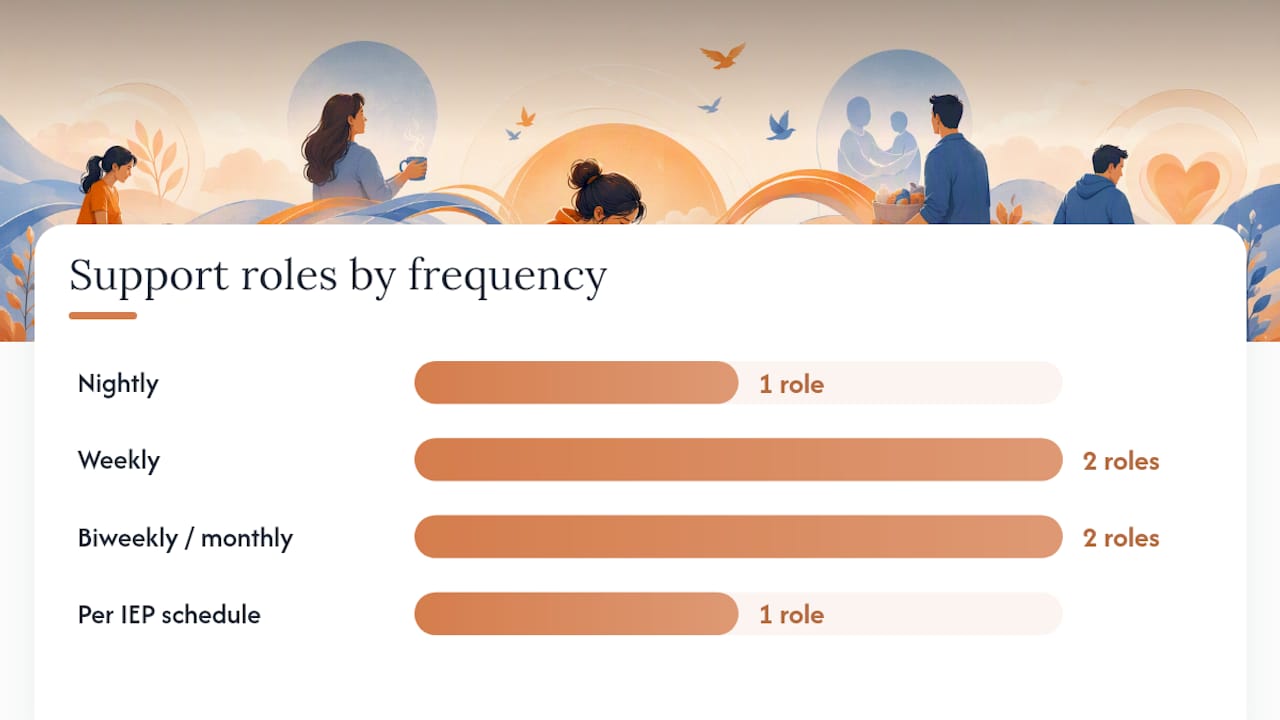
Support map: who does what and how often
Support Role | Who Fills It | Frequency |
Night care coverage | In-home skilled nurse or trained family member | Nightly or rotating |
Daytime respite | Trained respite worker, family, or friend | Weekly minimum |
Medical coordination | Pediatric care coordinator or social worker | Monthly or as needed |
School-based support | School nurse, IEP team | Per IEP schedule |
Peer support | Parent support group (in-person or online) | Weekly |
Mental health care | Therapist, psychologist, or PCP | Biweekly or monthly |
Peer support and parent-to-parent groups consistently lower perceived burden and depressive symptoms in parents of children with special needs. Adding a peer group to your support map is one of the highest-value, lowest-cost steps available.
Evaluating in-home nursing: what to ask before you commit
Is the nurse trained in my child’s specific devices (trach, vent, G-tube, seizure protocol)?
What is the agency’s shift fill rate and nurse retention rate? Ask for published metrics.
Will my child have a consistent nurse, or does the agency rotate staff?
What is the emergency protocol if the assigned nurse cannot make a shift?
Does the agency assist with Medicaid or GAPP paperwork?
Can the nurse train a backup family caregiver on device management?
Request answers in writing. An agency that resists written commitments on continuity is telling you something important.
Funding and leave options:
Medicaid HCBS and state pediatric programs: Medicaid home and community-based services programs, including Georgia’s GAPP, fund long-term in-home skilled pediatric nursing. Eligibility and covered hours vary by state. Start at medicaid.gov and your state Medicaid office.
FMLA: The Family and Medical Leave Act provides eligible employees up to 12 weeks of unpaid, job-protected leave per year to care for a family member with a serious health condition. Check the Department of Labor’s FMLA page for eligibility criteria and how to initiate a request with your employer.
State respite programs: Many states fund respite through ARCH National Respite Network or state developmental disability offices. Search “[your state] pediatric respite program” for local options.
Pro Tip: When requesting Medicaid or GAPP authorization for in-home nursing, attach your completed ZBI, PHQ-9, and GAD-7 scores to the request. Quantified caregiver burden data strengthens the clinical justification and can shorten authorization timelines.
Red flags that mean you need professional help now
Some signs of caregiver fatigue are manageable with rest and support. These are not:
Suicidal ideation or thoughts of harming your child. Call 988 immediately.
You cannot reliably perform a safety-critical care task (medication administration, suctioning, ventilator management) without making errors. This is a patient safety emergency.
Severe depression or anxiety that impairs daily function: you cannot get out of bed, you cannot follow the care plan, you are not eating.
Repeated equipment or medication errors in the past week, even minor ones.
Complete social isolation with no contact with another adult for more than a few days.
Who to call, in order:
988 for any mental health crisis or safety concern involving yourself or your child.
Your child’s pediatrician for a same-day or next-day urgent appointment. Say: “I am the primary caregiver and I am experiencing a mental health crisis that is affecting my ability to care safely.”
Pediatric social worker or case manager for respite coordination and benefits navigation.
Your home health agency to request emergency coverage or a nursing assessment.
Document everything before you make these calls: dates, specific incidents, screening scores, and the exact care tasks you are struggling with. A concrete, dated record moves referrals and authorizations faster than a general description of feeling overwhelmed.
Keep a dated log of incidents and errors. When you call your pediatrician or case manager, having specific dates and descriptions (“on Tuesday I administered the wrong dose of [medication] and caught it 20 minutes later”) transforms a subjective report into a clinical record that providers act on.
How your child’s healthcare team can reduce your burden directly
The healthcare team is not just there for your child. They are a resource for you, and most families underuse them in this specific way.
What a skilled in-home nurse can take off your plate:
Trach care, suctioning, and ventilator management during their shift, including overnight
G-tube and NG-tube feeds, medication administration, and documentation
Training a backup family caregiver on device management so you are not the only person who can do it
Completing clinical documentation that supports Medicaid/GAPP authorizations
Monitoring for early signs of illness or device complications, reducing ER visits
For families managing trach, vent, or G-tube care, a skilled nurse covering even two or three nights per week can restore enough sleep to meaningfully reduce burnout symptoms within weeks.
Interview checklist for agencies and providers:
Clinical competency in your child’s specific diagnosis and devices
Training protocol for nurses new to your child’s care plan
Continuity plan: what happens when the assigned nurse is sick or unavailable?
Emergency protocols and escalation contacts
Assistance with Medicaid, GAPP, or prior authorization paperwork
Published shift fill rates and nurse retention data
Pro Tip: Before any agency intake call, prepare a one-page problem list: diagnosis, device list with current settings, medication list, and the top two safety concerns. Agencies that can match a nurse to this profile quickly are demonstrating real clinical infrastructure, not just availability.
What the research shows about pediatric caregiver burnout
The evidence base here is specific and worth knowing, because it validates what you are experiencing and points toward what actually helps.
A large retrospective study published in JMIR Pediatrics and Parenting analyzed 6,506 caregivers and found that a substantial share reported elevated burnout at baseline, with a substantial number reporting elevated absenteeism. Among caregivers whose children participated in a pediatric digital mental health intervention, many reported a decrease in burnout at some point during care, with improvements often appearing within one to three months.
A PMC cohort study confirmed that burnout correlates directly with disease severity and comorbidities, and that caregivers with higher depression and anxiety scores showed higher burnout. Burnout decreased as children aged, which suggests the early years of complex pediatric care are the highest-risk window.
The MDPI retrospective review found that device dependence (including NG tubes, tracheostomy, and ventilators) and higher care complexity were associated with elevated caregiver burden. Families managing multiple devices reported more time on complex tasks and higher psychological strain.
A PMC review of primary family caregivers of children with medical complexity found that professional in-home support and respite correlate with measurable decreases in caregiver burden across multiple studies, reinforcing that skilled nursing is not a convenience. It is a clinical intervention.
One thing worth saying plainly
The conventional framing of caregiver self-care, the advice to “take a bubble bath” or “remember to breathe,” misses the structural reality of caring for a medically complex child. You are not burned out because you forgot to practice gratitude. You are burned out because you are doing a clinical job, around the clock, without adequate staffing, training, or recovery time. That is a systems problem, not a personal one.
What actually moves the needle, based on the evidence, is structural relief: a skilled nurse covering nights, a funded respite block, a peer group that understands what a trach alarm at 3 AM actually means. Small self-care habits matter, but they work best when they are layered on top of structural support, not offered as a substitute for it.
The one micro-goal worth committing to this week: schedule one two-hour respite block, even if it feels impossible. Tell one person exactly what you need. Complete the PHQ-9 and share the score with your pediatrician at the next visit. Any one of these three moves the situation forward in a concrete, measurable way.
Dependable in-home pediatric nursing in Georgia, starting with the right fit
For families in Georgia whose children require skilled nursing care for trach, vent, G-tube, seizure, or neurological conditions, Opulentprivatecare provides statewide in-home pediatric nursing with a staffing model built around continuity. No rotating nurses. No guessing whether tonight’s nurse knows your child’s device settings.

Opulentprivatecare’s 3 Thumbs Up Rule requires sign-off from the family, the nurse, and Opulentprivatecare before care begins, so the match is right before the first shift. The agency publishes shift fill rates and nurse retention metrics, and assists families with Medicaid and GAPP paperwork from intake through authorization. For families outside Georgia, the Medicaid HCBS page and your state Medicaid office are the right starting points for finding equivalent programs. To check eligibility and request an intake, visit Opulentprivatecare or use the contact form to start the conversation today.
Authoritative U.S. resources for crisis, benefits, and caregiver support
988 Suicide & Crisis Lifeline (SAMHSA): Call or text 988 for immediate mental health crisis support, 24/7.
Medicaid: Federal gateway for home and community-based services; start here to find your state’s pediatric in-home nursing program.
Family and Medical Leave Act (DOL): Federal FMLA guidance, eligibility checker, and employer notification forms.
Cleveland Clinic: Caregiver Burnout: Clinician-reviewed overview of signs, symptoms, and prevention.
Mayo Clinic: Caregiver Stress: Evidence-based guidance on managing long-term caregiver stress and its health consequences.
JMIR Pediatrics: DMHI and Caregiver Burnout: Large retrospective study on the impact of pediatric digital mental health care on caregiver burnout and absenteeism.
PMC: Caregiver Burnout and Medical Complexity: Review of emotional impact, burnout, and isolation among primary caregivers of children with medical complexity.
Child Mind Institute: Caregiver Burnout for Special Needs Parents: Practical, parent-facing guidance on recognizing and addressing burnout.
ARCH National Respite Network: Locator tool for state-funded respite programs across the U.S.
State-specific Medicaid rules, covered hours, and GAPP eligibility vary. Verify current program rules directly with your state Medicaid office or a benefits navigator before making care decisions based on general guidance.
This article is general information, not a substitute for advice from a qualified doctor. Consult a qualified healthcare professional about your own circumstances before acting on anything here.
Sources
Recommended
Comments