
Best Infant Pulse Oximeter for Parents: Expert Picks

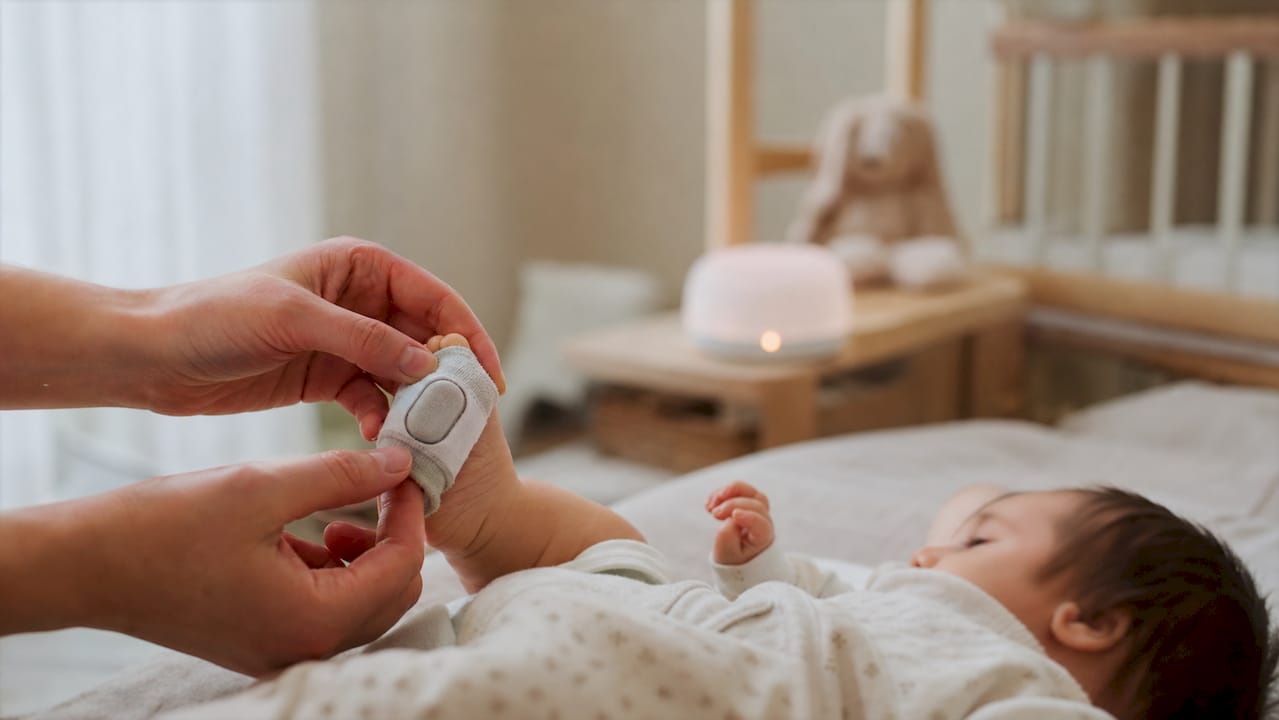
For most healthy infants, the Owlet Dream Sock is the best starting point for home monitoring. For clinically prescribed continuous monitoring, Masimo devices set the accuracy standard. Nonin Medical offers the most trusted clinical-grade fingertip option available without a prescription, and Wellue rounds out the shortlist as the most affordable entry for occasional spot checks.
Best for spot checks: Nonin or Wellue fingertip oximeters. Simple, portable, no subscription required.
Best for prescribed continuous monitoring: Masimo-based devices, used under clinician guidance for medically complex infants.
Best balance of ease and price: Owlet Dream Sock for parents who want overnight trend data with a consumer-friendly app.
Home pulse oximeters are monitoring aids, not diagnostic tools. Always consult your pediatrician before starting continuous overnight monitoring, and never adjust care based on a reading without clinical guidance. Devices with FDA clearance and peer-reviewed clinical evidence behind their signal processing offer the strongest safety foundation.
Table of Contents
What are the best infant pulse oximeters available in the U.S.?
Device | Best for | Sensor style | FDA clearance | Accuracy & motion resistance | Alarms / app | Price range | Age/size suitability |
Owlet Dream Sock | Overnight trend monitoring (consumer) | Sock/wrap sensor | FDA-cleared (BabySat is prescription; Dream Sock is consumer wellness) | Good in stable conditions; motion artifacts common | App alerts, audible alarm | — | 0–18 months, up to 30 lbs |
Owlet BabySat | Prescribed continuous monitoring | Sock/wrap sensor | FDA-cleared, prescription required | Higher clinical standard than Dream Sock | App + caregiver alerts | — | Newborn and infant sizes |
Masimo (MightySat / Rad-97) | Clinician-supervised or hospital-grade home use | Fingertip probe / cable sensor | FDA-cleared (medical-grade) | Masimo SET technology; strong motion resistance | Configurable alarms, clinical connectivity | — | Infant-specific probes available |
Nonin Medical (Model 2500) | Spot checks and clinical home use | Fingertip wrap probe | FDA-cleared, clinical-grade | High accuracy; validated in peer-reviewed studies | Audible alarm, simple display | — | Neonatal/infant probes available |
Wellue (FS20F) | Affordable spot checks | Fingertip clip | Consumer-grade | Acceptable for stable readings; motion-sensitive | Basic audible alarm | — | Infant-sized probe |
Owlet Dream Sock: The go-to for parents who want overnight trend visibility without a prescription. App connectivity is strong, but treat readings as wellness data, not clinical monitoring.
Owlet BabySat: The FDA-cleared, prescription version of Owlet’s platform. Intended for clinician-supervised use in infants who need documented SpO2 tracking.
Masimo: The benchmark for motion-resistant accuracy. Masimo SET signal processing is validated across clinical settings and used in NICUs worldwide. Requires clinical setup for infant-specific probes.
Nonin Medical: Nonin’s wrap-style infant probes have decades of peer-reviewed validation. The Model 2500 is a reliable spot-check device that pediatric nurses routinely use in home visits.
Wellue: Fits tight budgets for occasional checks. Not suitable for overnight or continuous monitoring in medically complex infants.
Mini reviews: which device fits your child’s situation?
Owlet Dream Sock
The Dream Sock uses a fabric sock sensor that wraps around the foot, measuring SpO2 and heart rate through a pulse oximetry chip embedded in the base unit. Setup takes under five minutes, and the companion app logs overnight trends you can share with your pediatrician.
Pros: Wireless, no adhesive probes, easy to reposition, good battery life (up to 16 hours per charge), low-light display on the base station.
Cons: Consumer wellness classification means it is not intended to diagnose or treat. Motion artifacts from a wriggling baby generate false alarms that can disrupt sleep for the whole family. Sock fit matters: a loose sock on a small newborn produces unreliable readings.
Parent usability note: The most common false-alarm driver is a shifted sock during active sleep. Checking the fit before bed reduces nighttime alerts significantly.
Owlet BabySat
BabySat uses the same sock form factor but carries FDA clearance as a medical device for clinician-prescribed monitoring. A prescription from your child’s physician is required. That distinction matters: it means the device has met regulatory safety and performance requirements for specified indications, and your clinician is part of the monitoring plan.
Pros: FDA-cleared, clinician-supervised workflow, app-based data logging suitable for clinical review.
Cons: Requires a prescription and clinician involvement. Higher cost than the consumer Dream Sock. Alarm burden remains a real issue even with clinical-grade devices if alarm thresholds are not calibrated to your child’s baseline.
Masimo infant monitoring solutions
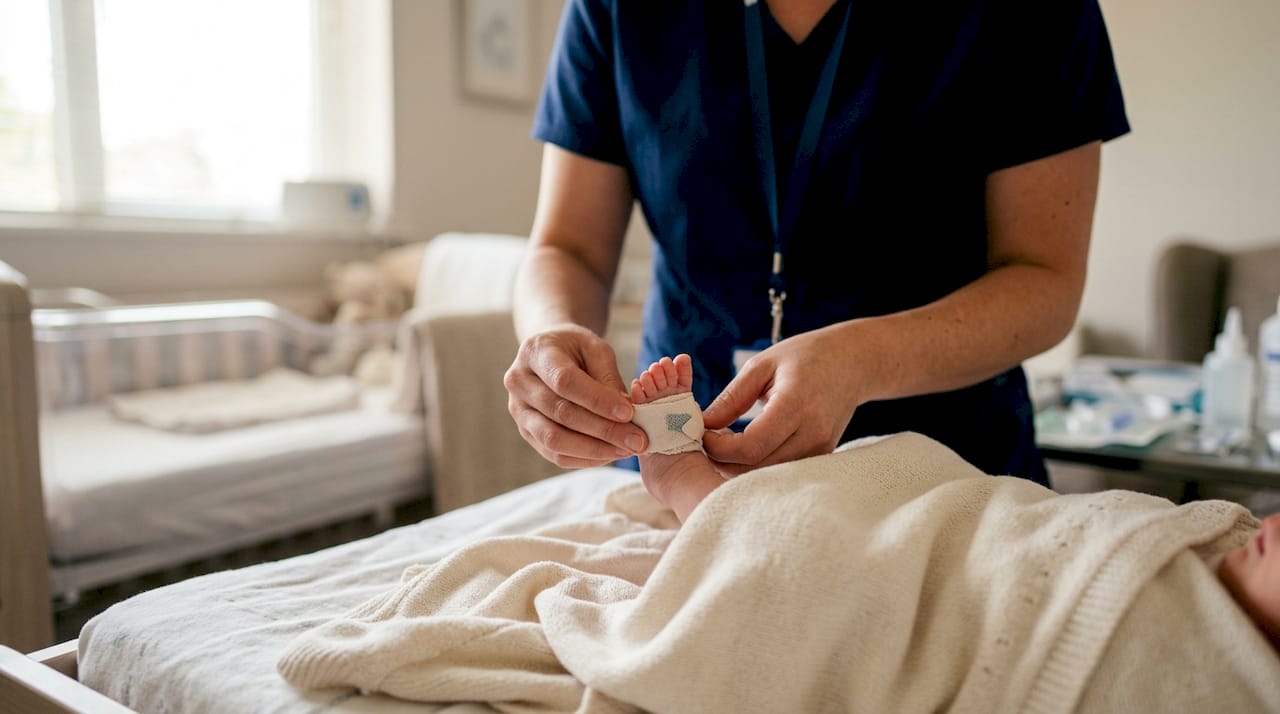
Masimo SET signal processing is the closest thing to a gold standard for motion-resistant SpO2 measurement outside a hospital. The technology distinguishes true arterial pulsation from motion noise, which is why it dominates NICUs. For home use, Masimo devices require infant-specific probes (disposable or reusable wrap-style) and typically involve a clinician or home nursing team for setup and alarm configuration.
Pros: Best-in-class motion resistance, configurable alarm thresholds, validated accuracy at lower saturations compared to consumer devices.
Cons: Higher cost, requires clinical involvement, probe replacement adds ongoing expense.
Parent usability note: Masimo is the right choice when your child’s care team has prescribed continuous monitoring and a skilled home nurse is part of the plan. It is not a device most parents should configure independently.
Nonin Medical (Model 2500)
Nonin has been building clinical oximeters since 1992, and the Model 2500 with infant wrap probes is a staple in pediatric home nursing. It is straightforward: no app, no Bluetooth, just a clear numeric display and an audible alarm. That simplicity is a feature, not a limitation.
Pros: Proven accuracy, durable, no connectivity dependencies, validated in peer-reviewed comparative studies.
Cons: No trend logging, no smartphone integration. Replacement wrap probes add cost over time.
Wellue (FS20F)
Wellue’s infant fingertip oximeter is the most affordable option on this list. For a healthy baby with a brief illness where a pediatrician asks you to check SpO2 at home, it does the job. For any child with a cardiac, pulmonary, or neurological condition, it is not adequate for continuous or overnight monitoring.
Pros: Low cost, compact, battery-powered.
Cons: Consumer-grade accuracy, no motion resistance, basic alarm only.
Pro Tip: Before buying any oximeter for a medically complex infant, ask your child’s physician whether a prescription device is appropriate. A consumer oximeter used in place of a prescribed clinical monitor is not a safe substitute.
How do you choose the right infant pulse oximeter?
Criteria checklist
Motion resistance: — Critical for active infants. Masimo SET and Nonin’s signal processing outperform basic consumer chips here.
Spot checks vs. continuous monitoring
Clinician-supervised monitoring with home nursing support is the right model for medically complex infants with tracheostomies, cardiac conditions, or neurological diagnoses. A trained nurse manages alarm response and probe placement, which is where in-home pediatric nursing makes a measurable difference.
Questions to ask your pediatrician
What is my child’s target SpO2 range, and what threshold should trigger a call or ER visit?
What alarm delay and averaging settings are appropriate for my child’s condition?
Is a prescription device required, and does our insurance or Medicaid cover it?
Who should receive alarm notifications if I cannot respond?
How often should we review the monitoring data together?
Pro Tip: Ask your clinician specifically about alarm delay settings. Research on NICU alarm thresholds shows that averaging and delay settings dramatically affect how often alarms fire. A setting that is right for one infant may be wrong for another.
What does the evidence say about accuracy and false alarms?
Consumer and clinical infant pulse oximeters generally correlate well with hospital-grade devices for heart rate and stable SpO2 readings. Accuracy drops meaningfully at lower oxygen saturations and under motion, which is exactly when accurate readings matter most.
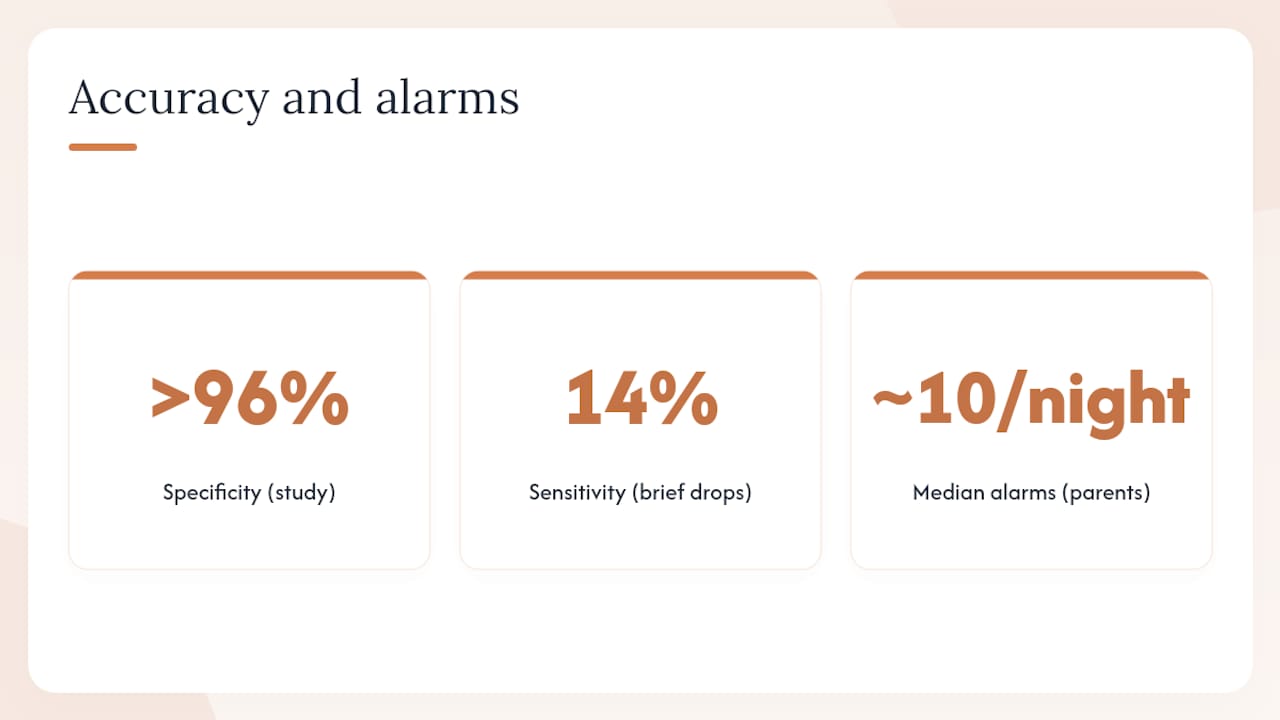
A 2025 study published in Archives of Disease in Childhood: Fetal & Neonatal Edition tested an over-the-counter smartphone-integrated infant oximeter in 66 infants. The device showed high specificity but low sensitivity for brief cardiorespiratory events: specificity exceeded 96%, but sensitivity for short SpO2 drops below 80% was only 14% using smoothed data. Sensitivity improved for longer events and higher SpO2 thresholds. That tradeoff is built into consumer devices by design: manufacturers reduce false positives by smoothing data, which means brief true events get filtered out.
“Home pulse oximeters are not substitutes for medical assessment. Overuse driven by false alarms causes caregiver anxiety and unnecessary healthcare use. Sensitivity for brief events is low in consumer devices, and parents should understand that a normal reading does not rule out a clinically significant event.” — ADC Fetal & Neonatal Edition, 2025
Parents in qualitative research report a median of roughly 10 alarms per night with some home monitors, driven by probe displacement, motion, and poor adhesion. That alarm burden leads families to adopt unsafe workarounds: turning off monitors, switching to less accurate devices, or stopping monitoring entirely. The clinical literature is clear that monitoring should be redesigned around family needs, with clinician-guided alarm thresholds and accessible support when alarms fire.
Pulse oximetry is an adjunct to clinical assessment, not a standalone diagnostic tool. A reading that looks normal on a consumer device does not mean your child is clinically stable. Conversely, a low reading from a poorly fitted probe on a moving baby is usually a motion artifact, not a true desaturation event. Context and clinical judgment are irreplaceable.
For families managing supplemental oxygen or acute hypoxemic conditions, clinical monitoring protocols provide the SpO2 targeting framework that should guide alarm settings.
Key Takeaways
The best infant pulse oximeter for your child depends on clinical need: consumer devices suit spot checks, while prescribed clinical-grade monitors with nursing support are the right choice for medically complex infants.
Point | Details |
Match device to clinical need | Consumer oximeters work for spot checks; prescribed FDA-cleared devices are required for continuous monitoring. |
False alarms are the biggest practical problem | Research shows that some home pulse oximeters generate a median of roughly 10 alarms per night, which clinician-guided alarm settings can help reduce. |
Sensitivity is low for brief events | A recent study found that an over-the-counter infant pulse oximeter had high specificity but low sensitivity for brief oxygen saturation drops, with sensitivity improving for longer events and higher thresholds. |
Alarm delay settings matter | Averaging and delay configurations dramatically affect alarm frequency; always set these with clinician input. |
Nursing support improves safety | For medically complex infants, a skilled home nurse managing probe placement and alarm response is safer than parent-only monitoring. |
What parents get wrong about choosing a baby monitor
The conversation around the best infant pulse oximeter almost always focuses on the device. Which brand? Which sensor? Which app? Those are real questions, but they are the second question, not the first.
The first question is: what is this monitor actually for? A healthy baby with a cold is a completely different situation from an infant with a tracheostomy or a congenital heart condition. Consumer devices are designed for the first scenario. They smooth data, reduce false positives, and present reassuring trend graphs. That is appropriate for wellness monitoring. It is not appropriate for a child whose SpO2 genuinely needs to be tracked within a narrow clinical range.
What the conventional advice underweights is alarm burden. Parents who have never used a home oximeter overnight do not anticipate what 10 alarms a night does to a family. The research is unambiguous: alarm fatigue leads to workarounds, and workarounds lead to gaps in monitoring. The device that looks best on a spec sheet is not the best device if the family turns it off by week two.
The overlooked priority is clinical integration. A device paired with a trained home nurse who knows your child’s baseline, understands the alarm settings, and can distinguish a true event from a probe displacement is categorically safer than any device used in isolation. For families in Georgia managing medically fragile children, Opulentprivatecare provides exactly that kind of continuity: skilled nurses matched to your child’s specific needs, with no rotating staff. The monitor is a tool. The nurse is the safety net.
Buy the right device for the right purpose. Then make sure someone qualified is part of the monitoring plan.
This article is general information, not medical advice. Confirm monitoring requirements and alarm settings with your child’s physician or a qualified pediatric clinician before starting home pulse oximetry.
Recommended
Comments