
GAPP Nursing in Georgia: How to Get Started


The Georgia Pediatric Program (GAPP) provides Medicaid-funded in-home skilled nursing and personal support services for medically fragile children under 21, at no cost to families. The Georgia Department of Community Health (DCH) administers the program, and your single fastest next step is to contact a state-approved GAPP nursing agency. The agency handles the prior authorization and paperwork on your behalf.
Your immediate options:
Contact a state-approved GAPP nursing agency directly to start the intake process.
Call the DCH GAPP program specialist if you have eligibility questions before choosing an agency.
Reach out to Opulentprivatecare for provider-assisted onboarding, including physician paperwork and prior authorization submission.
“GAPP is a Medicaid-funded program providing at-home skilled nursing and personal support services to medically fragile children under 21 at no cost to families. Eligibility requires active Georgia Medicaid, a physician-ordered plan of care, and medical necessity criteria.” — Georgia Pediatric Program (GAPP) Presentation, DCH
Table of Contents
What is the Georgia Pediatric Program (GAPP)?
GAPP is a Medicaid-funded in-home nursing program for children under 21 who are medically fragile and require skilled nursing or personal support at home. It is not a waiver program. It operates under standard Medicaid authority, which means eligible children receive covered services without a separate waiver slot or waiting list.
The Georgia Department of Community Health coordinates, administers, and provides quality assurance for the program. Alliant Health Solutions conducts medical review of prior authorization requests for fee-for-service Medicaid members, while children enrolled in a Care Management Organization (CMO) follow that CMO’s prior authorization process.
“No cost to the family” means Medicaid pays the approved GAPP nursing agency directly. There is no copay, no invoice to the family, and no private-pay balance for authorized services. The agency bills DCH or the CMO; you never see a bill. The catch is that services must be prior-authorized before they begin, and authorization is tied to medical necessity, not just diagnosis.
GAPP is distinct from Georgia’s waiver programs. Families do not need to be on a waiting list to access services, but active Georgia Medicaid enrollment is required before any application can move forward.
Who qualifies for GAPP and what documents you need
Three core requirements determine eligibility: the child must be under 21, must have active Georgia Medicaid (not pending, not applied-for), and must have a documented medical need for skilled nursing or personal care at home.

Medical necessity is the deciding factor, not diagnosis alone. A child with a complex diagnosis who is medically stable and does not require skilled nursing interventions at home will not qualify. A child who needs daily tracheostomy care, ventilator management, or enteral feeding support almost certainly will.
Documents you should prepare before contacting an agency
Active Georgia Medicaid ID (verify the card is current, not pending renewal).
Physician order or PPOT (Appendix Y, required since January 1, 2023), signed and dated by the attending or primary care physician within 30 days of the completed PPOT. A Letter of Medical Necessity (LOMN) may also be submitted.
Medical records or hospital discharge summary documenting the child’s condition and care needs.
Proof of Georgia residency (utility bill, lease, or similar).
Child’s birth certificate or Social Security number.
Parent or guardian government-issued photo ID.
Pro Tip: The physician order is the most common bottleneck in the entire GAPP application process. Ask your chosen agency to send the correct Appendix Y/PPOT form directly to your child’s doctor, along with guidance on the medical necessity language required for approval. Physicians who receive the right form with clear instructions sign it faster and with fewer errors.
What GAPP covers: skilled nursing and personal support services
GAPP covers skilled nursing, personal care support, and technology-dependent care when medically necessary, with no cost to families for authorized services. Every service requires a physician order and prior authorization; hours are set based on what the medical record supports, not what a family requests.
Skilled nursing services commonly authorized under GAPP include:
Tracheostomy care and airway management
Ventilator management and monitoring
Oxygen therapy and respiratory support
G-tube and NG-tube feeding support
IV and enteral medication administration
Seizure monitoring and management protocols
Wound care and dressing changes
Vital signs monitoring for cardiac or neurological conditions
Personal Support Services (PSS) are distinct from skilled nursing hours. PSS covers assistance with activities of daily living, bathing, dressing, mobility, and similar non-clinical tasks. A child’s authorized plan of care may include both skilled nursing hours and PSS hours, depending on what the physician orders and what Medicaid approves. Skilled nursing must be performed by a licensed nurse (RN or LPN); PSS can be delivered by a trained personal care aide.
The distinction between skilled nursing hours and PSS hours matters for scheduling. If your child needs both, your agency should reflect that split clearly in the plan of care, because the two service types are authorized and billed separately.
For families whose children depend on ventilators or other technology, GAPP’s technology-dependent care provisions are particularly relevant. These children typically qualify for higher authorized nursing hours because the clinical complexity demands continuous skilled oversight.
How do you apply for GAPP in Georgia?
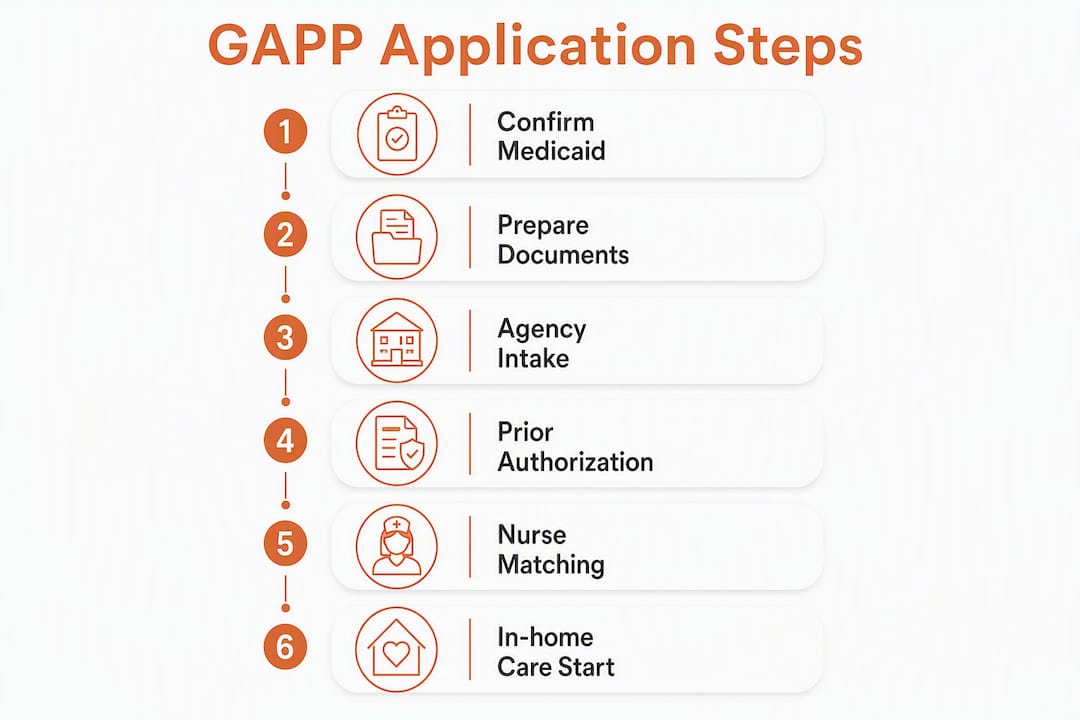
The application does not go directly to DCH or Medicaid. A state-approved GAPP nursing agency submits the prior authorization packet on your behalf. Here is the sequence, step by step.
Confirm active Georgia Medicaid. Log into Georgia Gateway or contact DFCS to verify current enrollment. Pending coverage does not qualify. If your child is not yet enrolled, address Medicaid eligibility first. The Katie Beckett deeming pathway may be an option for children who would not otherwise meet Medicaid income requirements.
Choose a state-approved GAPP nursing agency. The agency initiates the application and submits the prior authorization to Medicaid. If your child is being discharged from a hospital, the discharge planning or social work team can connect you with an agency directly.
Gather your documents and hand them to the agency. The agency needs the signed Appendix Y/PPOT, medical records, Medicaid ID, proof of residency, and parent/guardian ID. The more complete your packet, the faster the review.
Agency submits the prior authorization. Once a complete packet is submitted, Medicaid takes some time to review documents for approval, with PA review usually requiring a few weeks. CMO members follow their CMO’s PA process; fee-for-service members go through Alliant Health Solutions.
Respond quickly to any agency requests. Reviewers sometimes request additional records or clarification. Delays in responding extend the timeline.
The typical end-to-end timeline from first inquiry to first in-home nurse visit usually takes several weeks, depending on how complete the paperwork is and how quickly a matched nurse is available.
Pro Tip: Ask your agency for the exact date they submitted the prior authorization to Medicaid or the CMO. Write it down. That date is your reference point for following up if the review runs longer than expected.
What happens after GAPP approval?
Approval is not the finish line. It is the start of a structured intake process that leads to your child’s first nursing visit.
After prior authorization is approved, the agency schedules an in-home assessment and builds a personalized Plan of Care (PPOT) that reflects the authorized skilled nursing and PSS hours. This document drives everything that follows.
Intake assessment and plan of care
A nurse from the agency visits your home to assess the environment, review your child’s medical equipment, and confirm the care needs match what the physician ordered. The resulting plan of care specifies the authorized hours, shift structure, and clinical tasks the nurse will perform. You should review it carefully and ask questions before signing.
Nurse matching and family approval
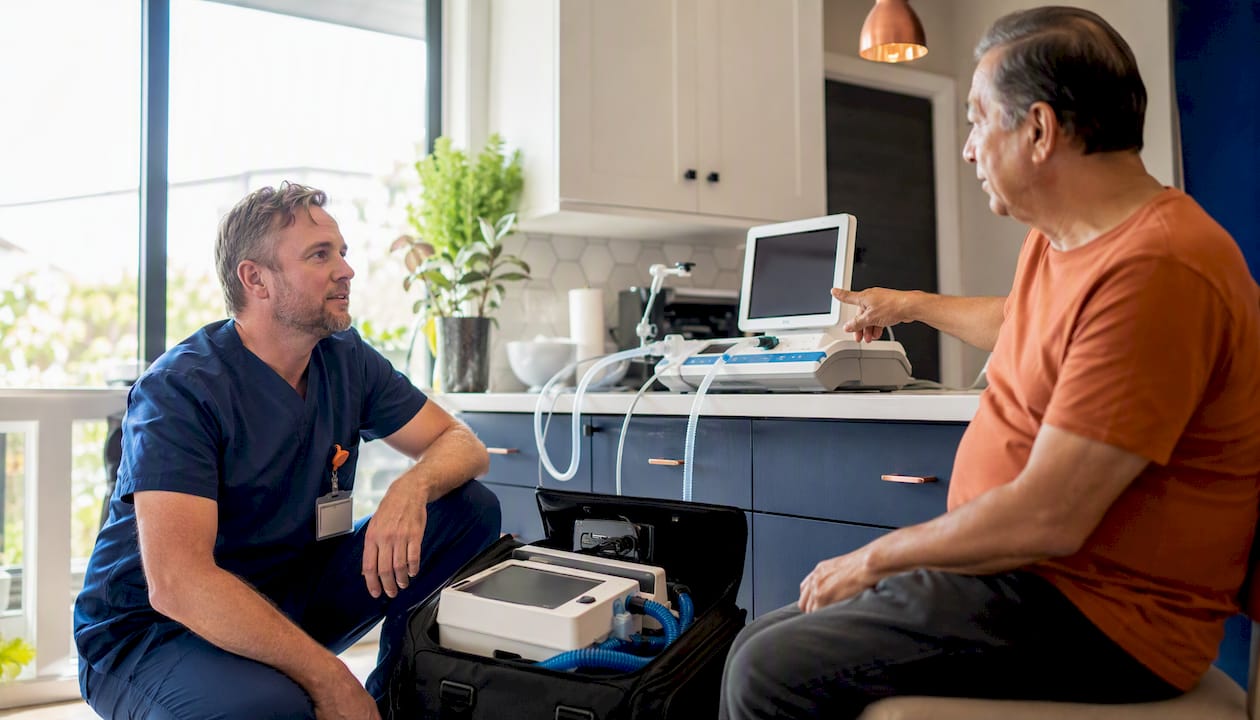
Good agencies do not simply assign whoever is available. They match nurses to the child’s clinical profile (trach care, ventilator, seizure protocols) and to the family’s schedule and communication style. At Opulentprivatecare, this process follows the “3 Thumbs Up Rule”: the family, the caregiver, and Opulentprivatecare must all approve the match before care begins. That three-way agreement reduces turnover and protects continuity.
Scheduling and shift coverage
Authorized hours are typically delivered in shifts, often 8 or 12 hours, depending on the child’s needs and the authorized plan. Families should ask agencies about their backfill policy: what happens when a scheduled nurse calls out. Nurse availability can be the limiting factor even after PA approval, particularly in rural counties, so asking about regional staffing depth before you commit to an agency is worth the conversation.
Ongoing reauthorizations
Authorization periods are not permanent. Providers must verify Medicaid eligibility month-to-month and follow CMO or fee-for-service PA routes depending on eligibility type. DMA-6A authorizations are valid for one year and must be renewed 30–60 days before expiration. Your agency should manage this calendar and alert you well in advance, but tracking renewal dates yourself is a reasonable safeguard.
What if a GAPP application is denied?
Denials happen, and most are fixable. The most common reasons are:
Insufficient physician order detail. The Appendix Y/PPOT lacks the specific medical necessity language reviewers need.
Incomplete prior authorization packet. Missing records, unsigned forms, or outdated medical documentation.
Medicaid ineligibility. Coverage lapsed, was pending, or the child does not meet income or residency criteria.
Insufficient medical necessity evidence. The clinical record does not clearly document the need for skilled nursing at home.
When you receive a denial, request the denial letter immediately. It will specify the reason. From there:
Have your child’s physician rewrite or expand the order with explicit medical necessity language. Agencies experienced with GAPP know exactly what phrasing Alliant’s reviewers look for.
Resubmit through the agency with the corrected documentation.
File a formal appeal per DCH guidelines if the denial is not resolved through resubmission. The denial letter will include appeal instructions and deadlines.
If Medicaid eligibility is the barrier, Katie Beckett deeming may open a path to enrollment for children who do not meet standard income requirements. Other Medicaid programs, hospice services, or waiver resources may also apply depending on the child’s situation. Some families pursue temporary private-pay care while an appeal runs, to avoid a gap in nursing coverage.
Keep copies of every document you submit and every date the agency files on your behalf. That paper trail is your strongest asset in an appeal.
How do you choose a state-approved GAPP nursing agency?
Not all approved agencies perform equally. The designation means they meet minimum state requirements; it does not guarantee responsiveness, staffing depth, or clinical competency in complex pediatric care.
What to look for
State-approved GAPP designation confirmed through DCH.
Documented experience with complex pediatric conditions: tracheostomy, ventilator management, feeding tubes, seizure protocols, and neurological care.
Published shift fill rates and nurse retention metrics. Agencies that track and share these numbers are telling you something meaningful about their reliability. Agencies that cannot answer the question are telling you something too.
Dedicated case management support so you have a named contact for PA questions, reauthorization, and scheduling issues.
Clear intake timeline. A good agency can tell you, within a reasonable range, how long their PA submission and nurse matching process typically takes.
Questions to ask at intake
How do you handle physician paperwork and Appendix Y/PPOT submission?
What are your typical PA turnaround and first-visit timelines?
What are your nurse retention and shift fill rates?
What is your backfill policy when a nurse calls out?
Do you have nurses currently available with experience in my child’s specific conditions?
Red flags
Refuses to submit prior authorizations or asks the family to handle it.
Cannot describe the PA process in specific terms.
Vague or evasive answers about staffing backfill.
No references and no published performance metrics.
For a deeper look at what clinical specialties to prioritize when evaluating nursing agencies, NurseFlex’s specialty overview breaks down the competencies that matter most in pediatric home care, including ventilator and tracheostomy nursing.
How Opulentprivatecare supports GAPP families
Opulentprivatecare is a state-approved GAPP provider offering in-home pediatric skilled nursing across Georgia, with a specific focus on medically complex children who need tracheostomy care, ventilator management, feeding tube support, seizure monitoring, and neurological care.
The agency handles the full intake process: completing and submitting the prior authorization packet, sending the correct Appendix Y/PPOT form directly to your child’s physician, coordinating medical records, and managing reauthorization renewals. Families do not navigate that paperwork alone.
Reliability Metric | What It Means for Your Family |
Published shift fill rates | Fewer missed shifts, more consistent daily coverage |
Nurse retention tracking | Same nurse over time, not a rotating roster |
3 Thumbs Up Rule | Family, caregiver, and Opulentprivatecare all approve the match before care starts |
Specialty clinical competencies | Nurses matched to your child’s specific conditions, not general pediatric experience |
Direct physician outreach | Agency sends the correct form to your doctor, reducing order delays |
The “3 Thumbs Up Rule” is worth understanding specifically. Before any nurse begins care, three parties must agree: the family approves the nurse, the nurse accepts the assignment, and Opulentprivatecare confirms the clinical fit. That structure exists because a nurse who is wrong for a family, even a clinically competent one, creates turnover. Turnover creates gaps. Gaps are what families in complex care situations cannot afford.
Opulentprivatecare publishes shift fill rates and nurse retention metrics so families can evaluate reliability before committing, not after a gap in care has already happened.
For families exploring how to secure the right skilled nursing hours under GAPP, Opulentprivatecare’s intake team can walk you through the process from the first call.
Key Takeaways
GAPP nursing in Georgia is a Medicaid-funded, no-cost in-home program for medically fragile children under 21, and the fastest path to care is choosing a state-approved agency that manages your prior authorization from day one.
Point | Details |
Confirm Medicaid first | Active Georgia Medicaid enrollment is required before any GAPP application can move forward. |
Agency submits the PA | You do not apply directly to DCH; a state-approved GAPP nursing agency files the prior authorization on your behalf. |
Plan for a 5–9 week end-to-end timeline from first inquiry to first nurse visit, with PA review typically taking 2–4 weeks. | |
Physician order is the bottleneck | Ask your agency to send the correct Appendix Y/PPOT form to your doctor with medical necessity language already included. |
Opulentprivatecare handles intake | Opulentprivatecare manages GAPP paperwork, physician outreach, PA submission, and nurse matching for complex pediatric conditions statewide. |
What families often miss about the GAPP process
Most of the delay families experience in GAPP enrollment comes down to one document: the physician order. Specifically, the Appendix Y/PPOT form with the right medical necessity language. Physicians are busy, and when a family hands them a blank form with no guidance, it often comes back incomplete or too vague for Alliant’s reviewers to approve. The fix is simple: let the agency send the form with the required language already templated. That one step alone can cut weeks off the timeline.
The second thing families underestimate is the importance of staying organized after submission. Keep a folder, physical or digital, with copies of everything: the signed PPOT, the medical records you submitted, the date the agency filed the PA, and any correspondence from the CMO or Alliant. If a denial comes or a reviewer requests additional records, you will know exactly what was submitted and when. That clarity makes appeals faster and less stressful.
Most families who come to the process with complete paperwork and a responsive agency move from first call to active nursing within a 5–9 week window. The process feels long when you are waiting, but it is predictable. Knowing the steps and tracking them actively puts you in control of the timeline rather than at the mercy of it.
Ready to start GAPP intake for your child?
Opulentprivatecare takes the paperwork burden off Georgia families from the first call. The intake team handles the Appendix Y/PPOT form, sends it directly to your child’s physician, assembles the prior authorization packet, and submits it to Medicaid or the CMO on your behalf. Nurse matching follows the 3 Thumbs Up Rule, so your family approves the caregiver before care ever begins, and the same nurse shows up consistently rather than a different face every shift.
Opulentprivatecare serves medically fragile children across Georgia, with clinical experience in tracheostomy, ventilator, feeding tube, seizure, cardiac, and neurological care. If your child needs in-home skilled nursing under GAPP, start your intake with Opulentprivatecare today and get a clear picture of next steps within one conversation.
Official sources and helpful contacts
Georgia Pediatric Program (GAPP) Official Presentation, DCH/MMIS — program policy, forms, Appendix Y/PPOT requirements, and PA process details.
GAPP Program Page, PAMMS/DHS — medical necessity criteria and eligibility guidance.
Georgia Pediatric Program, Medicaid.gov — federal program record and waiver history.
Georgia Pediatric In-Home Nursing, Opulentprivatecare — provider services, intake process, and performance metrics.
How to Get the Skilled Nursing Hours Your Child Deserves — practical guide to securing authorized hours under GAPP.
Assistance with Applying for Medicaid: 2026 Guide — for families who need help establishing Medicaid eligibility before applying for GAPP.
NurseFlex Agency Reviews — third-party agency listings and reviews to help families compare GAPP nursing providers.
This article provides general information about the Georgia Pediatric Program and is not a substitute for professional legal, medical, or Medicaid eligibility advice. Confirm current program rules and your child’s eligibility with DCH, your CMO, or a qualified GAPP provider.
Recommended
Comments