
G Tube vs J Tube: What Caregivers Need to Know

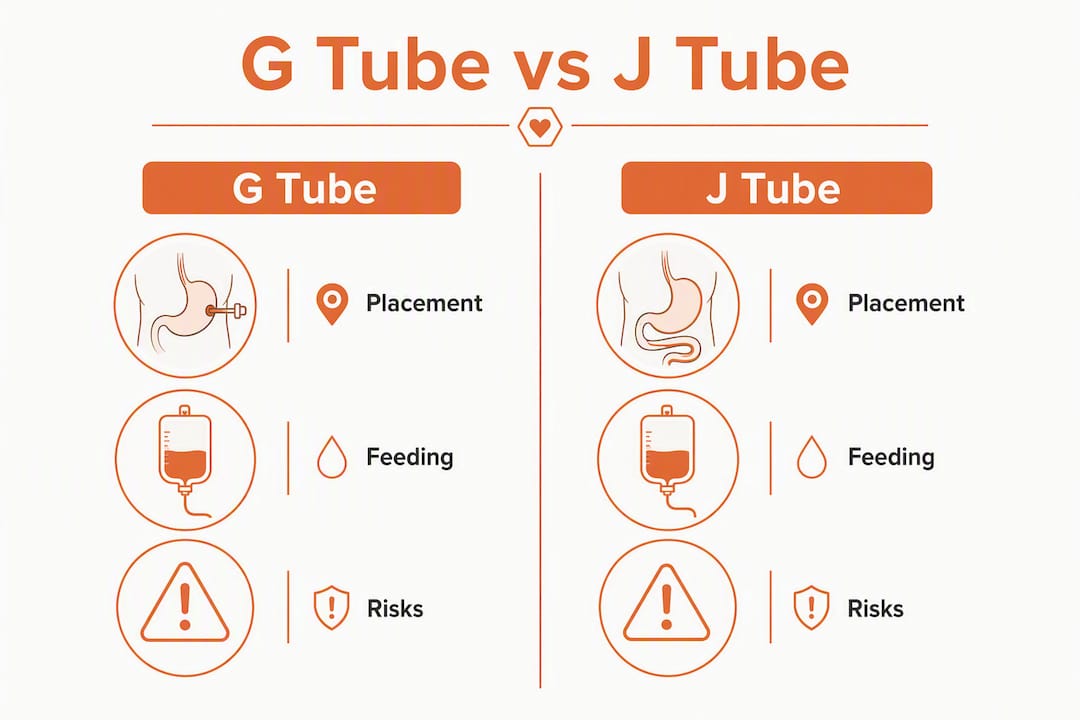
A G-tube is the first choice when a child’s stomach can safely tolerate feeds. A J-tube is used when it cannot. That single clinical distinction drives nearly every other difference between the two: where feeds land in the body, how they must be delivered, how the tube gets replaced, and what complications to watch for at home.
The three differences that matter most to caregivers day-to-day:
Anatomical target: A G-tube delivers nutrition directly into the stomach; a J-tube bypasses the stomach entirely and delivers into the jejunum, the upper section of the small intestine.
Feeding method: G-tubes can often be used for bolus feeds (a set volume over a short time), while J-tubes require continuous pump delivery because the small intestine cannot handle large volumes at once.
Replacement complexity: Once a G-tube tract matures, some families can replace it at home or in clinic. J-tubes and GJ-tubes almost always require image-guided replacement at a hospital.
Clinical sources including St. Jude Children’s Research Hospital, Cleveland Clinic, and peer-reviewed NCBI reviews consistently support this framework. For Georgia families managing these decisions at home, Opulentprivatecare provides in-home pediatric nursing specifically for children with feeding tubes.
Table of Contents
What are G-tubes, J-tubes, GJ-tubes, PEGs, and NG tubes?
Understanding where each tube sits in the body makes every other decision clearer.
Gastrostomy (G) tube
A G-tube is a small flexible tube inserted through the abdominal wall directly into the stomach. It delivers nutrition, fluids, and medication to the stomach, which then handles digestion the way it normally would. Because it accesses the stomach, a G-tube can also be used to vent trapped gas or drain stomach contents when a child is uncomfortable or nauseated. That venting function is one of its most practical advantages for caregivers managing bloating at home.
Jejunostomy (J) tube
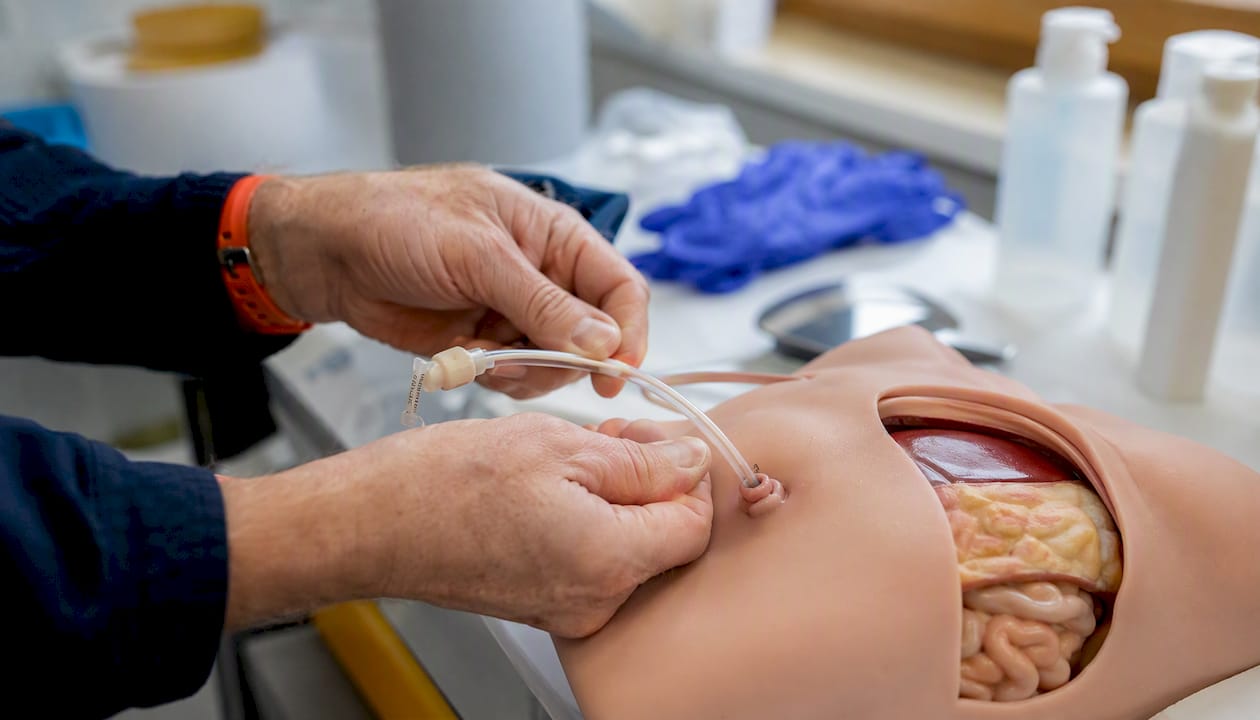
A J-tube is placed through the abdominal wall and threaded past the stomach and pylorus into the jejunum, the first section of the small intestine. Feeds delivered here bypass the stomach entirely, which is the whole point when the stomach is not functioning well. Because the jejunum has no reservoir capacity, feeds must go in slowly and continuously. J-tubes cannot vent stomach gas.
Gastrojejunostomy (GJ) tube
A GJ-tube is a single tube that enters through the stomach but has two ports: one that opens into the stomach (for venting or gastric feeds) and one that extends into the jejunum (for jejunal feeds). It is a hybrid device. The gastric port lets caregivers vent the stomach while simultaneously feeding into the small intestine, which is why it is often preferred over a standalone J-tube in pediatric patients who need jejunal feeds but also benefit from gastric decompression.
Percutaneous endoscopic gastrostomy (PEG)
PEG is a placement method, not a separate tube type. It describes how a G-tube is inserted: an endoscope guides the procedure from inside the stomach while the surgeon makes a small incision through the abdominal wall. The term “PEG tube” is often used loosely to mean any G-tube, but technically it refers to the endoscopic placement technique.
Nasogastric (NG) tube
An NG tube is a thin flexible tube passed through the nose, down the throat, and into the stomach. It is a short-term option, typically used while a child is hospitalized or during a brief illness. NG tubes are not designed for permanent home use and do not require surgery, but they carry risks of nasal irritation, accidental removal, and aspiration if displaced.
A simple labeled diagram showing the stomach, pylorus, and jejunum with tube entry points would help caregivers visualize these differences. Pediatric hospital resources from Children’s National or St. Jude often include printable versions worth requesting at your next clinic visit.
When do clinicians choose a G-tube versus a J-tube?
The decision comes down to one core question: can the stomach safely receive and process feeds?
Common reasons a G-tube is chosen
The child cannot take enough nutrition by mouth but the stomach functions normally
Long-term enteral feeding is needed and gastric tolerance is confirmed
The care team wants the option to vent the stomach for gas or nausea relief
The child needs a reliable route for liquid medications
Bolus feeding is preferred or clinically appropriate for the child’s schedule
Common reasons a J-tube is chosen
Severe gastroesophageal reflux with documented aspiration risk
Delayed gastric emptying (gastroparesis) that does not respond to medication
Prior gastric surgery that limits stomach function
Recurrent vomiting or retching that makes gastric feeds unsafe
A nonfunctional or surgically altered stomach
A child with severe reflux who aspirates feeds into the lungs is the clearest case for bypassing the stomach. A child with a neurological condition who simply cannot coordinate swallowing but has a normal stomach is a strong G-tube candidate.
The staged approach: G-tube first, then GJ
Pediatric teams commonly place a G-tube first and then convert to a GJ-tube after the stoma tract matures, typically around 6–8 weeks post-placement. This staged approach gives the team time to assess gastric tolerance before committing to jejunal feeding. If the child tolerates gastric feeds well, the G-tube stays. If intolerance persists, the G-tube is exchanged for a GJ-tube through the same stoma site. Direct primary GJ placement is reserved for children who clearly cannot tolerate any gastric feeding from the start.
J-tubes are intended for long-term use, often for at least six weeks and sometimes indefinitely, so the decision to place one is not taken lightly.
What to expect before, during, and after tube placement
Placement is a planned procedure, and knowing the timeline reduces a lot of anxiety.
Before the procedure
The care team will order baseline labs and review any medications that need to be held beforehand. Most children fast for several hours before placement, with the exact window depending on age and the type of anesthesia planned. Caregivers typically attend a pre-procedure education session covering stoma care basics, what the tube looks like, and what to expect in the first 24 hours. Consent forms cover the specific placement method and its risks.
During the procedure
Three main placement approaches exist: endoscopic (PEG), surgical, and image-guided radiologic placement. The table below compares them.
Placement Method | How It Works | Anesthesia | Typical Recovery |
Endoscopic (PEG) | Endoscope guides tube through abdominal wall into stomach | General or sedation | 1–2 days hospital; feeds often start within 24 hours |
Surgical gastrostomy | Open or laparoscopic; used when endoscopy is not possible | General | 2–4 days hospital; feeds start after bowel sounds return |
Image-guided (fluoroscopy) | Radiologist places tube under X-ray guidance; required for GJ/J placement | Sedation or general | 1–2 days; continuous feeds begin once position is confirmed |
GJ and J-tube placements use fluoroscopy to confirm the tip sits correctly in the jejunum. Getting that position right matters: a tube tip in the wrong place can cause obstruction or poor feed absorption.
After the procedure
The stoma site will be tender and may have some drainage for the first few days. Feeds typically begin within 24 hours for G-tubes placed endoscopically, though the timeline varies by method and the child’s overall condition. Before discharge, families receive hands-on training on stoma cleaning, feeding technique, and what to do if the tube is accidentally pulled out. Follow-up is usually scheduled within one to two weeks.
How feeding and medication administration differ between G and J tubes
This is where daily caregiver life diverges most sharply between the two tube types.
Bolus vs. continuous feeds
A G-tube allows bolus feeding: a measured volume of formula delivered over 15–30 minutes using a syringe or gravity bag, several times a day. This mirrors a normal meal pattern and gives caregivers flexibility. Some children do well with overnight pump feeds through a G-tube as well, but the bolus option exists.
J-tube feeding works differently. The jejunum has no storage capacity, so large volumes delivered quickly cause cramping, diarrhea, and dumping syndrome. Jejunal feeds must run continuously via pump, usually over 16–24 hours per day. Caregivers should plan for portable pump options so the child can move around during feeds. Pump alarms, battery management, and tubing changes become part of the daily routine with J-tube feeding, differing from bolus G-tube feeding routines.
Medication administration
Medications through a G-tube are generally straightforward: liquid formulations work best, and the stomach handles absorption as it normally would. Through a J-tube, the picture is more complicated. Some medications depend on the acidic stomach environment to activate or absorb properly. Others, like extended-release tablets, are designed to dissolve slowly in the stomach and should never be crushed and pushed into the jejunum. Jejunal medication delivery requires pharmacy review for every drug on the child’s list. Ask the pharmacist specifically whether each medication can be safely given beyond the pylorus, and whether a liquid alternative exists.
Flushing and clog prevention
Both tube types need regular flushing with water before and after feeds and medications. J-tubes clog more easily because of their smaller diameter and the continuous-feed setup. Warm water flushes work for minor clogs; some teams recommend a small amount of carbonated water or a pharmacy-approved enzyme solution for stubborn blockages. Never use a wire or sharp object to clear a clog. If a clog does not clear with gentle flushing, call the care team before the next scheduled feed.
What complications should you watch for with each tube type?
Both tube types carry risks. The profiles are different, and knowing which to watch for helps caregivers catch problems early.
Shared risks (both G and J tubes)
Stoma site infection is the most common complication for both tube types. Signs include redness spreading beyond the stoma edge, warmth, increasing discharge, or a foul smell. A small amount of clear or slightly yellow drainage in the first weeks is normal; pus is not.
Leakage around the tube can happen when the tube shifts or the stoma widens. A small amount of moisture is expected; soaking through dressings or skin breakdown from chronic leakage needs prompt attention.
Granulation tissue (small, red, moist bumps around the stoma) is common in pediatric patients and usually responds to silver nitrate treatment applied by the care team.
Risks more specific to J-tubes
Clinical reviews document higher rates of bowel obstruction, abdominal distension, intussusception, and non-routine replacements with jejunostomy tubes compared to gastrostomy tubes. Intussusception, where a section of bowel folds into itself, is a serious complication that can occur when a J-tube migrates. Migration happens when the tube tip moves out of the correct jejunal position, either pulling back into the stomach or advancing further into the bowel.
Complication | More Common With | Why |
Stoma infection | Both | Skin-tube interface; moisture and bacteria |
Granulation tissue | Both (especially pediatric) | Body’s response to foreign material |
Tube migration | J-tube / GJ-tube | Longer tube path through bowel; peristalsis moves it |
Bowel obstruction | J-tube | Tube tip or balloon can obstruct intestinal lumen |
Intussusception | J-tube | Tube acts as lead point for bowel telescoping |
Leakage / skin breakdown | Both | Stoma widening, tube movement |
Clogging | J-tube (higher risk) | Smaller diameter; continuous feeds; medication residue |
Emergency warning signs
Act immediately if you see any of these:
Fever above 101°F with redness or swelling at the stoma site
Sudden abdominal distension or a visibly bloated, rigid belly
Vomiting or retching that is new or significantly worse than baseline
Blood at the stoma or blood in tube output
Tube has come out completely and the stoma is less than a few months old
No output from the tube when feeds are running, combined with abdominal pain
How do you care for a feeding tube at home?
Consistent daily care prevents most complications. Here is what that looks like in practice.
Routine stoma care: step by step
Wash your hands thoroughly with soap and water before touching the tube or stoma site.
Gently clean around the stoma with warm water and mild soap using a soft cloth or gauze. Move in a circular motion from the tube outward.
Rinse thoroughly and pat dry. Moisture left under the tube disc causes skin breakdown faster than almost anything else.
Check the stoma for redness, swelling, discharge, or granulation tissue. Note any changes from the day before.
If a dressing is used, apply a clean one after the site is fully dry. Many pediatric teams recommend leaving the site open to air once it has healed.
Check the tube’s external bumper or disc position. It should sit snugly but not so tight that it digs into the skin. A gap of about the width of a finger is a common guideline, though your care team will specify the exact measurement for your child’s tube.
Rotate the tube gently (if your care team has instructed this) to prevent the internal bumper from adhering to the stomach wall.
Flush the tube with the prescribed volume of water before and after each feed and medication.
Do and don’t checklist
Do keep the stoma site dry between cleanings.
Do tape the tube to the skin to prevent accidental pulling, using a method your nurse demonstrates.
Do check tube position before every feed by confirming the external length marking matches the baseline.
Don’t submerge the stoma in a bath until the care team clears it (usually after the tract is fully healed).
Don’t use hydrogen peroxide or iodine on the stoma unless specifically instructed.
Don’t attempt to replace a J-tube or GJ-tube at home. Image-guided replacement is required to confirm correct jejunal tip placement.
If the tube comes out
For a G-tube: cover the stoma with a clean cloth and go to the emergency room or call your care team immediately. If the tract is mature and you have a spare balloon tube, your nurse may have trained you to reinsert it temporarily to keep the stoma open. Never attempt this without prior training and explicit instructions from your team.
For a J-tube or GJ-tube: do not attempt reinsertion. Cover the site, call your care team or interventional radiology line, and go to the hospital. The stoma can close within hours in younger children.
Who to call first: your home nursing agency, then the pediatric surgery or GI clinic line, then the hospital’s interventional radiology department if the tube requires imaging for replacement. Have the tube’s brand name, size (French gauge), and balloon volume written down and kept with your emergency contacts. For Georgia families, Opulentprivatecare’s nursing team can help coordinate that call sequence and be on-site during urgent situations.
For a comprehensive guide to feeding tube care for children, Opulentprivatecare has published a parent-focused resource covering stoma care, unclogging, and daily feeding routines.
How do medical teams decide between a G-tube and a J-tube?
The decision is rarely made in a single appointment. It usually follows a clinical workup that looks at several factors together.
Aspiration risk is the most urgent driver. If a child is aspirating gastric contents into the lungs, bypassing the stomach is a priority. The team will typically review imaging, pH probe studies, or a swallowing evaluation before making this call.
Gastric emptying is assessed through a gastric emptying scan or clinical observation. A stomach that empties slowly is a strong argument for jejunal feeding, because feeds sitting in the stomach for too long increase reflux and aspiration risk.
Prior abdominal surgery matters because adhesions or altered anatomy can make certain placement methods safer than others and may affect how the tube sits long-term.
Respiratory status is closely tied to aspiration risk. A child already on supplemental oxygen or a ventilator has less reserve to handle aspiration events, which raises the threshold for choosing jejunal access.
Tolerance of bolus feeds is sometimes tested before a permanent decision is made. A child who tolerates small bolus feeds through an NG tube may be a reasonable G-tube candidate; one who vomits every bolus is not.
The staged conversion timeline
The typical path in pediatric care is G-tube placement first, then reassessment. If the child tolerates gastric feeds, the G-tube stays. If intolerance persists after a few weeks of trialing, the team converts to a GJ-tube through the existing stoma once the tract has matured. This avoids a second surgical procedure and uses the same abdominal site. Primary GJ placement, skipping the G-tube stage entirely, is used when the clinical picture makes it clear from the start that gastric feeding will not be safe.
Questions to bring to the care team
Ask the team to walk you through the specific reason they are recommending one tube over the other for your child, not just the general indications. Ask what the plan is if the first tube type does not work out, and what the conversion process would look like. Ask how tube replacement will be handled once the tract matures, who performs it, and what the expected frequency is. Ask the pharmacist to review every medication on your child’s list for jejunal compatibility before placement if a J-tube is being considered.
Nursing insights that clinicians don’t always say out loud
The clinical team explains the procedure. What they sometimes skip is what the first few months actually feel like.
Skin breakdown around the stoma is the complaint families report most often, and it almost always traces back to moisture. Keeping the site dry is not just a hygiene step; it is the single most effective thing caregivers can do to prevent granulation tissue and infection. A small piece of split gauze under the tube disc, changed when damp, makes a noticeable difference.
Clogging tends to happen at predictable moments: after a medication flush that was not thorough, after a feed that ran dry and left formula residue, or when a pump alarm was silenced and the tube sat idle for too long. Building a 10-second flush check into the end of every feed and every medication pass catches most clogs before they set.
Families consistently report that initial adjustment is hard but manageable with consistent support. The learning curve for tube care is steep in the first two to four weeks and then flattens quickly. Most caregivers reach a point where the daily routine takes less than 15 minutes. Getting there faster usually depends on having a nurse who can answer questions in real time at home, not just at clinic appointments.
For broader context on supporting a child with complex medical needs, Opulentprivatecare’s guide on pediatric caregiver responsibilities covers what skilled home nursing looks like in practice.
Pro Tip: Keep a small laminated card taped to the pump or feeding bag with your child’s tube size, balloon volume, and the after-hours number for your care team. In an urgent situation, that card saves critical minutes.
Key Takeaways
A G-tube is the standard first choice for children who can tolerate gastric feeds; a J-tube is reserved for those who cannot, and the feeding method, replacement logistics, and complication profile differ substantially between the two.
Point | Details |
G-tube is the default starting point | Clinicians prefer G-tubes when the stomach tolerates feeds; J-tubes are chosen when it does not. |
Feeding method drives daily life | G-tubes allow bolus feeds; J-tubes require continuous pump delivery, which affects the child’s schedule and mobility. |
Replacement complexity differs | G-tube replacement can sometimes be done at home or in clinic; J-tube and GJ-tube replacement requires image-guided hospital procedures. |
Staged conversion is common | Most pediatric teams place a G-tube first and convert to a GJ-tube after the tract matures at roughly 6–8 weeks if gastric intolerance persists. |
Opulentprivatecare supports Georgia families | Opulentprivatecare provides in-home pediatric skilled nursing for children with G-tubes and J-tubes in Georgia, including Medicaid/GAPP assistance and continuity-focused nurse matching. |
A perspective on what home care actually requires
Most of the conversation around G-tubes and J-tubes focuses on the procedure itself. What gets less attention is what happens after discharge, when the family is home, the nurse has left, and a pump alarm goes off at 2 AM.
The families who navigate this best are not necessarily the ones with the most medical background. They are the ones who had consistent, knowledgeable support in the first weeks at home. A nurse who shows up reliably, knows the child’s specific tube and formula, and can troubleshoot a clog or a stoma flare without sending the family to the ER is worth more than any amount of written instruction.
There is also a piece of this that clinical guides understate: the emotional weight of managing a feeding tube for a child is real and cumulative. Caregivers who feel confident in their skills carry that weight differently than those who feel like they are guessing every day. Confidence comes from repetition with good coaching, not from reading a discharge packet once.
Opulentprivatecare’s approach to this is built around continuity. The 3 Thumbs Up Rule requires that the family, the assigned nurse, and Opulentprivatecare all agree on the match before care begins. That is not a formality. It is how you prevent the rotating-nurse problem that leaves families re-explaining their child’s tube setup to a different face every week. Nurse retention metrics are published, not just promised. For children managing tracheostomies alongside feeding tubes, that continuity is not a preference; it is a clinical necessity.
Georgia families: in-home pediatric nursing for feeding tube care
Children with G-tubes and J-tubes need more than a good placement procedure. They need skilled nursing support at home, where most of the actual care happens.
Opulentprivatecare provides statewide in-home pediatric skilled nursing in Georgia for medically fragile children, including those with G-tubes, J-tubes, tracheostomies, ventilators, and neurological conditions. Every family goes through the 3 Thumbs Up matching process so the assigned nurse is a genuine clinical and personal fit, not whoever was available that week.
Services include:
Skilled nursing for feeding tube management, stoma care, and pump troubleshooting
Medicaid and GAPP program paperwork assistance for eligible Georgia families
Nurse matching based on your child’s specific clinical needs
Published shift fill rates and nurse retention metrics so you know what reliability actually looks like
To start the intake process or ask whether your child qualifies, visit Opulentprivatecare and reach out directly. The first step is a conversation, not a commitment.
Authoritative sources and further reading
The clinical information in this article draws from the following U.S.-focused sources. Save or print this list to share with your child’s care team.
St. Jude Children’s Research Hospital: Feeding Tube Placement (G, GJ, J Tubes) — covers placement methods, pre-op preparation, and post-procedure expectations in detail.
Cleveland Clinic: J-Tube (Jejunostomy) — explains J-tube indications, placement, medication considerations, and long-term use.
Children’s National: GJ-Tube Placement — covers the staged G-to-GJ conversion process and image-guided replacement requirements.
NCBI: Complications and Outcomes in Enteral Feeding — peer-reviewed review of complication rates, including bowel obstruction and intussusception risks specific to jejunostomy tubes.
AboutKidsHealth: Making the Decision to Get a Feeding Tube — family-facing resource on feeding method differences, pump use, and family adjustment.
Children’s Hospital of Philadelphia: Primary Feeding Tube Conversion — practical guidance on tube types, low-profile buttons, and conversion procedures.
DC DDS: Functions and Interventions for G-Tubes and J-Tubes — a caregiver-focused reference covering daily care functions and nursing interventions.
A note on insurance and home nursing authorization in Georgia: Families pursuing in-home skilled nursing for a child with a feeding tube typically need a Medicaid authorization or GAPP approval before services begin. The process involves physician orders, a care plan, and payor review. Opulentprivatecare assists Georgia families with this paperwork as part of the intake process. For families outside Georgia, your state’s Medicaid office or a pediatric care coordinator at your child’s hospital is the right starting point.
Print this sources section and bring it to your next clinic visit. Having the source names on hand makes it easier to ask your care team specific questions based on what you have read.
Recommended
Comments