
How to Fix a Clogged G-Tube: Safe Steps for Caregivers

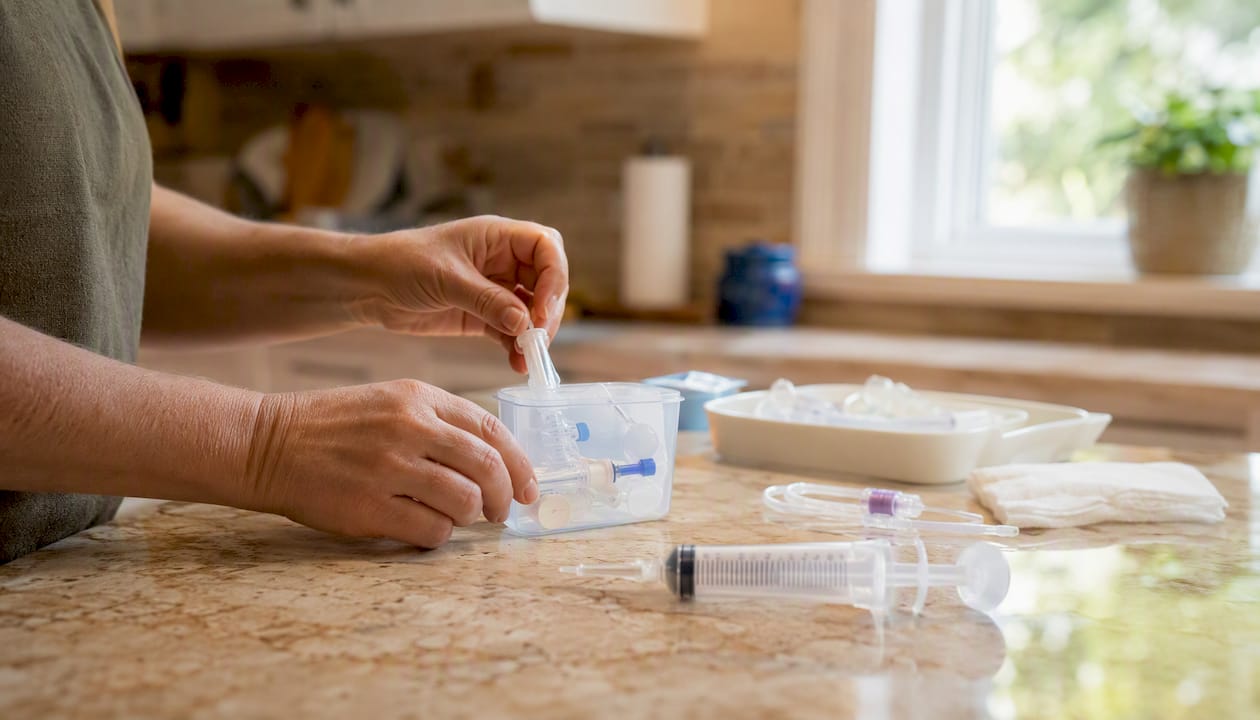
The safest first move when a G-tube clogs is a gentle warm-water flush using a 30–60 mL syringe with a slow push–pull motion. That single step clears the majority of blockages at home. Before you try anything else, though, run through three quick checks: confirm the tube is not clamped or kinked; look at the external adaptor for visible debris; and inspect the skin around the stoma for any redness or bleeding.
Is the clamp open? Check it first, every time.
Is the tube kinked near the stoma or under clothing?
Is the adaptor or extension set the actual blockage point?
Is the skin around the stoma intact, or do you see drainage, swelling, or granulation tissue?
If all four checks pass and there are no emergency signs, you are ready to attempt a home g tube clog fix.
Key Takeaways
Warm-water push–pull flushing with a 30–60 mL syringe is the safest first-line home method for a clogged G-tube; stop after two or three attempts and call your feeding team if it does not clear.
Point | Details |
First-line method | Use a 30–60 mL syringe with lukewarm water and a gentle push–pull motion; allow 5–20 minute soak cycles. |
Syringe size matters | Syringes smaller than 30 mL generate dangerous pressure; always use a 30 mL or 60 mL syringe for flushing. |
When to stop | Call your clinic or go to the ER for dislodgement, bleeding, severe pain, fever, or failure after two or three attempts. |
Prevention priority | Flush 30–60 mL before and after every bolus feed and every 4–8 hours during continuous feeds; use liquid medications when possible. |
Opulentprivatecare | Provides in-home pediatric G-tube nursing and caregiver training across Georgia, with Medicaid/GAPP enrollment support. |
Table of Contents
What supplies do you need before you start?
Gather everything before you touch the tube. Stopping mid-attempt to hunt for a syringe adds stress and increases the chance of a mistake.
Essential supplies:
One 30–60 mL ENFit, catheter-tip, or large slip-tip syringe (never smaller)
Lukewarm sterile water or tap water, per your provider’s instructions
Clean gloves
A clean towel or absorbent pad
A clock or phone timer
Your feeding team’s phone number within reach
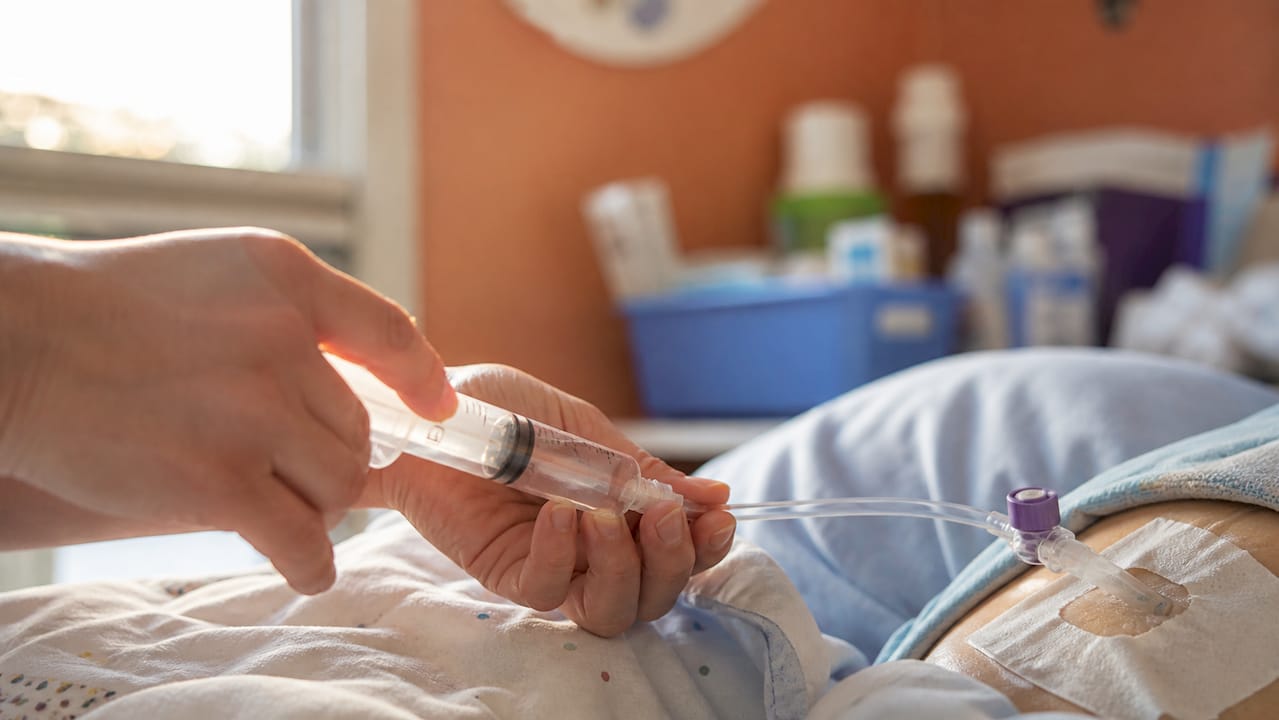
The syringe size is not a minor detail. Device instructions advise using 30 mL or 60 mL syringes for flushing because smaller syringes (1–10 mL) generate far higher internal pressure per push. That pressure can crack tubing, damage the tube’s internal valve, or injure tissue. A 60 mL syringe with a gentle hand is the right tool.
Pro Tip: Label a small zip-lock bag or plastic bin as your “unclog kit” and keep it stocked at all times. Include a spare syringe, a printed copy of your provider’s flush instructions, and the clinic’s after-hours number. When a clog happens, you will not be scrambling.
Step-by-step first-line home method: warm-water flush
Patient handouts consistently recommend a 60 mL syringe with lukewarm water and a gentle push–pull motion as the first-line home approach. Here is how to do it safely.
Wash your hands and put on gloves. Lay a clean towel under the tube connection.
Aspirate first. Attach the syringe to the tube and gently pull back the plunger to remove any residual gastric contents. Discard the collected fluid.
Draw 30–60 mL of lukewarm water into the syringe. The water should feel warm on your wrist, not hot. Hot water can damage the tube.
Attach the syringe securely to the tube port or adaptor. Do not force it.
Use the push–pull technique. Push a small amount of water in slowly, then gently pull back. Repeat this back-and-forth motion patiently. You are trying to loosen the blockage, not blast through it.
Allow a soak. If water does not flow freely, clamp the tube (with water inside), set a timer for 5–20 minutes, and let the water soften the material. Then try the push–pull again.
Massage the tube gently along its length while the water soaks. This can help break up formula residue or medication deposits.
Check the adaptor separately. If your tube has a removable adaptor or extension set, detach it and flush it on its own. The blockage is often there, not inside the tube itself.
Repeat up to two or three cycles total. If the tube remains blocked after three careful attempts, stop.
Pro Tip: Set a phone timer for each soak cycle. Caregivers who skip the soak and keep pushing often give up too soon. Five minutes of patience does more than five minutes of force.
University of Virginia enteral nutrition guidance supports warm-water flushing as the first-line method and notes that mechanical declogging devices such as the Bard brush, Bionix declogger, or TubeClear exist but are hospital-use or clinician-directed tools. Do not attempt those at home unless your team has trained you specifically.
When does a clinician prescribe enzymatic treatment?
If warm-water flushing does not work, your provider may authorize a second-line option: a pancrelipase (pancreatic enzyme) product such as Viokase mixed with sodium bicarbonate. This combination works because pancreatic enzymes break down the protein and fat components in enteral formula, which are the main culprits in stubborn clogs.
What you need for the enzymatic method:
A clinician’s prescription and explicit written instructions
Pancrelipase powder or crushed tablet (brand examples: Viokase, Creon, or equivalent)
Sodium bicarbonate solution (your provider will specify the concentration)
An appropriately sized syringe
Gloves and a timer
Pediatric guidance describes the two-step approach: try warm-water pulsatile flushing first; if unsuccessful and the provider has prescribed it, instill the enzyme-bicarbonate solution, clamp the tube, and allow it to soak for 20–60 minutes before attempting to flush again.
Key cautions:
Never attempt this method without a prescription. Enzyme products are medications.
Pediatric repetition limits apply, particularly for very young infants. Your provider will specify how many cycles are safe.
Some tube types and certain clinical situations make enzymatic treatment inappropriate. Your feeding team decides, not the internet.
If the solution does not clear the tube after the authorized number of attempts, call your provider rather than repeating the cycle.
Device-specific notes for balloon, button, and pediatric tubes
Not every G-tube works the same way, and the unclogging approach shifts depending on what your child has.
Low-profile (button) tubes:
Flush the extension tubing first before assuming the button itself is blocked.
If the extension set is clogged, a trained caregiver can replace it with a new one per their training.
Never insert anything into the button port without specific instruction. The anti-reflux valve inside is easy to damage.
Balloon tubes:
Do not deflate or reinflate the balloon unless you have been trained to do so and your provider has authorized it.
Never insert instruments or probes through the stoma to try to reach a clog.
After any manipulation, confirm the tube is still seated correctly at the correct external length marking.
Pediatric and infant considerations:
Use smaller flush volumes for infants. Your provider will give you the exact amount; do not default to adult volumes.
Enzymatic repeat limits are stricter for children under 12 months.
After any unclogging attempt, check tube position and watch for signs of leakage, pain, or distress.
Skin complications add another layer of concern. A published study found hypergranulation tissue (overgrowth of skin cells around the stoma) in a substantial portion of children after G-tube placement, with rates in some series spanning roughly 44%–68%. This tissue can bleed easily and may be mistaken for a tube problem. If you see raised, moist, reddish tissue around the stoma, contact your provider before attempting any flush.
When should you stop and call your feeding team or go to the ER?
Some situations require a clinician, not another flush attempt. Call your G-tube specialist or on-call nurse first. Go directly to the emergency department or call 911 for the items marked urgent.
Call 911 or go to the ER immediately:
The tube has come out of the stoma or appears to have moved inward
Active, uncontrolled bleeding at the stoma or from the tube
Severe abdominal pain or a rigid abdomen
Fever combined with redness, swelling, or discharge at the stoma site
You cannot give a critical medication or feed and there is no safe alternative
Call your clinic or on-call nurse:
The tube remains blocked after two or three careful warm-water attempts
You were not given authorization to try enzymatic methods and warm water failed
You notice new leakage around the stoma after flushing
Your child seems uncomfortable or is vomiting during attempts
When in doubt, call. A five-minute phone conversation with your nurse is always the right move.
How do you prevent G-tube clogs from happening again?
Consistent flushing is the single most effective prevention strategy. Patient education materials recommend flushing schedules tied to feed type and advise working with your pharmacy to choose medication formulations that lower clog risk.
Feed type | Flush timing | Recommended volume |
Bolus feeds | Before and after each feed | 30–60 mL (adult/older child); provider-specified for infants |
Continuous feeds | Every 4–8 hours during the feed | 30–60 mL (adult/older child); provider-specified for infants |
After each medication | Immediately after each dose | 30–60 mL after the last one |
Medication tips:
Use liquid formulations whenever your pharmacist can provide them.
If you must crush a tablet, dissolve it fully in water before instilling it. Undissolved particles are a leading cause of blockages.
Flush between each medication, not just at the end of the sequence.
Avoid bulk-forming powders (such as psyllium) through the tube unless your provider has specifically approved it.
Daily maintenance:
Clean the ENFit moat (the threaded connection area) after each use. Residue collects there and hardens over time.
Change extension tubing on the schedule your provider recommends, typically every 24–72 hours.
Inspect the stoma and surrounding skin daily for redness, granulation tissue, or drainage.
Schedule routine tube exchanges as your provider advises. Tubes degrade over time and become harder to flush.
Pro Tip: Ask your pharmacist to review every medication your child receives through the tube. Some formulations, particularly extended-release tablets and certain liquid suspensions, are known to cause clogs. A pharmacist can often suggest a safer alternative.
Common mistakes and unsafe methods to avoid
Several approaches circulate online that sound plausible but cause real harm.
Never use these:
Carbonated beverages (cola, sparkling water): clinical guidance advises against them. They are ineffective and can alter gastric pH.
Meat tenderizer: ineffective and not sterile.
Hot water: damages tubing and can burn gastric tissue.
Pipe cleaners, cotton swabs, or any sharp object: these puncture or scratch the tube interior and can cause serious injury.
High-pressure forcing: pushing hard on a small syringe does not clear clogs. It risks tube damage or dislodgement.
Common fixable problems that are not actual clogs:
A clamped or kinked tube (check this first, every time)
A blocked adaptor or extension set (replace it before assuming the tube is blocked)
Medication residue in the ENFit moat (clean the connection)
Document every attempt: what you tried, how many cycles, and the outcome. Bring that record to your next clinic visit or share it with your nurse. Patterns in clog frequency often point to a fixable cause, whether a medication formulation, a flushing gap, or a tube that needs replacement.
What caregivers often learn the hard way about G-tube clogs
The advice that tends to stick is not about technique. It is about pace. Most caregivers who have managed a blocked tube for any length of time will tell you the same thing: the moment you feel yourself rushing or pushing harder, that is the moment to stop, set a timer, and let the water do the work.
Keeping a packed unclog kit with a printed step-by-step reminder card stored in the same spot every day removes the panic from the equation. When the supplies are ready and the steps are written down, the situation stays manageable. Having the clinic’s after-hours number taped to the kit means you never have to search for it at 2 AM.
Skilled in-home nursing support for families managing feeding tubes
Families dealing with frequent clogs, complex medication schedules, or a child who has recently received a new G-tube often reach a point where hands-on nursing support makes more sense than managing alone.
Opulentprivatecare provides in-home pediatric skilled nursing across Georgia for medically fragile children, including hands-on G-tube care, caregiver training, and continuity-focused nurse matching. The team helps families navigate Medicaid and GAPP enrollment so that skilled nursing coverage does not become another burden. Unlike rotating staff arrangements, Opulentprivatecare’s model prioritizes a consistent nurse who knows your child, which means fewer errors, faster recognition of complications, and a caregiver who can spot a pattern of clogs before they become an emergency.
If your child’s feeding tube care has become harder to manage at home, or you want a supervised training session to practice unclogging steps safely, reach out to Opulentprivatecare to ask about an education visit or ongoing nursing support in Georgia.
Sources
This article is general information, not a substitute for advice from a qualified doctor. Consult a qualified healthcare professional about your own circumstances before acting on anything here.
Recommended
Comments