
Push Fill Rates to 90–95%: Home Care Shift Fill for Agencies


Yes: a combination of automated outreach and a maintained backup pool cuts time-to-fill dramatically and raises schedule fill rate. Simultaneous SMS and voice alerts, eligibility filters, and platform integrations replace the old call-down list. This guide covers the full workflow, the KPIs worth tracking, onboarding realities, pricing shapes, and the exact questions to ask before you sign anything.
TL;DR:
Automated outreach and eligibility filters can cut shift-fill time from 30-90 minutes to under 30 minutes, especially in high-risk or urgent cases.
Key performance indicators include Medicaid delivery hours competing with authorized hours and time-to-fill, not just overall schedule fill rates.
Proper integration with EVV and scheduling platforms must be confirmed before implementation, along with a clear pilot plan and documented escalation rules.
Vendors should provide live call-out simulations, real-time fill reports, and transparent escalation policies; lack of these signals potential issues.
Focusing on building a reliable roster and passing the 3 Thumbs Up Rule reduces the need for constant emergency fill, improving caregiver retention and continuity of care.
Table of Contents
What Is Home Care Shift Fill?
Home care shift fill is the process of covering an open caregiver visit, whether from a call-out, a no-show, or a new authorization, fast enough that the client never notices a gap. Agencies handle this two ways: a human scheduler working a phone tree, or an automated system that pushes alerts to eligible caregivers the moment a shift opens.
The scenarios that create the most pressure are predictable. A caregiver calls out at 5 a.m. for an 8 a.m. visit. A weekend shift goes unstaffed because the part-time roster is thin. A flu season or holiday stretch spikes call-outs across the whole schedule at once. Each of these turns into a missed visit, an overtime assignment, or a coordinator burning an hour on the phone if there’s no system behind it.
The payoff for solving this well shows up in three places:
Fewer missed or late visits, which protects client retention and Medicaid billing integrity
Lower overtime spend because shifts get filled by the right caregiver instead of whoever’s willing at any cost
Coordinators freed from manual call-downs to focus on scheduling quality and caregiver relationships
How Does the Shift-Fill Process Actually Work?
A call-out triggers a sequence, and the quality of that sequence is what separates agencies with an 85% fill rate from ones limping along at 60%.
Capture and triage. The call-out gets logged immediately, tagged by urgency (same-day, overnight, routine), and flagged with the visit’s clinical or personal-care requirements.
Eligibility filtering. The system checks certification match, geographic proximity, overtime exposure, and client preferences (some families have flatly rejected certain caregivers before, and a good system remembers that).
Outreach. Eligible caregivers get simultaneous SMS and voice alerts rather than a sequential call list. Some platforms use “first to accept” logic; others route acceptance through a coordinator for a final check, particularly on high-acuity cases.
Booking and sync. Once accepted, the shift updates in the scheduling system, syncs to the EVV record, and the client gets a notification with the new caregiver’s name and arrival window.
Audit trail. Every step, timestamp, and decision gets logged for compliance and for measuring performance later.
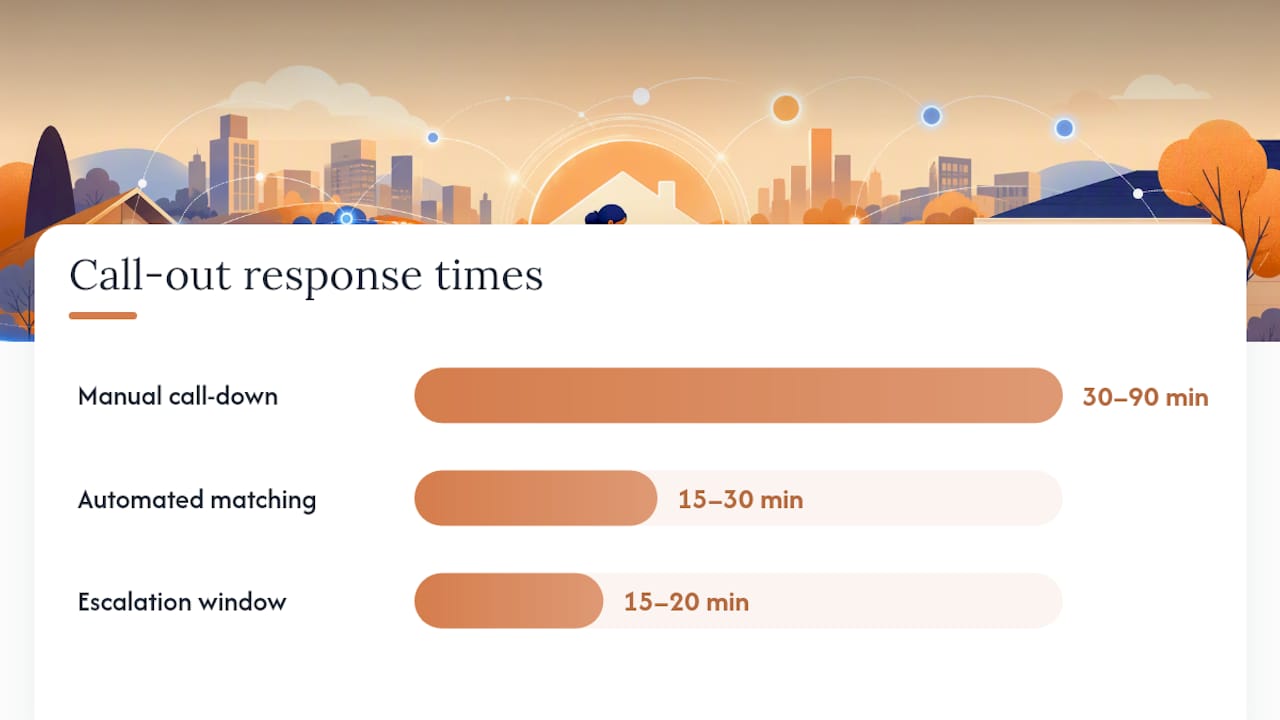
Manual call-down lists typically take 30 to 90 minutes to cover a call-out. Automated matching with simultaneous alerts can cut that to under 15 to 30 minutes in practice. Overnight and high-risk visits need their own escalation ladder, with a defined window (often 15 to 20 minutes) before the system automatically wakes an on-call supervisor rather than letting a fragile visit sit unstaffed until morning.
Pro Tip: Write your escalation rules down before you ever need them at 2 a.m. A coordinator improvising a decision about waking on-call staff at midnight makes worse calls than one following a rule the team agreed on in daylight.
What KPIs Actually Measure Shift-Fill Performance?
Two fill-rate numbers matter, and conflating them causes bad decisions. Schedule fill rate measures the percentage of all scheduled shifts that get covered. Medicaid fill rate measures authorized hours actually delivered against what the state approved, which is the number regulators and payers care about most.
That distinction matters because the national numbers are sobering: authorized hours delivered range from about 71% for home health aide services to 85% for home health nursing, with caregiver shortages cited as a primary driver of the gap. Agencies operating below that range are losing revenue and risking compliance exposure, especially with Medicaid’s Access Rule set to require states to report authorized-hours-delivered data starting in 2027.
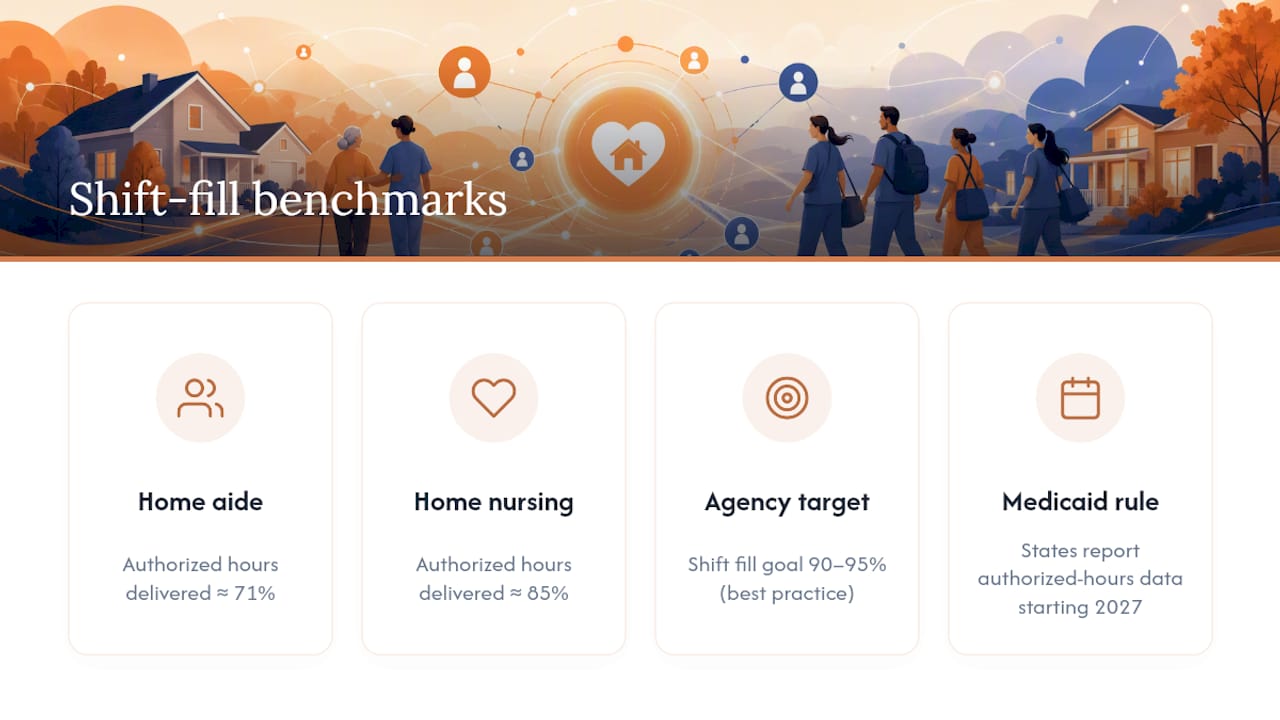
Best-practice agencies using automated matching and alerting push shift fill rates into the 90 to 95% range, with last-minute coverage typically resolved in under 30 minutes.
Time-to-fill and overtime percent are your leading indicators. If time-to-fill creeps up before fill rate drops, that’s your early warning to add backup capacity. Scheduling teams should own time-to-fill and roster health daily; finance and operations leadership should review Medicaid fill rate and overtime percent monthly, since those numbers tie directly to revenue and compliance risk.
What Do You Need Before You Integrate a Shift-Fill Tool?
Shift-fill tools are only as useful as what they connect to. Most agencies need integration with their EVV system and their core scheduling platform, since fill data that doesn’t sync to EVV creates compliance headaches, not solutions. Common integration points include scheduling and billing platforms already in use across the industry, plus whatever EVV vendor the state mandates.
Before rollout, confirm these are in place:
A signed business associate agreement (BAA) covering any system that touches protected health information
Defined data access roles so scheduling staff, not everyone, can see and edit shift assignments
An audit trail that captures every outreach attempt, acceptance, and escalation
A realistic pilot: a two-week parallel run alongside your existing process is the standard way vendors validate time-to-fill claims without full migration risk
Internally, prep matters just as much as the tech. Your backup roster needs to actually be healthy going in, your call-out scripts need to be consistent across coordinators, and your escalation documentation needs to exist somewhere other than one scheduler’s memory.
What Does Shift-Fill Pricing Actually Look Like?
Pricing generally falls into a few shapes: per-scheduler weekly fees, per-shift-filled charges, flat subscription tiers based on roster size, or a pilot/trial period before any commitment. What’s included varies. Some vendors bundle outreach, eligibility filtering, and reporting; others charge extra for EVV integration or overnight escalation coverage.
Run the math before you sign anything:
Add up your current overtime premium spent covering last-minute gaps over a typical month
Estimate lost revenue from missed or late visits at your average per-visit reimbursement rate
Compare that total against the vendor’s monthly cost, not just the per-shift fee, since per-shift pricing can hide true cost at scale
Watch contract terms closely: a real pilot period, a clear cancellation clause, and confirmed multi-state support if you operate across state lines. A vendor that resists a pilot is telling you something about its confidence in its own numbers.
What Should You Ask Vendors on a Demo Call?
Treat every demo as an audit, not a sales pitch. Ask the vendor to prove claims with data, not slides.
Request a live call-out simulation, not a recorded demo, so you see real outreach timing.
Ask for an exported time-to-fill report from an existing client, with timestamps intact.
Confirm a signed BAA is standard, not an add-on negotiated later.
Get the full list of scheduling and EVV integrations supported out of the box.
Ask for their documented escalation rules for overnight and high-risk visits, in writing.
Listen to sample caregiver outreach scripts. A cold, transactional tone drives caregivers to ignore alerts.
Confirm onboarding timeline in writing, including what a two-week pilot actually covers.
Pro Tip: Ask for an audit trail sample from a real (anonymized) shift fill, start to finish. If a vendor can’t produce one on the spot, that capability probably doesn’t exist yet.
Red flags worth walking away from: no pilot option, fill-rate numbers with no source or timeframe attached, and any platform that can’t confirm EVV integration for your state’s mandated system.
How Opulent Private Care Approaches Shift Coverage
Opulent Private Care built its model around a different question: not “how fast can we fill a gap,” but “how do we avoid creating one in the first place.” The 3 Thumbs Up Rule requires sign-off from the family, the nurse, and Opulent before care ever starts, which cuts down on the mismatched placements that lead to early call-outs and turnover.
Instead of rotating a pool of unfamiliar caregivers through a household, Opulent focuses on:
Publishing shift fill and nurse retention metrics so families and referring agencies can see reliability, not just hear about it
In-home skilled nursing for tracheostomy, ventilator, feeding tube, and neurological care, matched to family and clinical needs
A family caregiver option for households that want a trained relative covering care alongside or instead of an outside nurse
GAPP paperwork handled on the agency’s side, removing one more point of delay when a family needs coverage started quickly
Continuity, in this model, is the shift-fill strategy: fewer new faces means fewer surprises.
Best Practices for Communicating With Staff During a Call-Out
The tone of a shift-fill outreach message determines whether caregivers respond fast or start ignoring the agency’s number entirely. A generic blast that reads like a robot texting “SHIFT OPEN, RESPOND NOW” gets worse response rates than a message that names the client, the time, and why the request matters.
Specificity builds trust. Tell the caregiver which client, what the visit involves, and what proximity or schedule fit made them a match. Caregivers who feel like they’re being asked because they’re genuinely qualified, not just the next name on a list, respond faster and burn out slower.
Timing matters as much as wording. A 5 a.m. call-out text needs a different cadence than a routine weekend gap posted three days out. For urgent shifts, simultaneous SMS and voice alerts outperform text-only outreach because voice calls cut through notification fatigue. For routine gaps, a single well-timed message with a 24-hour response window respects caregivers’ downtime instead of training them to expect constant urgency.
Two-way communication closes the loop. Caregivers need a simple way to decline without penalty and a fast confirmation once they accept, so nobody’s left wondering whether their response actually registered. A coordinator who never follows up after a caregiver picks up an extra shift is quietly teaching that caregiver not to bother next time.
Consistency across coordinators also matters more than most agencies realize. If one scheduler negotiates flexible terms and another is rigid about the same policy, caregivers notice, and it erodes trust in the whole system, not just one person.
Handling Emergency Cancellations Inside a Shift-Fill Workflow
An emergency cancellation, a caregiver’s car breaks down an hour before a visit, a family member gets sick, needs a different response than a planned call-out logged the night before. Speed is everything, and the workflow has to compress steps rather than skip them.
The moment a cancellation comes in, the system should immediately re-run eligibility filters against the shrinking pool of caregivers who are close, certified, and under their overtime cap. Waiting to manually confirm each detail before starting outreach wastes the minutes that matter most.
For visits involving tracheostomy care, ventilator management, or other high-acuity needs, the eligible pool is naturally smaller, and that’s exactly where a maintained backup pool earns its cost. Industry guidance recommends keeping a backup pool at roughly 15 to 20% of the active caregiver roster specifically to absorb these last-minute gaps without scrambling.
If no one accepts within the defined escalation window, usually 15 to 20 minutes for high-risk visits, the system needs a hard rule: escalate to a supervisor, who then decides whether to wake on-call staff, ask a nearby caregiver to extend a shift, or, as a last resort, notify the family directly about a delay. Silence past that window is the failure mode to design against.
After the dust settles, log what happened. Was the gap from a scheduling blind spot, an overloaded roster, or genuine bad luck? Patterns in emergency cancellations often point to burnout building in a specific caregiver group before it shows up anywhere else.
What Training Do Staff Need to Run This Well?
A shift-fill platform is only as good as the people operating it, and most failed rollouts trace back to skipped training, not bad software.
Coordinators need hands-on practice with the eligibility filter logic before go-live, not just a walkthrough. They should understand why the system suggests one caregiver over another, so they can override it intelligently when local knowledge says otherwise, a family’s specific preference, a caregiver’s recent burnout signs.
Escalation training deserves its own session, separate from general platform onboarding. Every coordinator, including part-time and weekend staff, needs to know the exact criteria for waking on-call supervisors versus waiting until morning. This can’t live in one senior scheduler’s head.
New hires should shadow a live call-out cycle before handling one solo. Watching triage, outreach, and booking happen in real time teaches judgment that a training manual can’t.
Ongoing support matters more than the initial rollout. Ask vendors what happens when a coordinator gets stuck at 6 a.m. on a Saturday: is there live support, or a ticket queue that responds Monday? Also confirm refresher training exists for system updates, since scheduling platforms change features regularly and staff who trained on version one often miss new capabilities added later.
Documentation should live somewhere accessible, not buried in a folder nobody opens. A simple one-page reference for escalation steps, posted where every coordinator can see it, prevents more overnight mistakes than any amount of formal training.
What Legal and Compliance Issues Come Up With Shift Fill?
Every shift-fill workflow touches protected health information the moment it books a visit tied to a client’s care needs, which makes HIPAA compliance non-negotiable for any platform or scheduler involved. A signed business associate agreement (BAA) with any vendor accessing that data is the baseline requirement, not an optional upgrade.
EVV alignment is its own compliance layer. A shift filled outside the system’s official record, even briefly, creates a gap that looks like fraud during an audit even when it was a genuine scheduling fix. Every fill needs to sync to the EVV record in near real time, not batched at the end of the day.
Medicaid’s forthcoming Access Rule adds pressure here: starting in 2027, states will require reporting on authorized hours actually delivered, which means the fill-rate numbers agencies track internally will start facing external scrutiny. Agencies that can’t produce clean fill-rate documentation now will struggle once that reporting requirement takes effect.
Overtime rules add another layer. A shift-fill system that keeps assigning the same caregiver extra hours to hit a fill target can create wage-and-hour exposure if it pushes someone past legal overtime thresholds without proper compensation tracking.
Liability coverage matters too, particularly for agencies using outside staffing services or surge coverage during peak call-out periods. Reviewing workers’ compensation coverage designed for staffing arrangements is worth doing before, not after, an agency starts leaning on external shift-fill support regularly.
Finally, audit trails aren’t just good practice, they’re often the difference between passing and failing a state review. Every outreach attempt, acceptance, decline, and escalation should be logged with a timestamp, retrievable on demand.
Does Shift-Fill Strategy Affect Caregiver Retention?
It does, and often in the opposite direction agencies expect. A shift-fill system that constantly leans on the same handful of reliable caregivers to cover gaps burns them out fastest, even as it protects the schedule short term.
Caregivers who get last-minute outreach requests that respect their actual availability, rather than blanket blasts sent to everyone regardless of fit, report feeling valued rather than used. That distinction shows up in whether they keep answering the phone six months later or start letting it go to voicemail.
Overtime tells part of the story too. Agencies that fill gaps by pushing existing staff into overtime hours repeatedly, instead of maintaining a real backup pool, tend to see those same caregivers exit within a year. The connection between scheduling stability and nurse retention runs both directions: unpredictable schedules drive people out, and predictable ones keep them.
Continuity of assignment also plays a bigger role than most fill-rate conversations acknowledge. Caregivers who bounce between unfamiliar clients report lower job satisfaction than those with consistent placements, even when the pay and hours are identical. A continuity-focused matching approach that reduces the need for constant shift-fill outreach in the first place is, in a real sense, a retention strategy disguised as a scheduling one.
The agencies with the strongest fill rates aren’t always the ones with the best technology. Often they’re the ones who’ve reduced how often shift fill gets triggered at all, by building schedules and matches sturdy enough to not need constant rescue.
Operational Perspective: When to Buy vs. When to Build
Buy shift-fill technology when call-outs are outpacing your coordinators’ capacity right now. Invest in retention and schedule redesign when the same caregivers keep quitting within months of starting. Most agencies need both, sequenced deliberately, because a great outreach tool that keeps papering over a broken roster just delays the reckoning.
— Opulent
A Continuity-First Alternative to Constant Shift-Fill Scrambling
Automated outreach tools solve the emergency. Opulent Private Care is built to reduce how often the emergency happens in the first place. Because every placement passes the 3 Thumbs Up Rule, approval from the family, the nurse, and Opulent, before care begins, families get a caregiver match built to last, not one that needs backup coverage within the first month.

For families managing tracheostomy, ventilator, feeding tube, or neurological care needs in Georgia, Opulent’s in-home skilled nursing and GAPP program support handles the Medicaid paperwork directly, so coverage can start without weeks of administrative delay. Families exploring a family caregiver option or considering a transfer from another GAPP agency can start that conversation today by requesting a consultation through Opulent’s GAPP program page.
Sources
FAQ
What Shifts Do Home Health Aides Typically Work?
Home health aides usually work in blocks tied to client needs: mornings for wake-up and medication routines, evenings for wind-down care, and overnight shifts for clients needing continuous monitoring. Shift length varies widely by client acuity, from short one to two hour visits to full 8 or 12 hour shifts.
What Is the Easiest Shift to Fill in Home Care?
Weekday daytime shifts are generally easiest to fill because more caregivers are available and eligibility pools are largest. Overnight and weekend shifts are hardest, which is why they require stronger backup-pool planning and faster escalation rules.
How Long Do Caregiver Shifts Usually Last?
Shift length depends on the care plan, ranging from short visits under two hours for medication checks to full 8-hour shifts for continuous skilled nursing needs. Pediatric skilled nursing cases often involve longer or overnight shifts due to tracheostomy or ventilator monitoring requirements.
Is Shift-Fill Software Free to Use?
Pricing varies by vendor and typically follows per-scheduler, per-shift, or subscription models rather than being free. Current pricing details for any specific service should be confirmed directly on the vendor’s site, since costs depend on roster size and included features.
How Does Opulent Private Care Reduce the Need for Shift Fill?
Opulent Private Care reduces reliance on emergency shift fill by matching nurses to families through its 3 Thumbs Up Rule, which requires approval from the family, nurse, and agency before care starts. This continuity-first matching, paired with published retention metrics, cuts down on the mismatched placements that typically drive call-outs and turnover.
Recommended
Comments