
Reduce GAPP Denials: Start Renewal 75 Days Before DMA-6A in Georgia


Start your GAPP renewal 30 to 60 days before your child’s DMA-6A expires, not after. Three things must be in the packet before it goes to Alliant Health Solutions: the completed DMA-6A and DMA-80, a physician-signed Physician Plan of Treatment (Appendix Y) dated within 30 days, and current nursing narrative notes. Confirm your child’s Medicaid status is active on Gateway.ga.gov before anything is submitted, because a lapse there stalls the whole process regardless of how strong the clinical case is.
TL;DR:
Starting the renewal process 30 to 45 days before the DMA-6A expiration helps avoid delays caused by physician signatures or portal issues.
The renewal packet must include the current DMA-6A, DMA-80, physician-signed PPOT within 30 days, current nursing notes, and verification of active Medicaid status.
Using outdated forms or signatures dated more than 30 days old often causes rejection or delays in approval.
Submit the complete packet through GAMMIS, ensuring PDFs are consolidated, pages are in order, and confirmation of receipt is obtained from the agency.
Lapses in Medicaid eligibility automatically halt review, so confirming active coverage on Gateway.ga.gov is essential before renewal submission.
Table of Contents
GAPP Renewal Timeline: When to Start and How to Find Your Deadline
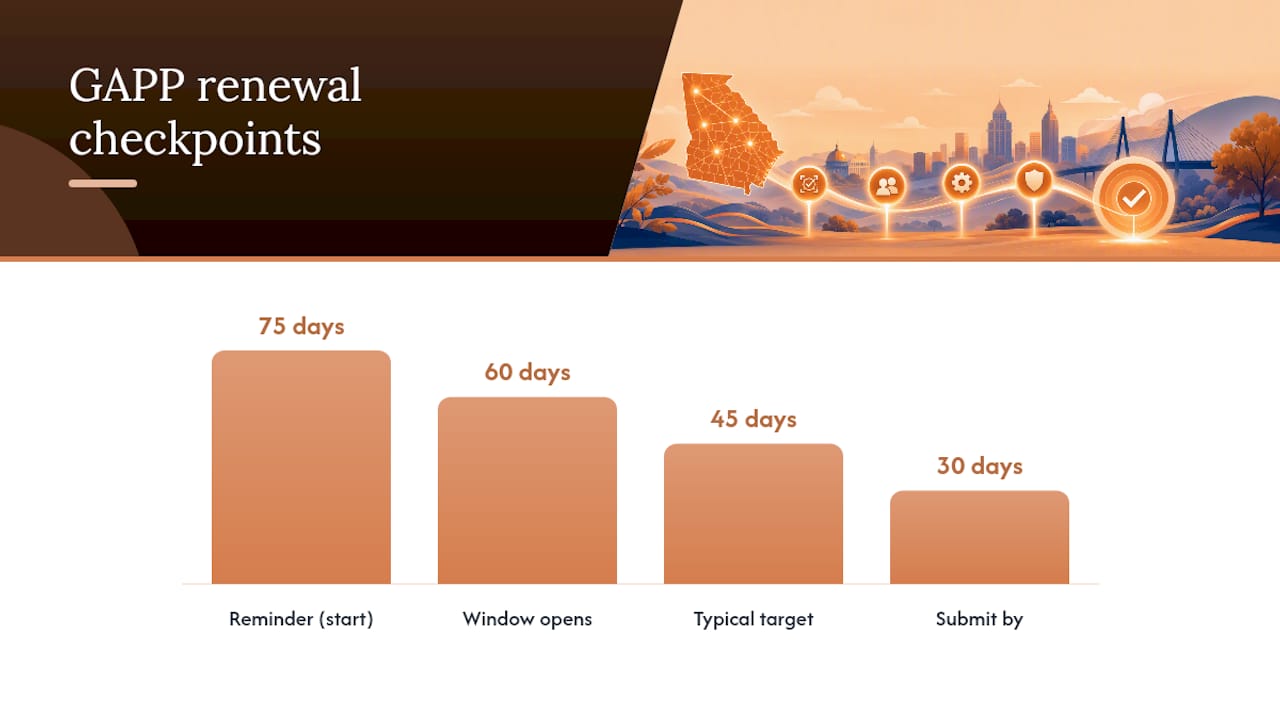
Most families lose weeks they didn’t need to lose simply because nobody flagged the expiration date until it was almost gone. The DMA-6A authorization that anchors your child’s GAPP nursing hours is typically valid for up to one year, and the renewal window generally opens 30 to 60 days before that date. In practice, many families and agencies aim for the tighter 30 to 45 day range, since it leaves margin for a physician’s schedule or a portal hiccup.
Some children are authorized for shorter periods instead of a full year, particularly right after a hospital discharge or a significant change in care needs. If you’re not sure which category your child falls into, check the authorization letter or Letter of Understanding (LON) your agency has on file. That document lists the DMA number tied to the current authorization and the exact expiration date. If you can’t locate it, your nursing agency’s case coordinator should be able to pull it within a day.
A practical internal calendar looks like this:
60 days out: Pull the current LON, confirm the expiration date, and start gathering nursing narrative notes from the past three months.
45 days out: Get the PPOT (Appendix Y) in front of your child’s physician for review and signature. This is usually the slowest step, so don’t wait on it.
30 days out: Submit the complete packet, DMA-6A, DMA-80, signed PPOT, and supporting notes, through the GAMMIS Medical Review portal.
Day 0 (expiration): Confirm the portal shows the packet as received and under review, not sitting incomplete.
Hospital discharges complicate this schedule because there’s often no 60-day runway. If your child is being discharged with a new or increased need for skilled nursing, tell your agency’s intake team immediately. Alliant does process urgent requests tied to discharge, but the packet still needs the same components, just compressed into days instead of weeks.
Pro Tip: Set a recurring calendar reminder for 75 days before the DMA-6A expiration, not 60. That extra two-week buffer covers physician office delays, which are consistently the slowest link in the chain.
What Documents Go Into a Complete GAPP Renewal Packet
A packet is either complete or it isn’t. Alliant’s Medical Review Team does not partially review a renewal, and one missing signature can send the entire submission back to the start. Here’s what actually has to be inside it.
DMA-6A
This is the core enrollment and eligibility form for GAPP. It’s valid for one year from the date it’s completed, and your agency typically fills it out based on current household, eligibility, and clinical information. Because it expires exactly one year from completion, the renewal timeline you build should work backward from that specific date, not from a general sense of “around when we last renewed.”
DMA-80
The DMA-80 is the prior authorization submission, the document that actually requests the nursing hours and attaches the clinical justification. It’s linked to the DMA-6A but serves a distinct function: while the DMA-6A establishes eligibility for the program, the DMA-80 asks Alliant to approve a specific number of skilled nursing hours per week. Every supporting document, the PPOT, the nursing notes, the LON, gets attached to this submission.
Physician Plan of Treatment (PPOT / Appendix Y)
This is where renewals most often stall. The PPOT has to be signed by your child’s physician, and it needs to be dated within 30 days of when the plan itself was completed. A PPOT signed weeks after it was written, or one that shows a mismatched date between the treatment plan and the signature, is a common reason Alliant kicks a packet back.
The PPOT should include specific, observable clinical detail rather than general statements. Language like “requires suctioning every 2 to 4 hours due to increased secretions” or “ventilator settings adjusted twice in the past 90 days” gives reviewers something concrete to evaluate. Vague phrasing like “needs ongoing nursing care” doesn’t tell Alliant why the current hours are still medically necessary.
Nursing narrative notes
Reviewers want to see documentation covering a recent period of skilled care. These notes should show:
The frequency of skilled interventions (tube feeding adjustments, seizure monitoring, tracheostomy care).
Any changes in acuity, whether improving, stable, or declining.
Specific skilled tasks performed, not just “monitored patient” but what was actually done and how often.
Consistency with what the PPOT claims about the child’s condition.
Notes that read the same month after month, with no specific detail about frequency or intervention type, tend to weaken a renewal case even when the underlying clinical need is real.
Letter of Understanding, Freedom of Choice, and county requirements
The Letter of Understanding documents the agreed authorization terms between the family, the agency, and the state. Freedom of Choice paperwork confirms the family’s right to select their nursing provider, which matters if you’re renewing with the same agency or transitioning to a new one. Some counties layer on additional DFCS verification steps tied to Medicaid eligibility, so check with your local office if you’ve had any recent changes in address, income, or household composition.
Common document errors that delay approval:
Using an outdated version of the DMA-6A or DMA-80 form. The GAPP manual is explicit that outdated forms will not be accepted, and resubmission restarts the receipt clock.
A PPOT signature dated more than 30 days after the plan was written.
Missing initials or signatures on any page, even ones that seem administrative.
Nursing notes that don’t cover a recent enough period, or that contradict the PPOT’s stated hours.
Inconsistent dates between the DMA-6A, DMA-80, and PPOT.
Using outdated forms is one of the most avoidable causes of delay in the entire GAPP recertification process, and it’s entirely within a family’s or agency’s control to check the form version before submitting anything.
How to Submit a GAPP Renewal Through GAMMIS
Georgia’s GAPP renewals move through the GAMMIS Medical Review portal, the same system Alliant Health Solutions uses to receive and log DMA-6A and DMA-80 submissions. Understanding who does what in this process saves a lot of confusion.
Your nursing agency typically handles the DMA forms and the technical upload, since agencies have direct portal access and experience with the required file structure. Your child’s physician supplies the signed PPOT, either directly to the agency or through a secure document exchange the agency sets up. Families generally don’t upload documents themselves, but you play a critical coordinating role: confirming the physician has actually signed and dated the PPOT correctly, making sure your Medicaid status is current on Gateway.ga.gov, and following up if anything stalls.
A clean submission sequence looks like this:
Agency compiles the DMA-6A, verifies current Medicaid eligibility, and pre-fills as much of the DMA-80 as possible from existing records.
Physician reviews and signs the PPOT (Appendix Y), dated within the required 30-day window.
Agency consolidates the nursing narrative notes into a single, clearly labeled document rather than scattered individual entries.
Complete packet, DMA-6A, DMA-80, signed PPOT, notes, LON, gets uploaded through GAMMIS as PDF attachments to the DMA-80 submission.
Agency confirms the portal has logged a receipt, ideally noting the DMA number assigned and the date stamped as received.
File format matters more than most families expect. PDFs are the standard, and multi-page nursing notes should be consolidated into one file rather than uploaded as dozens of separate scans, since fragmented uploads are a frequent source of portal processing errors. A packet that looks complete to the person uploading it can still get flagged if pages are out of order or a scan is missing a signature page that was actually signed.
Pro Tip: Ask your agency for written confirmation of the exact date and DMA number once the packet is logged as received. That receipt date is what starts Alliant’s review clock, and having it in writing protects you if there’s ever a dispute about timing.
If the portal flags something as missing, don’t wait for a follow-up call to come to you. Reach out to your agency’s case coordinator the same day, since the fix is often as simple as re-uploading a single page rather than restarting the entire packet.
What Alliant’s Medical Review Team Checks Before Approving Renewal
Alliant Health Solutions’ Medical Review Team evaluates renewals against a fairly consistent standard: does the documentation prove the child still needs the level of skilled nursing being requested, right now, not six months ago. They generally have up to 30 days from receipt of a complete packet to issue a decision, and that clock starts only once the packet is complete, an incomplete submission doesn’t start the countdown at all.
Medical necessity documentation needs to answer specific questions: What skilled tasks is the nurse performing? How often? Has the child’s condition changed since the last authorization? A PPOT that repeats the exact language from the prior year’s authorization, without any updated detail, raises a flag rather than smoothing approval.
The most common reasons Alliant delays or denies a renewal:
Outdated or incorrect form versions submitted instead of the current DMA-6A or DMA-80.
Missing or mismatched signatures and dates across the PPOT, nursing notes, and DMA forms.
Nursing narrative notes that don’t reflect recent enough care or lack specific skilled detail.
Lapsed Medicaid eligibility discovered during the eligibility check, which halts the review even if the clinical case is strong.
A packet submitted piecemeal, missing an attachment that arrives days later, which can reset how the review timeline is counted.
Losing Medicaid eligibility is a distinct failure point from a weak clinical case, and it’s worth treating separately. Clinical authorization for GAPP nursing hours is reviewed by Alliant, but the underlying Medicaid eligibility is verified independently through Gateway.ga.gov. A child can have an airtight medical case and still see services paused because a household’s Medicaid recertification lapsed and nobody caught it in time.
Reviewer discretion also shapes how long the next authorization period runs. A renewal supported by detailed, specific documentation, exact frequencies, named interventions, clear acuity trends, tends to result in longer approval windows, sometimes a full 12 months instead of a shorter interim period. Vague or boilerplate notes more often trigger a shorter authorization with a faster next review, since the reviewer doesn’t have enough evidence to justify a longer commitment.
What to Do If GAPP Authorization Lapses or Gets Denied
A lapse or denial isn’t the end of care, but the clock matters, and the first 48 hours determine how smoothly the next steps go.
Notify your nursing agency immediately if you learn an authorization has lapsed or been denied. Document the date you found out and every communication that follows.
Continue documenting care needs even during a gap, since this record supports both an appeal and a new reauthorization request.
Ask for an expedited review if your child’s clinical status has changed, worsened, a new diagnosis, a recent hospitalization. Alliant does accommodate urgent submissions tied to genuine clinical change.
File a reconsideration request with Alliant if you believe the denial was made in error, and route supplemental clinical evidence, updated notes, a revised PPOT, through your agency’s coordinator rather than submitting it independently.
Check Gateway.ga.gov to confirm Medicaid eligibility is active. If eligibility lapsed, contact your county DFCS office right away, since GAPP services cannot be authorized without active Medicaid regardless of clinical need.
Retroactive payment for care provided during a gap is not guaranteed, which is exactly why documentation of dates and communications matters so much during this window. Keep every email, portal confirmation, and phone log. If DFCS restores Medicaid eligibility after a gap, notify the GAPP prior authorization unit directly so the reauthorization request can move forward without additional delay.
How Opulent Private Care Reduces Renewal Risk for Georgia Families
Renewal paperwork fails most often for administrative reasons, not clinical ones, which is exactly the kind of risk a well-run agency can absorb on a family’s behalf. Some agencies handle the DMA-6A and DMA-80 preparation, check form versions before uploading, and coordinate the PPOT signature process with physicians to avoid delays.
Opulent’s 3 Thumbs Up Rule, requiring sign-off from the family, the nurse, and the agency before care starts, does more than match personalities well. A nurse who stays with the same family over time writes more consistent, more specific documentation, because they actually know the child’s baseline and can describe changes accurately. That continuity shows up directly in the quality of the nursing narrative notes reviewers depend on.
Opulent also publishes shift fill and nurse retention rates rather than treating them as internal metrics. For a renewal packet, that matters practically: a family whose nurse has been consistent for months has cleaner, more coherent documentation than one working with rotating coverage where every note reads slightly differently.
Questions worth asking any agency before you rely on them for renewal support:
Who specifically checks form versions before a packet is submitted?
What happens if the physician doesn’t sign the PPOT in time, is there an escalation process?
How is nurse continuity managed, and what happens if a nurse leaves?
Will the agency confirm submission receipt in writing?
Pro Tip: When requesting a physician signature, give a specific deadline in writing, “please sign and return by [date] to meet a Medicaid authorization deadline”, rather than a general request. Physician offices prioritize dated deadlines over open-ended asks.
Why Documentation Timing Matters More Than the Paperwork Itself
Most families treat GAPP renewal as a forms problem. It’s really a timing problem wearing a forms costume. The DMA-6A, DMA-80, and PPOT are static documents; what determines whether a renewal sails through or gets kicked back is whether those documents were assembled in the right sequence, with enough runway for the slowest link, almost always the physician’s signature, to clear before the deadline.
Reviewers at Alliant aren’t looking for perfect prose in a nursing note. They’re looking for consistency: does the PPOT match the notes, do the dates line up, does the documented acuity justify the requested hours. Families who build in a buffer, starting the collection process at 60 days instead of 30, tend to avoid the scramble that produces mismatched dates and rushed signatures in the first place.
If there’s one habit worth adopting immediately, it’s a simple dated submission checklist, kept in writing, tracking when each document was requested, received, and uploaded. It sounds almost too basic to matter, but it’s the single practice that prevents the most common and most avoidable renewal delays.
— Opulent
Get Help With Your Child’s GAPP Renewal Paperwork
There are agencies that assist with managing GAPP renewal paperwork and coordinate the DMA-6A, DMA-80, and PPOT processes as part of ongoing care rather than a once-a-year effort.
Opulent’s in-home skilled nursing and Medicaid/GAPP paperwork assistance covers exactly the renewal steps this guide walks through: form preparation, physician signature coordination, and consolidated nursing documentation that holds up under Alliant’s review. For children with tracheostomy, ventilator, or feeding tube needs, the trach, vent, and G-tube nursing program is built around the same continuity model. Families who prefer a relative or trusted caregiver to provide care can ask about the Family Caregiver option, and families currently with another agency who want a change can review the GAPP agency transfer process and Freedom of Choice rights before their next renewal date arrives.
If your child’s authorization is coming up for renewal, or you’re not sure exactly when it expires, contact Opulent through the GAPP program page for an intake and paperwork review before the deadline gets closer than it should.
Official GAPP Forms and Program Pages to Bookmark
The GAPP policy and manual covers program eligibility rules and how Medicaid status connects to clinical authorization.
The GAPP program presentation explains the DMA-6A and DMA-80 forms and submission process in detail.
Alliant’s GAPP review resources outline review timelines and approval procedures.
The Georgia Medicaid waiver programs page provides the state’s overview of GAPP and related services.
Check Medicaid eligibility status anytime at Gateway.ga.gov.
This article is general information, not a substitute for advice from a qualified doctor. Consult a qualified healthcare professional about your own circumstances before acting on anything here.
Sources
FAQ
What Is the GAPP Program in Georgia?
The Georgia Pediatric Program provides Medicaid-funded in-home skilled nursing and personal care support for medically fragile children under 21, with all services requiring prior authorization through an approved nursing agency.
How Do I Renew My Benefits on GA Gateway?
Log in to Gateway.ga.gov to confirm or update your household’s Medicaid eligibility status; this is separate from the GAPP clinical authorization, which Alliant Health Solutions reviews using the DMA-6A, DMA-80, and PPOT submitted through GAMMIS.
What Happens to GAPP Services if Medicaid Eligibility Lapses?
Clinical need alone doesn’t keep GAPP nursing hours active. If Medicaid eligibility lapses, services cannot be authorized until eligibility is restored through DFCS and verified on Gateway.ga.gov, regardless of how strong the medical documentation is.
How Long Do I Have to Renew My GAPP Authorization Before It Expires?
Start the process 30 to 60 days before the DMA-6A expiration date, with many families and agencies aiming for the narrower 30 to 45 day window to leave time for physician signatures and any portal corrections.
Can Opulent Private Care Help With the GAPP Renewal Paperwork?
Yes. Opulent Private Care assists with DMA-6A and DMA-80 preparation, PPOT signature coordination, and consolidated nursing documentation as part of its ongoing pediatric nursing services.
Recommended
Comments