
5 Home Care Steps Families Need for Cuffed vs Uncuffed Trach Tubes


A cuffed trach has an inflatable balloon near the tip that seals the airway, usually to support a ventilator or manage aspiration risk. An uncuffed trach has no balloon, letting air move around the tube, which makes it the better fit for speech, swallowing therapy, and many long-term pediatric cases. Neither is universally “safer.” The clinical team picks based on ventilation needs, secretion control, and how ready the airway is to work without a seal.
TL;DR:
Cuffed trachs are primarily used for positive-pressure ventilation or aspiration prevention, with cuff pressure kept between 15 and 25 cmH2O to avoid tissue injury.
Uncuffed trachs are preferred for patients who need to speak, swallow, or breathe without a seal, but an inflated cuff does not fully prevent aspiration.
Speech and swallowing return only when the cuff is deflated or replaced with a cuffless tube, and speaking valves must never be used with an inflated cuff due to safety risks.
Transitioning from cuffed to uncuffed tubes requires staged deflation trials and careful monitoring by trained clinicians to prevent decompensation.
Home-care routines involve precise cuff pressure management, frequent equipment checks, and adherence to written plans, with support available from specialized providers.
Table of Contents
Cuffed vs Uncuffed Trach: How the Cuff Actually Works
The cuff is a balloon that sits around the tube, below the vocal cords. Inflating it presses the balloon against the tracheal wall, sealing the airway so air from a ventilator goes into the lungs instead of leaking back out through the mouth and nose. That seal is the whole point of a cuffed tracheostomy tube. Without it, positive-pressure ventilation would lose too much air to work reliably.
Not all cuffs behave the same way. High-volume, low-pressure cuffs spread contact over a wider area of tracheal tissue and are the most common design today because they reduce pressure on any single point. Low-volume, high-pressure cuffs create a tighter, more localized seal and carry more risk of mucosal injury. Foam-filled cuffs expand to fit the trachea passively and can’t be fully deflated on demand, which makes them incompatible with speaking valves. Some cuffs fill with air, others with sterile water, and manufacturer instructions differ enough that using the wrong filling method on the wrong tube model is a real risk, not a technicality.
When Clinicians Choose Cuffed vs Uncuffed Tracheostomy Tubes
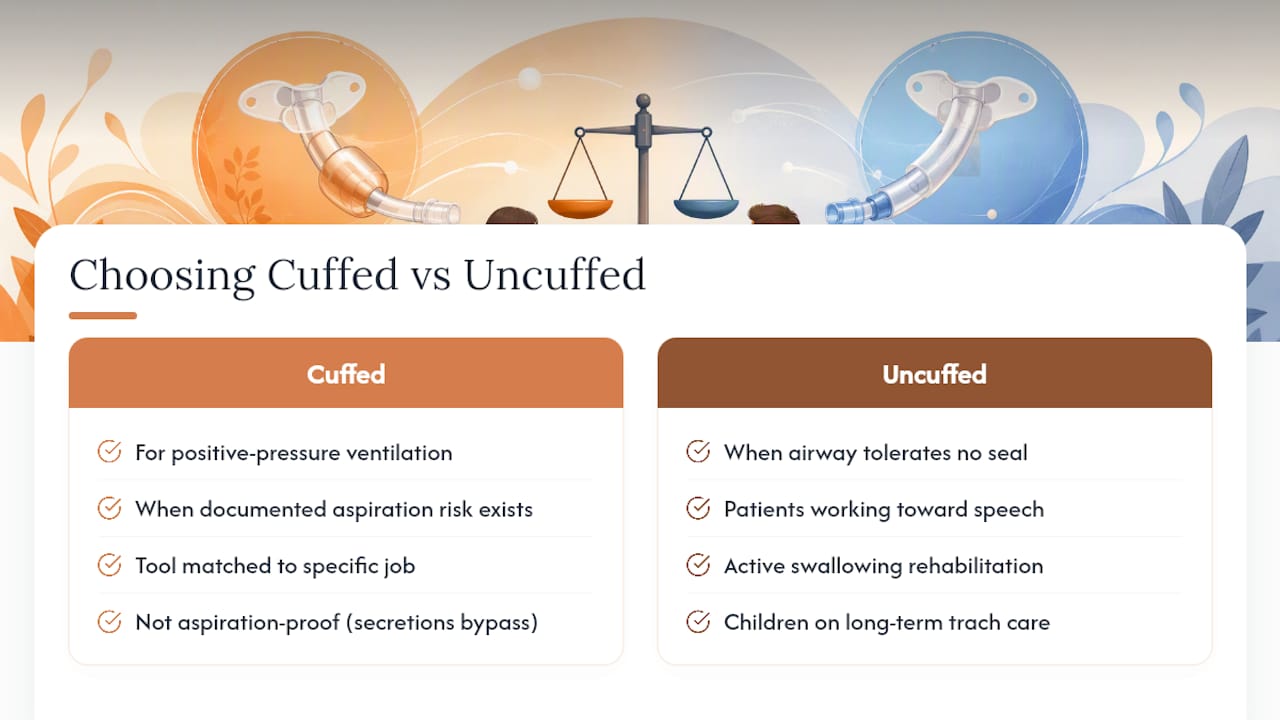
Cuffed tubes are generally reserved for two situations: the patient needs positive-pressure ventilation, or the care team has identified a specific, documented reason to manage aspiration risk. That’s the guidance from the AARC clinical practice guideline on pediatric tracheostomy management, and it applies just as sensibly outside pediatrics. A cuff isn’t a default safety feature. It’s a tool matched to a specific job.
Uncuffed tubes get chosen when the airway can tolerate life without a seal. That includes patients working toward speech, those in active swallowing rehab, and a large share of children on long-term trach care, where minimizing mucosal contact matters for growth and comfort. Here’s the part families often get wrong: an inflated cuff is not an aspiration-proof barrier. The cuff sits below the vocal cords, so secretions or refluxed material above it can still work their way into the airway even with the cuff fully inflated, according to National Tracheostomy Safety Project guidance on cuff pressure. Choosing cuffed over uncuffed is a ventilation and secretion-management decision first, not a guarantee against aspiration.
Speech, Swallowing, and What Cuff Status Changes
An inflated cuff blocks the path air needs to reach the vocal cords, so speech generally isn’t possible while it’s up. That’s a mechanical fact, not a workaround problem: Johns Hopkins Medicine notes that exhaled air simply can’t pass the vocal cords with the seal in place.
This is where the safety rule matters most: never place a speaking valve on a tube with an inflated cuff. Air has nowhere to go, and the results can be dangerous fast. Speaking valves only get used with the cuff deflated or on a cuffless tube, and only after the clinical team has ordered and supervised the change. Restoring airflow past the vocal cords does more than allow words. It restores the sensory feedback and cough strength that swallowing therapy depends on, which is why speech and swallowing goals often drive the push toward deflation trials in the first place.
Cuff Pressure and Safety: What Caregivers Need to Watch
Cuff pressure lives in a narrow window for a reason. Day-to-day pressure is typically kept between about 15 and 25 cmH2O, with 35 cmH2O treated as an upper limit not to cross, per NTSP cuff management guidance. Go too high, and the balloon presses hard enough on tracheal tissue to cause injury, scarring, or in serious cases, damage to the airway wall. Go too low, and the seal fails: air leaks around the tube, ventilation gets less effective, and secretions can slip past the cuff more easily.
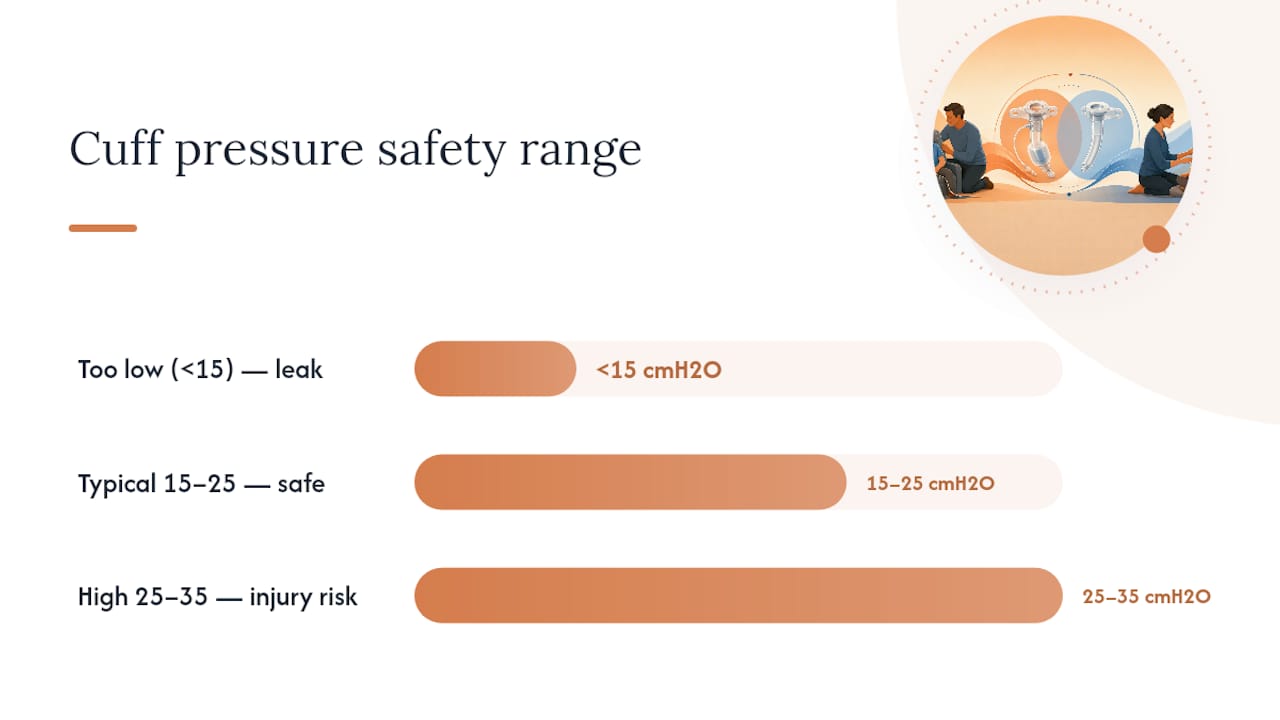
That’s a real range, but it’s also not a job for guesswork. Don’t add or release cuff air unless you’ve been specifically trained to do it and it’s part of the written trach care plan. Pressure should be checked with a manometer, not by feel, and any adjustment should follow the exact instructions for that tube model.
Certain signs mean you stop troubleshooting and get help immediately: sudden difficulty breathing, a persistent air leak you can hear, a spike in secretions, or any sign of respiratory distress. Call the care team for anything that seems off but stable. Call emergency services for anything that looks like it’s getting worse fast.
How Teams Transition From Cuffed to Uncuffed
Moving away from a cuff isn’t a light switch. It’s a staged process built around monitored trials. A clinician progressively deflates the cuff in small steps, watching for fatigue, oxygen drops, or secretion buildup the patient can’t manage. If that goes well, the next stage often introduces a speaking valve or capping trial, still under supervision, with objective measures like oxygen saturation guiding whether to continue or pull back.
Ventilator settings and secretion control matter enormously here. A patient who looks stable at rest can decompensate once airway resistance changes, which is exactly why a 2026 systematic review on cuff management found no solid evidence that keeping a cuff inflated long-term in non-ventilated, neurologically impaired patients actually improves outcomes. The review did flag real downsides to prolonged inflation: lost communication, weaker cough, slower rehab. These decisions are individualized, and they run through a multidisciplinary team, not a single provider working alone.
Home-Care Checklist for Cuffed and Uncuffed Trach Tubes
Daily routines look similar for both tube types, but a cuffed tube adds a layer of documentation and readiness that uncuffed care doesn’t require.
Record cuff status at each shift change, including pressure if inflated, and note why it’s set that way.
Check suction equipment and confirm it’s ready. Suction based on visible secretions or abnormal breath sounds, not a fixed clock.
Inspect and clean the inner cannula per the prescribed schedule, and keep humidification running as ordered.
Confirm emergency contacts, the written trach care plan, and cuff instructions are current and accessible to every caregiver in the home.
Keep a spare tube of the same size, an obturator, and functioning suction within reach at all times, along with the specific HME or humidifier setup that tube model requires.
For a fuller walk-through of daily pediatric trach routines, Opulentprivatecare’s home-care guide for kids breaks the process down step by step.
Pro Tip: Write the cuff status and target pressure directly on the trach care plan taped near the bed, not just in a binder in another room. In an emergency, seconds matter more than paperwork.
If the tube dislodges, or breathing gets harder right after a deflation, follow the written plan exactly. Don’t improvise with a different tube size or a workaround part. Call emergency services if breathing doesn’t stabilize quickly.
Continuity Matters More Than People Expect During Cuff Transitions
Cuff deflation trials and weaning aren’t one-time events. They unfold over days or weeks, and a nurse who was there yesterday catches subtle changes a new face would miss. That’s why Opulent’s 3 Thumbs Up Rule and published retention numbers exist: consistent, trained caregivers reduce risk during exactly these transitions. Talk through your written cuff plan and emergency steps with whoever is in your home.
— Opulent
How Opulent Private Care Supports Families Through Trach Care
Managing a trach at home, cuffed or uncuffed, is a lot to carry alone, and the transitions in between are where families feel it most. Some providers work specifically with families managing tracheostomy, ventilator, and feeding tube needs at home, matching each child with a nurse who fits both the clinical picture and the household.

The core of it is in-home skilled nursing built around trach, vent, and G-tube care, including caregiver training on cuff status documentation, suctioning, and emergency response. Because some agencies only start a placement once the family, the nurse, and the agency all sign off, cuff deflation trials and weaning happen with a nurse who’s actually familiar with the child, not someone meeting them for the first time on a hard day. Families who prefer to manage care themselves have a family caregiver option, and Opulentprivatecare also handles GAPP agency transfers for families switching providers, plus the Medicaid GAPP paperwork that comes with either path. Families navigating a cuff transition or needing steadier care may consider reaching out to providers who offer in-home nursing to discuss available support options.
This article is general information, not a substitute for advice from a qualified doctor. Consult a qualified healthcare professional about your own circumstances before acting on anything here.
Sources
FAQ
Can you talk with an uncuffed trach?
Yes, in most cases. Without a cuff sealing the airway, air can typically pass around the tube and reach the vocal cords, which is why uncuffed tubes are often chosen when speech is a priority.
Is the Shiley trach cuffed or uncuffed?
Shiley makes both cuffed and uncuffed tracheostomy tube models. Which one a patient uses depends entirely on the clinical decision made by their care team, not the brand itself.
Why would someone switch from a cuffed to a cuffless trach?
Teams move toward cuffless tubes once positive-pressure ventilation or aspiration protection is no longer needed, usually to support speech, swallowing rehab, or reduce long-term mucosal pressure. The switch follows monitored deflation trials, not a single decision made overnight, and a 2026 systematic review found this shift doesn’t appear to raise aspiration-pneumonia risk in the non-ventilated patients studied.
What are the three main types of tracheostomy tubes?
The main categories are cuffed tubes, uncuffed tubes, and fenestrated tubes, which have an opening that allows more airflow toward the vocal cords. Many tubes also come in single or double cannula versions, which adds another layer of variation on top of these three types.
Does Opulent Private Care help with tracheostomy cuff management at home?
Opulentprivatecare provides in-home skilled nursing for trach, vent, and G-tube care for Georgia families, including caregiver training tied to each child’s specific cuff and care plan. Pricing details aren’t published; families can get specifics directly through Opulentprivatecare.
Recommended
Comments